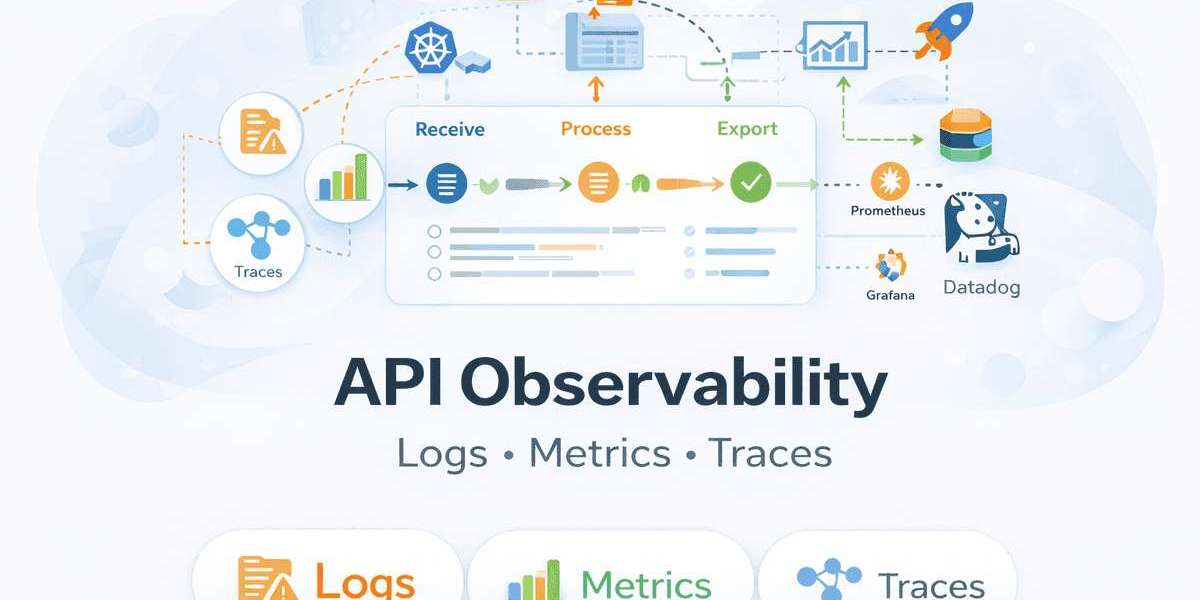

APIs power modern applications by enabling seamless communication between services, platforms, and users. As organizations adopt microservices, cloud-native architectures, and distributed systems, maintaining API reliability becomes increasingly challenging. This is why businesses are investing in strong API observability practices to gain deeper visibility into API behavior and performance.
Unlike traditional monitoring, API observability helps teams understand not only what is happening within an API but also why it is happening. This deeper insight enables faster troubleshooting, better performance optimization, and improved user experiences.
What Is API Observability?
API observability is the practice of collecting and analyzing telemetry data to understand the health, performance, and behavior of APIs. It helps engineering teams monitor requests, identify bottlenecks, diagnose failures, and optimize service reliability.
A comprehensive observability strategy typically focuses on three key pillars:
Metrics
Logs
Traces
Together, these data sources provide a complete picture of how APIs operate across complex environments.
Why API Observability Matters
Modern applications often depend on dozens or even hundreds of interconnected APIs. A single API failure can create cascading issues throughout an entire system.
Without proper observability, teams may struggle to:
Detect performance degradation
Identify root causes of failures
Track service dependencies
Monitor API usage patterns
Maintain service-level objectives
API observability enables organizations to proactively identify issues before they impact customers.
Key Components of API Observability
Metrics
Metrics provide numerical insights into API performance and usage.
Common API metrics include:
Response time
Request volume
Error rate
Throughput
Latency
These measurements help teams quickly detect anomalies and performance trends.
Logs
Logs capture detailed records of API events and transactions. They provide valuable context when investigating issues and understanding application behavior.
Well-structured logs can help engineers trace failures, identify security concerns, and validate system operations.
Distributed Tracing
Distributed tracing follows a request as it travels through multiple services and components.
Tracing is especially valuable in microservices environments where identifying the source of a problem can be difficult. Engineers can visualize request paths and locate performance bottlenecks more efficiently.
Benefits of API Observability
Faster Incident Resolution
Observability provides the context needed to identify root causes quickly, reducing downtime and minimizing business impact.
Improved Performance
Teams can analyze API response times and optimize services for better speed and efficiency.
Enhanced Reliability
Continuous visibility helps prevent outages and ensures APIs remain available during peak traffic periods.
Better User Experience
Reliable APIs contribute directly to smoother application experiences and higher customer satisfaction.
Stronger Security Monitoring
Observability can help detect unusual API activity, suspicious traffic patterns, and potential security threats.
API Observability in Microservices Architectures
Microservices have become a popular approach for building scalable applications. However, they also introduce greater complexity due to the large number of interconnected services.
API observability helps organizations:
Understand service dependencies
Monitor communication between services
Identify latency issues
Detect failures across distributed systems
Improve overall system resilience
Without observability, troubleshooting problems in microservices environments can become extremely time-consuming.
Best Practices for API Observability
Define Meaningful Metrics
Focus on metrics that align with business goals and service-level objectives.
Implement Structured Logging
Consistent log formats make analysis and troubleshooting significantly easier.
Use Distributed Tracing
Tracing provides visibility into request flows and helps identify performance bottlenecks.
Monitor Continuously
Observability should be integrated into daily operations rather than used only during incidents.
Automate Alerting
Automated alerts help teams respond quickly when performance thresholds are exceeded.
The Role of API Observability in DevOps
DevOps teams rely on rapid releases and continuous delivery pipelines. API observability supports these workflows by providing immediate feedback on application health and performance.
When observability is integrated into development and deployment processes, teams can:
Detect regressions early
Validate releases with confidence
Improve deployment reliability
Reduce operational risk
This proactive approach supports faster software delivery while maintaining system stability.
Conclusion
As applications become increasingly distributed and API-driven, visibility into API behavior is essential for maintaining reliability and performance. API observability gives teams the tools they need to monitor services effectively, troubleshoot issues quickly, and optimize user experiences.
By implementing strong observability practices, organizations can improve operational efficiency, strengthen system resilience, and ensure their APIs continue to meet growing business and customer demands.