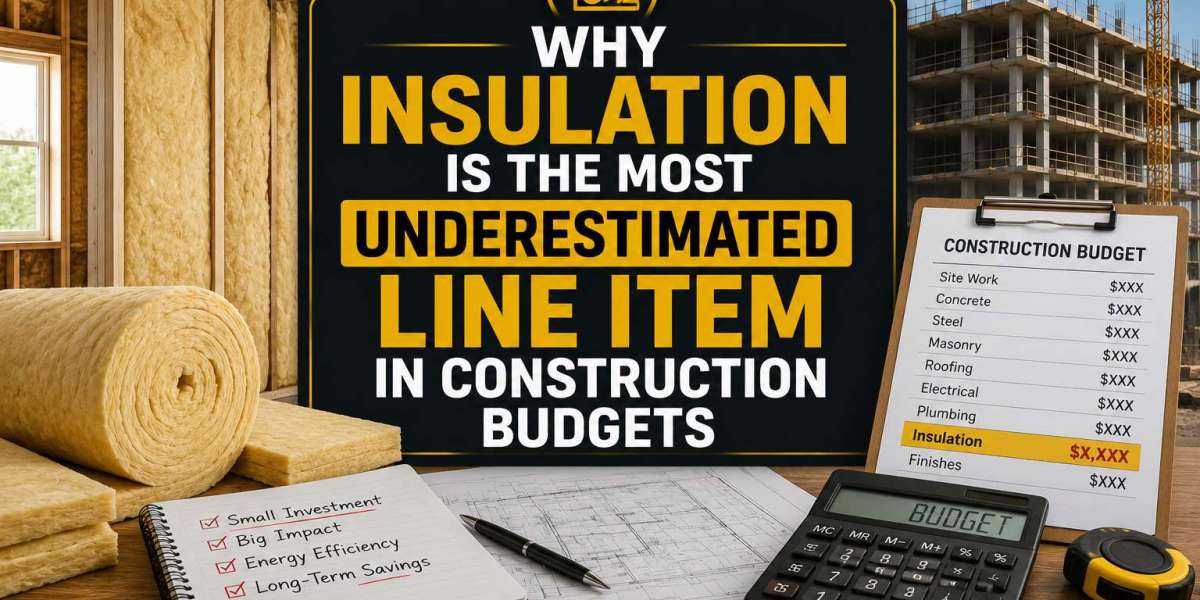

If you ask most contractors which parts of a build tend to blow past budget, insulation rarely makes the top of the list. It's not glamorous. It doesn't show up in the final walkthrough the way a granite countertop or a well-finished facade does. It sits inside walls, above ceilings, and wrapped around mechanical systems where nobody but an inspector will ever really look at it closely. And that, oddly enough, is exactly why it causes so many budget problems.
Insulation is one of those categories where the gap between "close enough" and "actually correct" can cost real money, both up front and for years afterward through energy bills, code violations, or callbacks. It deserves a lot more attention at the estimating stage than it typically gets.
Why Insulation Estimates Go Wrong So Often
It Looks Simple, But It Isn't
On the surface, insulation seems like one of the more straightforward trades to estimate. Measure the square footage, pick a material, multiply by a price per square foot, done. In practice, it's far more layered than that. Different assemblies require different R-values depending on climate zone, wall orientation, and local code. Thermal bridging at studs, corners, and penetrations can quietly undercut performance if it isn't accounted for. And the material itself isn't one thing, it's a whole category, from fiberglass batts to spray foam to rigid board to specialty products like aerogel or reflective systems, each with different costs, labor requirements, and installation methods.
Small Miscalculations Compound Fast
A modest error in square footage or R-value on a single-family home might mean a few hundred dollars of variance. Scale that same error up to a commercial building with dozens of wall assemblies and mechanical insulation running through miles of ductwork and piping, and the number balloons quickly. Industry estimates suggest insulation-related miscalculations contribute meaningfully to the budget overruns commonly seen on commercial projects, often in the range of 15 to 20 percent when other factors compound the issue.
The Technical Details That Actually Matter
R-Value Isn't Just a Number on a Spec Sheet
R-value gets treated as a simple input, but getting it wrong has consequences beyond a slightly less efficient building. Underestimating R-value requirements can mean failing an energy code inspection outright, which means rework, delays, and a very unhappy general contractor. Overestimating wastes money on material that wasn't needed. The right number depends on climate zone, assembly type, and the specific performance target for that section of the building, not a single blanket figure applied everywhere.
Fire Ratings and Code Compliance
Insulation isn't just a thermal product, it's often a life-safety product too. Fire-rated assemblies, smoke development indices, and flame spread classifications all factor into which materials are even legally permitted in certain applications. A project that ignores these distinctions during estimating risks a mismatch between what was priced and what's actually required to pass inspection.
Mechanical and Industrial Insulation Is a Different Animal Entirely
Insulating a wall cavity in a house and insulating a pipe run in a processing plant have almost nothing in common beyond the word "insulation." Mechanical and industrial applications involve heat transfer rates, surface temperatures, chemical resistance, and operating conditions that residential estimators rarely need to think about. Treating these as interchangeable categories in a budget is one of the more common, and more expensive, mistakes on larger projects.
Why This Category Benefits From Specialized Estimating
Given how many variables are actually in play, it's not surprising that generalist estimators, or contractors trying to price insulation themselves alongside a dozen other trades, sometimes miss details that a specialist would catch immediately. This is one of the areas of construction estimating where specialization genuinely pays for itself. A dedicated insulation estimator isn't just counting square footage; they're cross-referencing assembly types against code requirements, accounting for thermal bridging, and pricing materials that fluctuate based on regional availability and market conditions.
For contractors juggling insulation alongside everything else on a project, outsourcing this specific piece to people who focus on it full time is often the more cost-effective route. Professional insulation estimating services exist specifically to handle this level of technical detail, covering everything from R-value calculations and material takeoffs to code compliance across residential, commercial, and industrial projects, without the contractor needing to become an insulation specialist themselves.
A Practical Checklist Before Finalizing an Insulation Estimate
Confirm the climate zone and required R-values for every assembly type in the project, not just a single average figure for the whole building.
Account for thermal bridging at studs, headers, corners, and any structural penetrations that reduce effective insulation performance.
Match materials to fire and smoke ratings required by the specific occupancy type and local code amendments.
Separate mechanical insulation from building envelope insulation in the takeoff, since they involve entirely different specifications and labor.
Build in a contingency for price volatility, since insulation material costs can shift with supply chain conditions more than some other trades.
Cross-check the estimate against current energy codes, including any regional amendments layered on top of the base building code.
The Bottom Line
Insulation doesn't get the attention it deserves at the estimating table, largely because it's invisible once the job is done. But an underpriced or miscalculated insulation package doesn't stay invisible for long, it shows up as a change order, a failed inspection, or a homeowner's unusually high winter heating bill. Treating insulation as a detailed, technical line item rather than an afterthought is one of the simplest ways to protect a project's budget and its long-term performance at the same time.