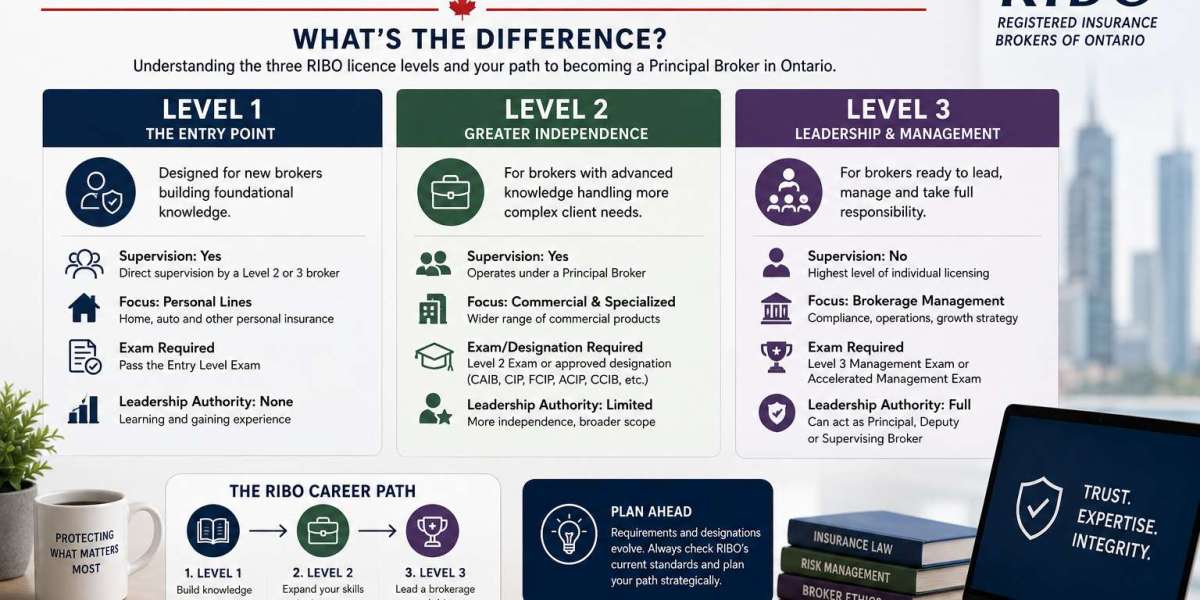

If you're building a career as an insurance broker in Ontario, you'll eventually run into the same question almost every new licensee asks: what actually separates a RIBO Level 1 licence from a RIBO Level 2 or RIBO Level 3 licence? The short answer is scope of authority, supervision requirements, and how much responsibility you can hold within a brokerage. The longer answer — and the one that actually matters for planning your career — depends on where you are now and where you want to end up.
This guide breaks down the three RIBO licence levels, what each one lets you do, how you move between them, and how they connect to the role of principal broker Ontario brokerages rely on to stay compliant.
What Is RIBO and Why Do the Levels Exist?
The Registered Insurance Brokers of Ontario (RIBO) is the regulatory body that licenses and oversees general insurance brokers in the province. Rather than issuing one blanket licence, RIBO uses a tiered structure so that brokers take on more independence and responsibility only as they build the experience and technical knowledge to handle it. This protects consumers, and it also gives brokers a clear, structured RIBO career path to follow instead of guessing what comes next.
RIBO Level 1: The Entry Point
A RIBO Level 1 licence is the starting credential for anyone entering the profession. It's built for brokers who are new to the industry and still developing their foundational knowledge of personal lines products like home and auto insurance.
Key characteristics of a Level 1 licence:
- Requires passing RIBO's Entry Level Exam, which covers core insurance products, regulations, and ethical obligations.
- Licensees must work under the direct supervision of a broker who holds a Level 2 or Level 3 licence.
- Focuses primarily on personal lines insurance, though Level 1 brokers are technically qualified to sell general insurance products under supervision.
- Serves as the mandatory first step — you cannot skip straight to Level 2 or Level 3 without first holding an active Level 1 licence.
Most brokers spend their first year or two at this level, using the time to build practical experience while working closely with more senior licensees.
RIBO Level 2: Greater Independence, Broader Scope
Once you've built a foundation at Level 1, the next step is RIBO Level 2. This licence signals that a broker has developed more advanced technical and commercial insurance expertise and can be trusted with a wider range of client needs.
What changes at Level 2:
- Brokers gain the ability to handle more complex commercial insurance policies, not just personal lines.
- There's meaningfully more independence, though Level 2 brokers still technically operate under the oversight of a Principal Broker at the firm level.
- Licensees expand their understanding of regulatory and legal issues specific to commercial and specialized insurance products.
- An active Level 1 licence is required before applying, and RIBO also requires passing the Level 2 Technical/Commercial Exam — though this can be exempted with an approved industry designation.
It's worth noting that RIBO's exam requirements are evolving. Standalone RIBO-specific Level 2 and Level 3 exams are being phased out in favor of recognized industry designations such as CAIB, CIP, FCIP, ACIP, and CCIB, aligning Ontario more closely with licensing standards in other provinces. Brokers working toward Level 2 can also qualify by completing CAIB 1–3 or CIP courses C130 and C131. If you're mapping out your qualification path, checking RIBO's current requirements directly is worthwhile, since these standards have shifted recently.
RIBO Level 3: Leadership and Management Authority
RIBO Level 3 is the top tier of individual licensing, and it's the credential required to take on true leadership responsibility within a brokerage. This is where the principal broker Ontario designation comes into play.
A Level 3 licence allows a broker to:
- Act as Principal Broker, responsible for the entire brokerage's operations and regulatory compliance.
- Serve as Deputy Principal Broker or Supervising Broker, overseeing Level 1 and Level 2 licensees.
- Manage the brokerage's day-to-day compliance with RIBO's regulatory requirements and act as the primary point of contact with RIBO.
- Take on strategic authority over business decisions, staff training, and overall brokerage growth.
To qualify, a broker generally must already hold an active Level 2 licence (typically for two or more consecutive years), then pass the Level 3 Management Exam — or an Accelerated Management Exam for eligible candidates. It's also possible to skip the Level 2 exam and move directly toward the Level 3 Management Exam, though the Level 2 Technical/Commercial qualification (or an approved exemption) still needs to be satisfied before the Level 3 licence itself can be issued.
Comparing the Three Levels at a Glance
| Licence | Supervision Required? | Primary Focus | Leadership Authority |
|---|---|---|---|
| Level 1 | Yes, by a Level 2 or 3 broker | Personal lines, foundational knowledge | None |
| Level 2 | Yes, under a Principal Broker | Commercial and specialized products | Limited |
| Level 3 | No | Brokerage management and compliance | Full — can act as Principal Broker |
Planning Your RIBO Career Path
For most brokers, the progression looks like this: pass the Level 1 exam and gain hands-on experience under supervision, move into Level 2 as commercial and technical knowledge grows, and eventually pursue Level 3 once you're ready to take on management responsibility or ownership within a brokerage. Because RIBO periodically updates exam and designation requirements — as seen with the recent shift toward recognizing CAIB and CIP designations for Level 2 and Level 3 — it's smart to confirm current requirements before mapping out your timeline.
Understanding these distinctions isn't just useful for individual brokers. Brokerage owners and hiring managers also need to know the levels to properly staff their teams, assign supervision responsibilities, and ensure the right person holds the Principal Broker designation required to keep the firm compliant.
Frequently Asked Questions
Can I skip RIBO Level 1 and go straight to Level 2?
No. An active RIBO Level 1 licence is a prerequisite for applying to Level 2. RIBO's licensing structure is designed to build technical competence progressively, so there's no way to bypass the entry-level credential.
Do I need a Level 3 licence to become a Principal Broker?
Yes. Only brokers holding a Level 3 licence are eligible to be appointed Principal Broker, Deputy Principal Broker, or Supervising Broker within a brokerage.
Are the RIBO exam requirements changing?
Yes. RIBO is transitioning away from standalone Level 2 and Level 3 exams in favor of recognized industry designations like CAIB and CIP, so it's a good idea to check RIBO's current requirements directly before starting your qualification process.