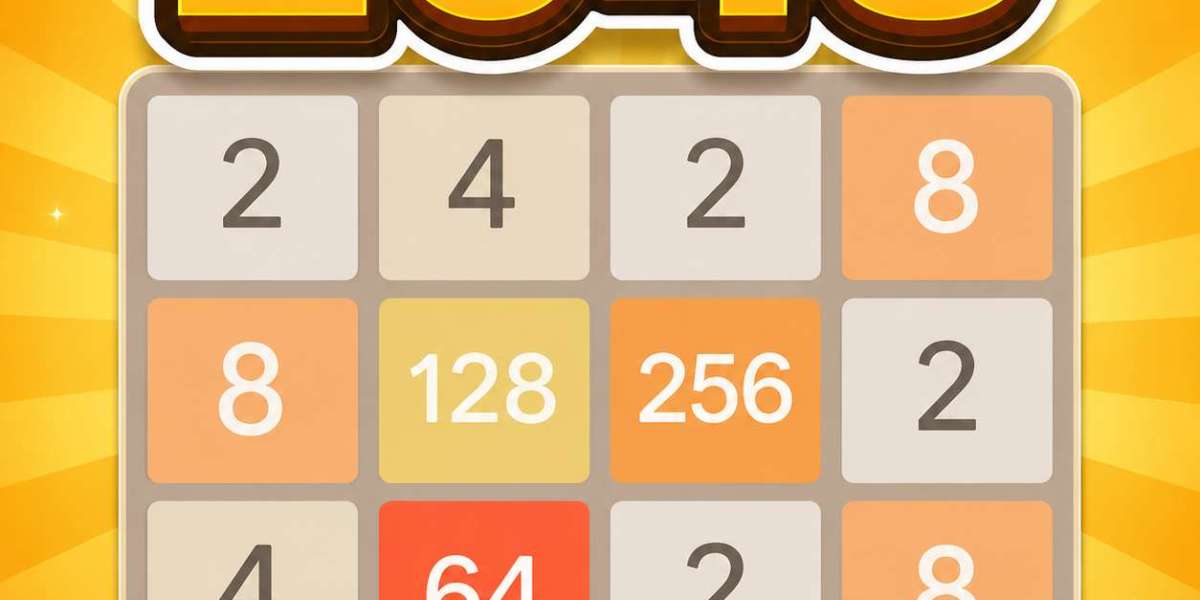

The 2048 game is a simple but highly engaging puzzle game that has become popular among people of different ages. It is easy to understand, requires no complicated equipment, and can be played on a computer, tablet, or mobile phone. Although the game has a very simple design, it requires logical thinking, planning, concentration, patience, and careful decision-making. The main goal of 2048 is to combine numbered tiles until the player creates a tile with the number 2048. Because of its simple rules and challenging gameplay, 2048 has become an excellent example of how a small and straightforward game can provide hours of entertainment while also exercising the mind.
The 2048 game was created in 2014 by Gabriele Cirulli, an Italian web developer. Cirulli developed the game as a personal project and was inspired by other tile-combining puzzle games. He created 2048 using web technologies, and the game quickly spread across the internet because it was free, simple, and easy to play. Its popularity increased rapidly through social media and word of mouth. Soon, many versions of the game appeared on different websites and mobile platforms. Despite the existence of many similar games, the original concept of 2048 remained recognizable because of its distinctive numbered tiles and simple four-by-four board.
The basic structure of 2048 is extremely simple. The player is given a square board consisting of sixteen spaces arranged in four rows and four columns. At the beginning of a game, a few numbered tiles appear on the board. Usually, these tiles have values such as 2 or 4. The player moves all the tiles in one direction by using the arrow keys or by swiping on a touchscreen. The four possible directions are up, down, left, and right. Whenever two tiles with the same number meet during a move, they merge into one tile with twice their original value. For example, two tiles marked 2 can combine to form a 4. Two 4 tiles can become an 8, and two 8 tiles can become a 16. This process continues until the player reaches 2048 or is no longer able to make useful moves.
One of the most interesting features of 2048 is that every move matters. A player cannot simply move tiles randomly and expect to succeed. Each movement changes the arrangement of the entire board. After most successful moves, a new tile appears in an empty space. As a result, the available space gradually decreases. The player must therefore think about both the present move and its possible consequences. A move that creates a large number immediately may sometimes make the board more difficult to manage later. Successful players learn to consider several possible moves before choosing one.
The main objective of the game is to create the 2048 tile. To accomplish this, smaller tiles must be combined repeatedly. For instance, two 2 tiles form 4, two 4 tiles form 8, two 8 tiles form 16, and so on. Eventually, a player must combine two 1024 tiles to create 2048. Reaching this number requires many successful combinations and careful control of the board. In some versions, the game continues even after 2048 is reached, allowing players to try to create larger tiles such as 4096 or 8192. This gives experienced players an additional challenge.
Although the rules are simple, 2048 can be surprisingly difficult. The greatest challenge is managing limited space. The board contains only sixteen positions, so the player must prevent the spaces from becoming filled with unrelated numbers. If there are no empty spaces and no neighboring tiles with matching values, the game ends. This means that players must constantly organize the board. Keeping large numbers in useful positions and maintaining enough empty spaces can make a major difference.
Another important aspect of 2048 is strategy. There is no single move that guarantees success in every situation because new tiles appear in different empty spaces. However, players can use several general strategies. One common approach is to choose one corner of the board and try to keep the largest tile there. For example, a player may decide to keep the largest tile in the bottom-left corner and avoid moving it unnecessarily. The remaining tiles can then be organized around it. This strategy can reduce confusion and make it easier to build larger numbers.
Another useful technique is to avoid making unnecessary movements in all four directions. Constantly changing directions can separate tiles that have been carefully organized. Players often concentrate on two or three directions while using the remaining direction only when necessary. This does not guarantee victory, but it can help maintain a more stable board. The key principle is to think ahead instead of reacting to every new tile immediately.
Planning is therefore one of the most important skills developed through the game. A player may see two matching tiles and immediately want to combine them. However, combining them might cause another important tile to move into an unfavorable position. Before making a move, the player should consider what the board will look like afterward. This encourages a habit of thinking about consequences. In this way, 2048 resembles many other logical puzzles in which a decision made now can affect several future possibilities.
The game also teaches patience. Players do not always reach 2048 on their first attempt. In fact, many new players lose repeatedly before understanding how to manage the board effectively. Losing can be frustrating, but it also provides information. A player can look at the final board and identify mistakes, such as creating too many isolated tiles, blocking a corner, or moving a large tile unnecessarily. The next attempt can then be based on what was learned from the previous game. This process of failure, reflection, and improvement is one reason why 2048 can be both entertaining and educational.
Concentration is another important skill involved in playing 2048. Because each movement changes the board, players must pay attention to the positions and values of the tiles. Missing a possible combination can lead to a poor arrangement. At higher levels, the board may contain many different numbers, making it harder to keep track of all possible combinations. A player therefore needs to remain focused and avoid making impulsive decisions.
2048 also demonstrates the importance of logical reasoning. Players must identify patterns and calculate possible outcomes. For example, if a player has two 32 tiles and wants to combine them, those tiles may need to be moved through several stages before they can reach each other. The player must determine how other tiles should be arranged to make this possible. This involves spatial reasoning and an understanding of sequences. Even though the mathematical calculations are basic, the process of organizing numbers on a limited grid can be mentally demanding.
The mathematical aspect of 2048 is particularly interesting. Every tile represents a power of two. The sequence begins with 2, 4, 8, 16, 32, 64, 128, 256, 512, 1024, and finally 2048. Each number is twice the previous one. The game therefore provides an informal way of becoming familiar with powers of two and exponential growth. Players may not think of themselves as studying mathematics while playing, but the structure of the game repeatedly exposes them to numerical relationships.
Despite its educational qualities, 2048 is primarily a form of entertainment. Its greatest strength is its balance between simplicity and challenge. A person can learn the rules in less than a minute, but improving at the game can take considerable time. This combination makes it accessible to beginners while still providing a challenge for experienced players. There is no need to memorize complicated instructions, understand a large fictional world, or master numerous controls. The player simply moves tiles and makes decisions.
The visual design of 2048 also contributes to its appeal. The board is usually clean and uncluttered, and different tile values are represented by different colors. The numbers are large and easy to read. The simple appearance allows players to focus on the puzzle rather than on unnecessary visual effects. The satisfying animation that occurs when two tiles merge also gives the player immediate feedback. Each successful combination feels like progress, encouraging the player to continue.
The game became especially popular because it could be played directly in a web browser. Players did not need expensive hardware or a powerful computer. Later, versions became available on mobile devices, making the game convenient to play almost anywhere. Its short individual sessions also suit people who want a quick mental activity. A player can complete a short session during a break or spend much longer trying to achieve a personal high score.
However, like many games, 2048 should be played in moderation. Because the game is easy to start and can create a strong desire to try again after losing, players may spend more time on it than they originally intended. Excessive gaming can interfere with study, work, sleep, exercise, or social activities. Therefore, the benefits of playing 2048 are greatest when it is treated as a short recreational activity rather than something that replaces important daily responsibilities.
Another interesting feature of 2048 is the large number of versions and variations that have appeared since its creation. Developers and enthusiasts have modified the basic concept in many ways. Some versions use different board sizes, while others introduce unusual shapes, alternative rules, or different themes. These variations demonstrate how a simple game mechanic can inspire creativity. The central idea of combining matching objects can be adapted to many different designs while preserving the fundamental puzzle experience.
The popularity of 2048 also shows how powerful simplicity can be in digital entertainment. Modern games can contain advanced graphics, complex stories, and large multiplayer worlds, but 2048 achieved widespread recognition with a small grid and a few numbers. Its success suggests that a good game does not necessarily need complicated features. A clear objective, understandable rules, meaningful decisions, and an appropriate level of challenge can be enough to make a game enjoyable.
From a broader perspective, 2048 can be seen as a small lesson in decision-making. Every move presents a choice, and every choice has consequences. Sometimes a move produces an immediate benefit but creates a problem later. At other times, a move may not appear useful at first but creates better opportunities in the future. This is similar to situations in everyday life, where people often have to balance short-term benefits with long-term goals. The game does not directly teach life skills in a formal way, but it provides a simple environment in which players can practice thinking ahead.
The game also encourages adaptability. Since new tiles appear unpredictably, a player cannot follow exactly the same sequence of moves in every game. A strategy must be adjusted according to the current board. This teaches players to respond to changing circumstances rather than depending entirely on a fixed plan. Good gameplay involves both preparation and flexibility.
In conclusion, 2048 is a simple yet intellectually engaging puzzle game that combines numbers, spatial organization, strategy, and chance. Created by Gabriele Cirulli in 2014, it became widely popular because of its accessible rules and challenging gameplay. The objective is straightforward: combine matching tiles until a tile with the value 2048 is created. Yet achieving this goal requires concentration, planning, patience, logical reasoning, and careful management of limited space.
The lasting appeal of 2048 comes from the fact that it is easy to learn but difficult to master. It offers entertainment while encouraging players to think about patterns, consequences, and long-term strategies. It can also provide an informal introduction to powers of two and exponential numerical sequences. Most importantly, the game demonstrates that an engaging experience does not always require complicated technology or elaborate design. A small board, a few numbers, and a clear set of rules can be enough to challenge the mind and keep players interested.
For these reasons, 2048 remains a memorable example of a simple digital puzzle with broad appeal. Whether played casually for a few minutes or studied as an example of game design and problem-solving, it provides an enjoyable way to exercise the mind. Its combination of simplicity, challenge, strategy, and repetition explains why the game has remained recognizable long after its original release.