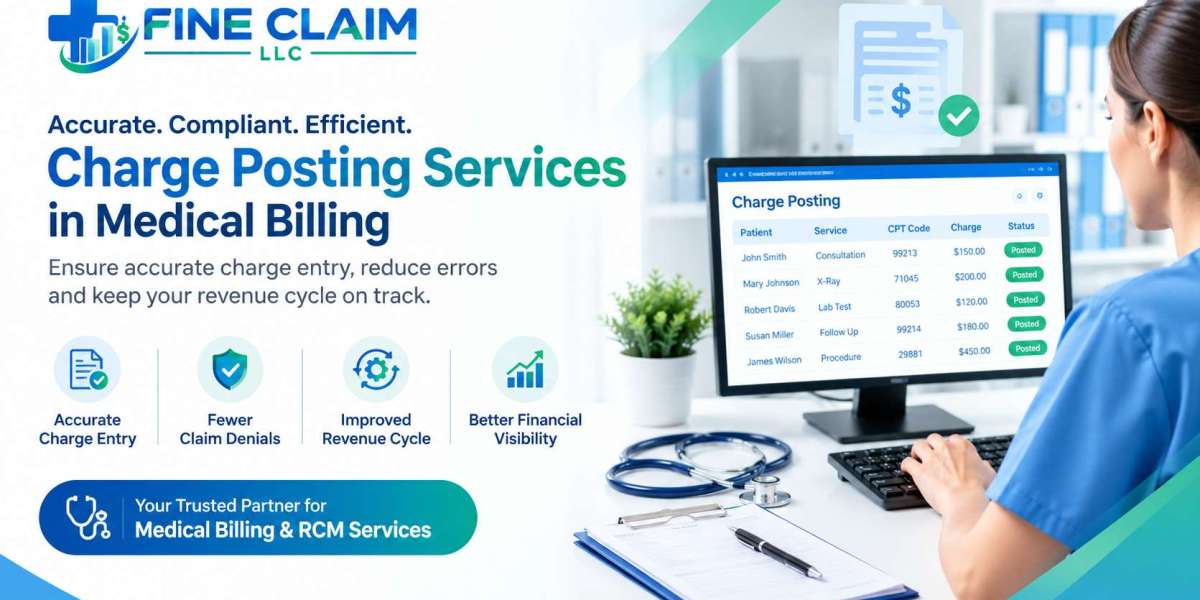

Medical practices must coordinate patient care, documentation, coding, billing, and reimbursement activities every day. When billing teams are overwhelmed by incomplete records or high encounter volumes, routine charge entry can become a source of delays and administrative pressure.
Outsourced charge posting services in the USA offer healthcare providers an option for managing this important billing function with support from an external team. When implemented correctly, outsourcing can help standardize charge entry, improve visibility into outstanding work, and give internal staff more time to focus on other responsibilities.
Understanding Outsourced Charge Posting
Outsourced charge posting involves assigning some or all charge entry responsibilities to an external medical billing service provider. The provider works with the practice's approved workflows, documentation, billing software, and quality requirements.
The process commonly includes receiving encounter information, reviewing documented services, entering charges, identifying missing data, and communicating discrepancies to the appropriate staff.
The precise scope varies by contract. Some providers handle charge entry only, while others integrate the work with medical coding, claim preparation, denial management, and broader revenue cycle management services.
Practices should establish clear responsibilities before outsourcing to avoid confusion over who reviews documentation, approves corrections, and submits claims.
Why Medical Practices Consider Outsourcing
1. Managing fluctuating workloads
Patient volumes may vary by day, provider, and specialty. An outsourced team can provide additional processing capacity when internal staff struggle to keep pace, subject to the provider's staffing and service commitments.
2. Improving workflow consistency
A documented charge posting procedure helps ensure that staff follow the same steps when entering service details and reviewing discrepancies. Standardization is particularly valuable for multi-provider practices.
3. Reducing repetitive administrative work
When charge entry is managed through an organized process, internal teams may spend less time handling routine data-entry tasks and correcting avoidable mistakes.
4. Supporting smaller billing departments
Independent physicians and smaller clinics may not have enough staff to separate every billing responsibility. Outsourcing can provide specialized assistance without requiring the practice to build a larger internal department immediately.
5. Strengthening reporting
Depending on the service agreement, outsourced charge posting teams may provide reports covering completed entries, pending encounters, missing information, and processing turnaround.
How Outsourced Charge Posting Works
A successful arrangement begins with workflow mapping. The practice and service provider agree on documentation requirements, software access, responsibility boundaries, escalation contacts, and processing targets.
The practice then supplies encounter information through an approved, secure workflow. The billing team reviews the available documentation and enters the relevant charges into the designated system.
If the team encounters a missing procedure detail, inconsistent date of service, or incomplete documentation, the issue should be routed for clarification rather than resolved through unsupported assumptions.
Quality checks may include verifying patient accounts, service dates, applicable codes, modifiers, units, and charge amounts against the available records. Once reviewed, charges move to the next stage of the billing workflow.
Performance should be evaluated regularly using agreed measures such as turnaround time, correction rates, incomplete encounter volume, and the number of unresolved exceptions.
Security and Compliance Considerations
Outsourcing medical billing requires careful attention to patient information. Healthcare providers should evaluate whether the service provider uses appropriate safeguards for protected health information.
Depending on the arrangement, relevant considerations include a business associate agreement, role-based access, secure data transmission, workforce training, incident response procedures, and appropriate access termination when staff no longer need the system.
HIPAA obligations depend on the parties and services involved. Practices should confirm that their outsourcing arrangement meets applicable legal and contractual requirements instead of relying solely on a provider's marketing claims.
How to Choose the Right Outsourcing Partner
Before selecting a medical charge posting company, ask how it handles incomplete documentation, corrections, specialty-specific requirements, software access, and reporting.
Also confirm whether the team has experience with your practice's specialty and whether it can communicate effectively with your existing billing and clinical staff.
A useful service agreement should define deliverables, turnaround expectations, escalation procedures, security responsibilities, and the process for resolving quality concerns.
Fine Claim LLC provides medical billing and revenue cycle management support for healthcare providers seeking organized billing workflows.
Frequently Asked Questions
Is outsourcing charge posting suitable for small medical practices?
Yes. It can be useful when a small practice has limited billing staff or needs additional processing capacity. Suitability depends on workload, cost, and operational requirements.
Does outsourcing guarantee faster reimbursement?
No. Outsourcing may improve charge processing consistency, but reimbursement also depends on documentation, coding, payer rules, eligibility, and claim processing.
Can outsourced charge posting work with existing billing software?
Often, yes, provided the provider supports the software and the practice establishes appropriate access, security, and workflow procedures.
Conclusion
Outsourced charge posting can help US healthcare providers manage workload fluctuations, establish consistent procedures, and improve oversight of billing operations. The greatest value comes from clear responsibilities, effective communication, reliable quality checks, and appropriate information security.
Practices considering outsourced charge posting services in the USA should assess their operational needs and select a partner that can work within their existing revenue cycle processes.