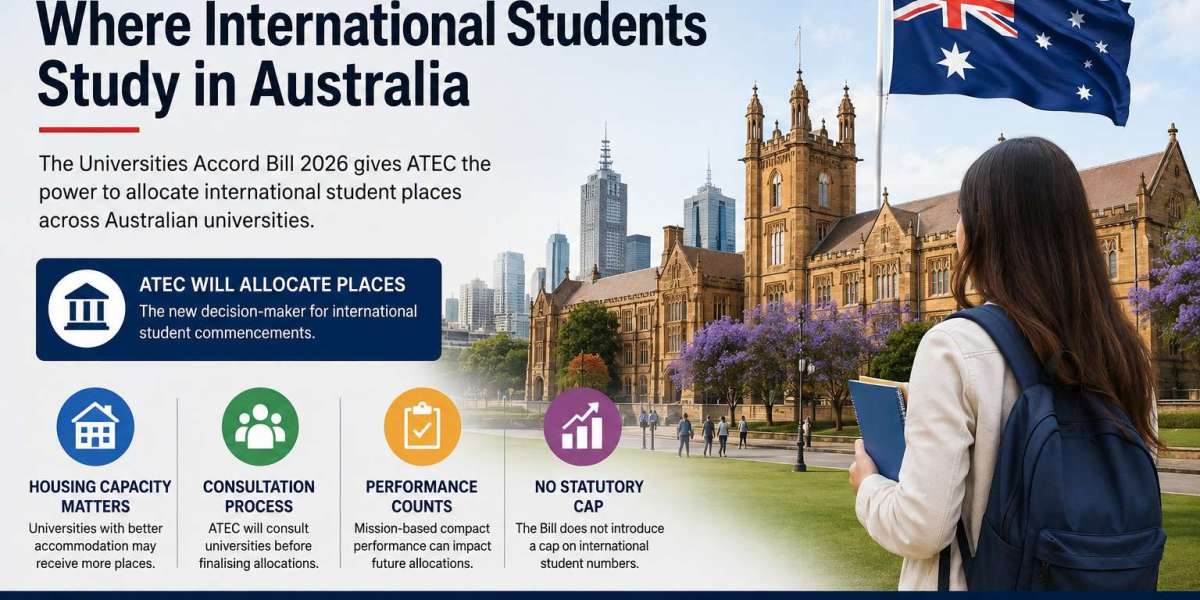

Choosing an Australian university has always involved comparing rankings, tuition fees, and career opportunities. Now, another factor is entering the equation: ATEC student allocation . While Australia has not introduced a legal cap on international students, a proposed reform would change who decides how international student places are distributed across universities.
For students and education agents, this isn't just another policy update. It could influence which universities have available places, how early applications should be submitted, and why flexibility has become more important than ever.
A Different Decision Maker, Not a New Student Cap
One of the biggest misunderstandings surrounding the Universities Accord Bill is that it creates a new cap on international students. It doesn't.
Instead, the proposal transfers responsibility for allocating international student commencements from the government to the Australian Tertiary Education Commission (ATEC). The overall National Planning Level would still exist, but ATEC would determine how those places are divided among individual universities and higher education providers.
Think of it like distributing seats on a flight. The airline still has the same number of seats, but a different team now decides how many are reserved for each travel agency. The total doesn't necessarily change, yet availability at each seller can look very different.
This distinction matters because universities may receive different allocations from year to year depending on several policy priorities.
What Will Influence University Allocations?
The proposed framework gives ATEC responsibility for consulting with universities before making allocation decisions. The Education Minister can also direct ATEC to consider specific government priorities.
Among the factors highlighted are student housing capacity and market diversification. Universities with stronger accommodation options or a broader mix of international student markets may receive different allocations than institutions facing housing shortages or relying heavily on a limited number of source countries.
Performance under mission-based compacts would also play a role for eligible universities. Rather than relying mainly on historical enrollment trends, future allocations could increasingly reflect how well institutions align with broader government objectives.
That means two universities offering similar degrees could experience noticeably different international student availability during the same intake.
Students Should Plan Earlier Than Before
The practical impact is straightforward. Students can no longer assume that a popular university will always have places available simply because demand has been high in previous years.
Checking Confirmation of Enrollment (CoE) availability before lodging a visa application becomes an important step. Universities may fill their allocated places sooner if their numbers are lower than expected for a particular intake.
Earlier planning also gives students more time to prepare backup options. Applying to multiple suitable institutions rather than focusing on a single university could become a smarter strategy if allocations fluctuate each year.
While researching universities, students often find themselves balancing admission requirements with ongoing coursework. Resources such as Expertsmind.com's subject expert network can help students manage demanding assignments across engineering, business, computing, and many other disciplines while they navigate changing admission timelines.
What Hasn't Changed?
Despite the policy discussion, several important parts of Australia's international education system remain exactly the same.
The proposed legislation does not introduce a statutory cap on international student numbers. Visa fees, processing requirements, and the Genuine Student requirement also remain unchanged under the proposal. The National Planning Level continues to guide overall planning rather than setting individual university quotas through the new legislation.
This means students should avoid reacting to misleading headlines suggesting Australia has already imposed a nationwide cap. The proposed reforms focus on distribution, not reducing the total number of international students through this legislation.
A More Dynamic Admission System
If the legislation proceeds, Australian university admissions may become more dynamic than they have been during the past decade.
Institutions with strong housing infrastructure, diversified international recruitment, and consistent performance could be better positioned when allocations are determined. Others may experience greater variation in available places even if student demand remains strong.
For prospective students, the best response isn't panic. It's preparation. Research universities carefully, apply early, monitor CoE availability, and stay informed as the new allocation framework develops.
Australian higher education continues to welcome international students. What may change is how available places are distributed across institutions. Understanding that difference could help students make better application decisions and avoid unnecessary delays during one of the most important stages of their study journey.