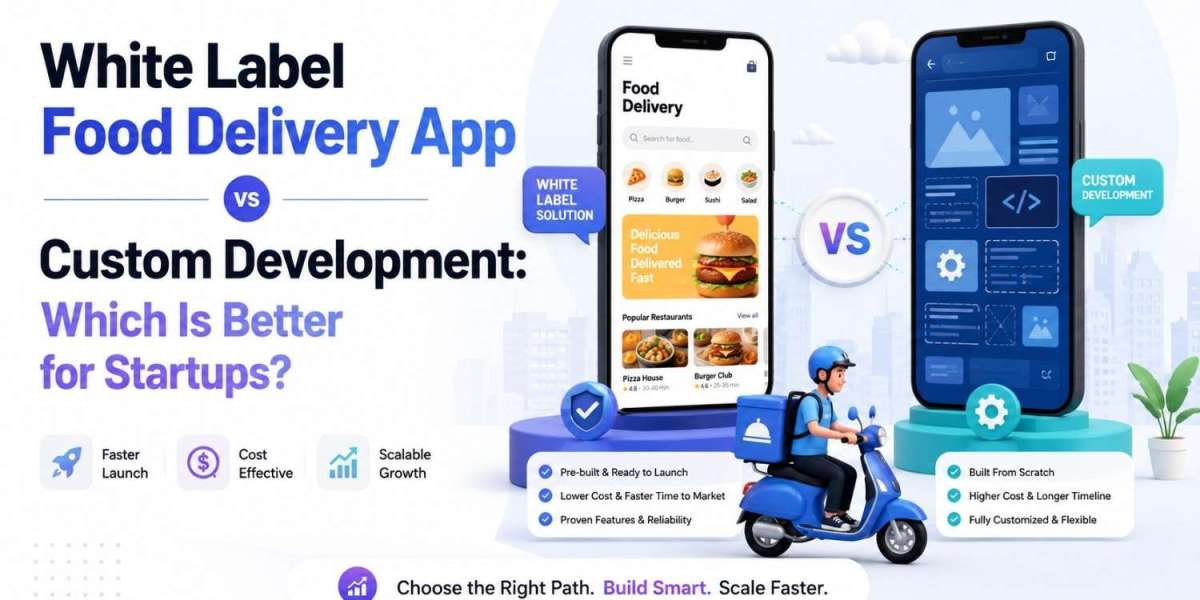

One of the first decisions startup founders make is whether to launch with a white label food delivery app or build a custom platform from scratch. The choice affects far more than your initial budget. It influences how quickly you can enter the market, how much control you have over features, and how easily your platform can scale as your business grows.
Many startups assume a custom-built app is the only way to stand out, while others choose a ready-made solution to reduce development time and upfront costs. Both approaches can work, but the right choice depends on your business goals, available resources, and long-term plans—not on which option offers more features. This article compares both approaches from a practical business perspective. You'll learn how they differ in cost, development time, customization, scalability, maintenance, and ownership, helping you choose the option that best fits your startup.
What Is a White Label Food Delivery App?
A white label food delivery app is a ready-made software solution that businesses can rebrand and launch under their own name. Instead of building an app from scratch, you start with an existing platform and customize it with your logo, brand colors, and business settings. This helps startups bring their product to market sooner while offering customers a consistent branded experience.
Most white label platforms include the core tools needed to run a food delivery business, such as a customer app, a restaurant or vendor panel, a delivery partner app, and an admin dashboard. They also commonly support features like real-time order tracking, multiple payment gateways, push notifications, and promotional tools. Since these components are already built and connected, businesses can spend less time on development and more time preparing for launch and attracting customers.
A white label food delivery app is a practical choice for startups, restaurant chains, and cloud kitchens that want to validate their business idea without building software from the ground up. While customization options are usually sufficient for most businesses, the level of flexibility depends on the provider, and highly specialized features may require custom development later.
What Is Custom Food Delivery App Development?
Custom food delivery app development involves building a platform from the ground up to match your business requirements. Instead of using an existing software framework, every feature, workflow, and user interface is designed specifically for your business. This gives you complete control over how the platform works, allowing you to create unique customer experiences, custom ordering workflows, and specialized integrations that support your business model.
Building a custom platform typically involves planning, UI/UX design, development, testing, and deployment. After launch, the application also requires regular maintenance, security updates, bug fixes, and feature enhancements to keep it running smoothly and support future business needs.
Custom development is often the right choice for businesses with complex operational requirements or a product vision that cannot be achieved with a ready-made solution. For example, companies that need proprietary features, advanced logistics workflows, or deep integrations with existing business systems often benefit from a fully customized platform.
The added flexibility comes with greater responsibility. Custom development requires a higher upfront investment, a longer development timeline, and an experienced technical team to manage ongoing maintenance and future improvements. For startups that are still validating their business idea, these costs and timelines can increase risk before market demand is proven.
White-Label Food Delivery App vs. Custom Development
Choosing between a white label food delivery app and custom development comes down to your business priorities. Some startups need to launch as quickly as possible, while others are building a highly customized platform for long-term growth. Comparing both approaches across the factors below makes it easier to decide which one fits your goals.
Cost
A white label food delivery app requires a much lower upfront investment because the core software has already been developed. You mainly pay for licensing, branding, and any agreed customizations.
Custom development involves designing and building every feature from scratch. Along with development costs, you should also budget for testing, infrastructure, maintenance, and future upgrades. For startups with limited funding, this can significantly increase the initial investment.
Development Timeline
If speed is a priority, a white label solution has a clear advantage. Since the platform is already built, businesses can often complete branding, configuration, and testing within a relatively short period.
Custom development follows a longer process that includes planning, design, development, testing, revisions, and deployment. Depending on the project's complexity, launching may take several months before the product is ready for customers.
Customization and Flexibility
White label platforms usually allow businesses to customize branding, business settings, payment methods, delivery options, and selected features. This level of flexibility is enough for many startups.
Custom development offers complete control over every part of the platform. Businesses can create unique user experiences, specialized workflows, and exclusive features that are difficult to achieve with a ready-made solution.
Scalability
Most modern white label food delivery software is designed to support growing businesses. It can typically handle additional users, restaurants, delivery partners, and new service areas as demand increases.
Custom-built platforms also scale well, but they require proper architecture and continuous technical improvements. Businesses expecting rapid expansion or highly complex operations may benefit from this flexibility in the long run.
Maintenance and Technical Responsibility
With a white label solution, software updates, security improvements, and bug fixes are often handled by the solution provider. This reduces the workload for startups that do not have an in-house technical team.
In contrast, custom development gives you full responsibility for maintaining the platform. Your team must manage updates, monitor performance, fix issues, and ensure the application remains secure and compatible with new technologies.
Which Option Offers Better Long-Term Value?
Neither option is universally better. A white label food delivery app is often the smarter choice for startups that want to validate their business model, launch quickly, and reduce development risk. Custom development becomes more suitable when a business has proven market demand, requires highly specialized features, or wants complete ownership of its technology.
The best decision depends on where your business is today and how you plan to grow over the next several years.
Which Option Is Better for Different Types of Startups?
There isn't a single solution that works for every business. The right choice depends on your budget, business model, growth plans, and how quickly you want to enter the market. Looking at common startup scenarios can help you decide which approach best aligns with your goals.
Bootstrapped Startups
If you're funding the business yourself, a white label food delivery app is often the more practical choice. It keeps upfront costs lower and allows you to launch without investing heavily in software development. This gives you an opportunity to validate your business idea, attract customers, and refine your operations before committing to a larger technology investment.
Venture-Funded Startups
Startups with strong funding and a unique product vision may benefit from custom development, especially if they plan to build proprietary features or create a highly differentiated customer experience. However, funding alone doesn't always justify building from scratch. Many venture-backed startups begin with an MVP to validate market demand before investing in a fully custom platform.
Restaurant Chains
Restaurant chains that already have an established brand, customer base, and menu often find a white label solution sufficient. It allows them to launch a branded ordering platform, strengthen direct customer relationships, and reduce reliance on third-party delivery marketplaces while avoiding the cost and time required for custom development.
Cloud Kitchens
Cloud kitchens usually focus on operational efficiency and rapid expansion. A white label platform typically includes the core tools needed to manage online ordering and delivery, making it easier for cloud kitchens to launch without building software from scratch. This is especially useful for businesses managing multiple brands or operating from a shared kitchen, where streamlined operations are essential.
Multi-Vendor Food Delivery Marketplaces
Running a marketplace that connects multiple restaurants, customers, and delivery partners involves more complex operations. Businesses that require advanced commission models, vendor onboarding workflows, settlement systems, or multi-city expansion may benefit from custom development. However, many startups begin with a scalable white label platform to validate demand before investing in a fully customized solution.
A Simple Decision Checklist
Before choosing between a white label food delivery app and custom development, ask yourself:
Do I need to launch as quickly as possible?
Can I afford both development and ongoing maintenance?
Do I need unique features that existing platforms cannot provide?
Do I have the technical resources to manage a custom platform?
Will my business require custom workflows or specialized features as it grows?
Your answers will usually point you toward the solution that best matches your current stage. For many startups, launching with a proven platform first and moving to custom development later is a practical way to reduce risk while keeping future growth options open.
Common Mistakes to Avoid Before Choosing
Choosing the right development approach involves more than comparing features or pricing. Many startups make decisions without considering long-term business needs, which can lead to unnecessary costs, delays, or technical limitations. Avoiding these common mistakes can help you make a more informed decision.
Building Too Many Features Too Soon
Many founders believe they need a feature-rich app from day one. In reality, customers care more about a smooth ordering experience than dozens of advanced features. Trying to match every feature offered by large food delivery platforms before attracting your first customers can delay your launch and increase development costs. Starting with essential features allows you to validate your business idea, gather user feedback, and improve the platform based on real customer needs.
Looking Only at the Initial Cost
A lower development price doesn't always result in a lower overall investment. In addition to development costs, consider hosting, infrastructure, software updates, security, third-party integrations, technical support, and future feature enhancements. Looking at the total cost of ownership provides a clearer picture than comparing upfront expenses alone.
Choosing Technology Before Validating the Business
Your business model, target audience, and revenue strategy should guide your technology decisions. Validating an MVP before investing heavily in custom development helps reduce risk, identify customer needs, and avoid spending resources on features that may not deliver business value.
Ignoring Maintenance and Future Growth
Launching your app is only the beginning. Every platform requires ongoing maintenance, performance improvements, security updates, and compatibility with new technologies. Choosing a solution that can support future growth helps reduce the need for expensive migrations or major redevelopment as your business expands.
The best decision is the one that supports your current stage while giving you the flexibility to grow as your business evolves.
Conclusion
Choosing between a white label food delivery app and custom development comes down to your business priorities. It can help businesses test their business model before deciding whether a fully custom platform is necessary. It allows you to focus on building your customer base before making a larger technology investment.
If your business depends on proprietary features, specialized workflows, or complete control over the platform, custom development offers greater flexibility and long-term ownership. Although it requires more time, investment, and technical resources, it may provide a stronger foundation as your business becomes more established.
Evaluate your budget, product goals, and long-term growth plans before making a decision. Choosing the right approach at the right stage can help you reduce risk today while creating room for future growth.
Frequently Asked Questions
What is the difference between a white label food delivery app and custom development?
A white label food delivery app is a ready-made solution that you can rebrand and launch under your own business name. Custom development involves building the platform from scratch, giving you complete control over its design, features, and functionality. The right choice depends on your budget, launch timeline, and long-term business goals.
Is a white label food delivery app suitable for startups?
Yes. A white label food delivery app is often a good choice for startups that want to launch quickly and validate their business model without investing heavily in software development. It allows founders to test market demand and refine their operations before deciding whether custom development is needed.
Can a white label food delivery app be customized?
Most white label platforms support customization beyond branding. Businesses can typically modify elements such as payment methods, delivery settings, business rules, and selected features. However, the level of customization varies by provider, so it's important to understand what is included before choosing a solution.
Do I own the source code of a white label food delivery app?
Source code ownership depends on the software provider and the licensing agreement. Some providers offer access to the source code, while others license the software without transferring ownership. Before choosing a white label solution, review the licensing terms to understand your rights, customization options, and any restrictions on future migration or development.
Can I move from a white label solution to custom development later?
Yes. Many businesses start with a white label platform to launch quickly and validate their business model. As the business grows and requires unique features or more flexibility, they transition to a custom-built platform based on real customer needs and operational requirements.
Which option is better for launching an MVP?
For most startups, a white label food delivery app is the faster and more cost-effective option for launching a minimum viable product (MVP). It allows businesses to test their idea, gather customer feedback, and evaluate market demand before investing in custom development.
How long does it take to launch each option?
The timeline depends on the project's scope and the development provider. A white label food delivery app can usually be branded, configured, tested, and launched much faster because the core software is already built. Custom development takes longer since every feature must be planned, designed, developed, tested, and deployed before launch.