
Food delivery businesses are no longer competing only on menu variety or delivery speed.
The next advantage is how intelligently the platform can understand customers, predict demand, coordinate deliveries, and automate everyday decisions.
For entrepreneurs, integrating AI into food delivery app development can turn a basic ordering marketplace into a more responsive business—one that learns from every order and uses that information to improve operations and revenue. The role of AI now extends across personalization, logistics, demand forecasting, customer support, fraud detection, and pricing.
Make Every Customer Interaction More Valuable
Customers don't always know what they want until they see the right suggestion.
AI-powered personalization can analyze previous orders and preferences to recommend relevant restaurants and dishes. Voice assistants can also allow customers to search and place orders using natural-language commands rather than navigating multiple screens.
For startups, this creates an opportunity to make the ordering journey faster while increasing the relevance of every recommendation.
Predict What Customers Will Order Before They Do
One of the biggest advantages of AI is its ability to identify patterns.
A predictive demand engine can analyze historical orders and purchasing behavior to help restaurants anticipate demand for particular meals or time periods.
This can support better inventory planning, reduce unnecessary food waste, and help restaurants prepare for busy periods without relying entirely on guesswork.
Make Your Delivery Network More Efficient
Delivery operations become increasingly complex as order volumes grow.
AI can analyze driver availability, restaurant locations, traffic conditions, and order patterns to improve delivery assignment and route planning. Intelligent systems can also group nearby orders and help delivery partners complete multiple deliveries efficiently.
The business impact goes beyond faster delivery:
Better coordination can help increase delivery capacity while controlling operational costs.
Turn Customer Support Into an Always-On Service
Customers don't want to wait for business hours to ask about an order.
AI chatbots can handle common questions, assist with ordering, collect customer requirements, and pass relevant information to restaurants or delivery teams.
This gives startups an opportunity to automate repetitive support interactions while allowing human teams to focus on more complex customer requests.
Make Pricing More Responsive
Demand can change dramatically during lunch hours, weekends, holidays, weather events, or special occasions.
AI-driven pricing systems can analyze demand and delivery-partner availability to help businesses adjust pricing strategies during high-demand periods.
Used responsibly, this can help businesses balance customer demand with delivery capacity.
Add Another Layer of Protection
Digital food delivery involves payments, refunds, cancellations, and promotional activity—all of which can create opportunities for suspicious behavior.
AI-powered fraud detection can identify unusual transactions and refund patterns, allowing administrators to investigate or respond more quickly.
For growing marketplaces, automated monitoring can become increasingly valuable as transaction volumes rise.
Don't Build AI Features Just Because They're Trending
The strongest food delivery apps don't use AI everywhere simply for the sake of it.
Entrepreneurs should first identify where AI can create measurable value:
More orders? Use personalization and recommendations.
Higher delivery capacity? Use intelligent dispatch and route optimization.
Less food waste? Use demand forecasting.
Lower support workload? Use conversational AI.
Better transaction security? Use fraud detection.
This approach ensures AI becomes a business growth tool rather than an expensive collection of features.
Build Your AI-Powered Food Delivery Platform With SpotnEats
SpotnEats provides white-label food delivery app technology that can be customized for startups, restaurant chains, aggregators, and on-demand delivery businesses.
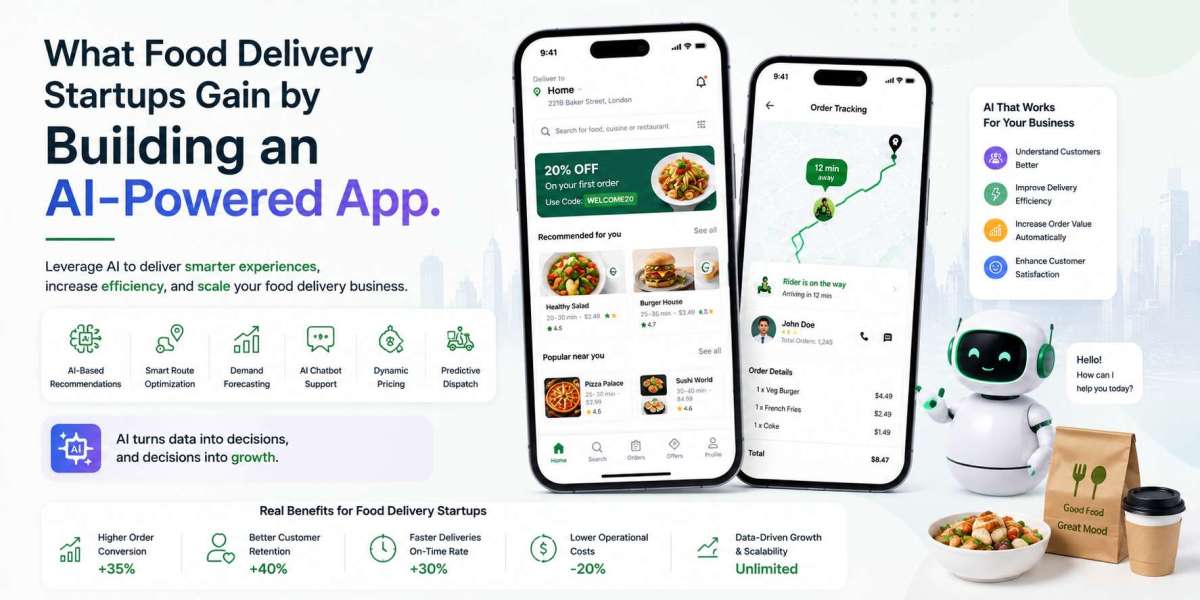
Its AI-focused capabilities can support personalized recommendations, voice ordering, predictive demand forecasting, intelligent delivery matching, route optimization, AI chatbots, dynamic pricing, fraud detection, and automated delivery workflows.
The opportunity isn't simply to add AI to a food delivery app.
It's to build a platform where every order generates useful data, every interaction becomes more personalized, and every operational decision can become smarter.
Build a food delivery business that doesn't just process orders—it learns from them.