
Walk into two nearly identical retail stores, restaurants, or offices, and there's a good chance one just feels better than the other brighter where it should be, warmer in the seating area, easier on the eyes at the front desk. Most people can't articulate why. It's rarely the paint color or the furniture. More often than not, it's the lighting.
Commercial lighting is one of the most overlooked line items in a business build-out or renovation, and also one of the most consequential. It affects energy bills, employee productivity, customer perception, and even how long people choose to stay in a space. Yet it's frequently treated as an afterthought, handled last, and budgeted for whatever's left over.
Why Commercial Lighting Deserves More Attention Than It Gets
Lighting decisions get made quickly, often by whoever happens to be finishing out a space, without much thought given to how those choices will play out over years of daily use.
The Real Cost of "Good Enough" Lighting
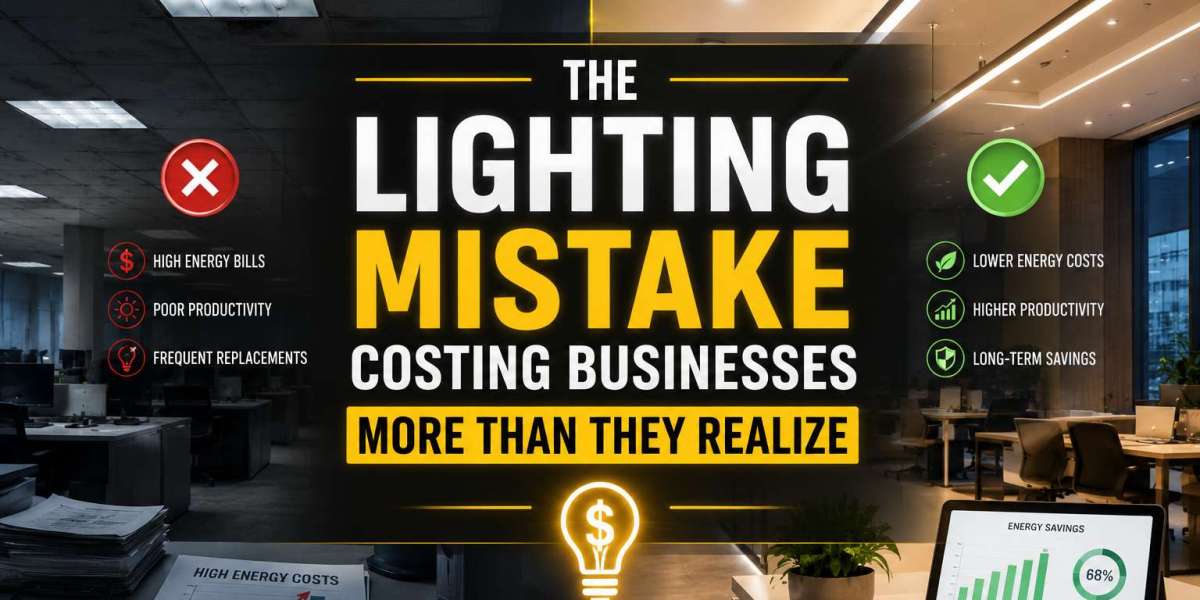
Cheap, poorly specified fixtures tend to fail faster, run hotter, and cost more to operate over their lifespan than better-built alternatives. What looks like a savings on day one often turns into a maintenance and energy expense that quietly outpaces the original cost difference within a couple of years.
Lighting Shapes How People Feel in a Space
Harsh, overly bright lighting can make a retail space feel clinical and uninviting. Dim, uneven lighting in an office can contribute to eye strain and fatigue over a workday. These aren't minor aesthetic concerns; they measurably affect how customers perceive a business and how comfortable employees are while working.
Energy Costs Add Up Fast at Commercial Scale
A lighting inefficiency that seems trivial in a single room becomes significant when multiplied across an entire office floor, retail location, or warehouse running lights for ten or more hours a day. Small differences in fixture efficiency translate into real dollar amounts once scaled across a full commercial footprint.
Common Commercial Lighting Mistakes
Treating All Spaces the Same
An open office, a retail sales floor, and a warehouse have completely different lighting needs, yet businesses sometimes apply a single lighting approach across every space in a building. Task-focused areas need brighter, more direct light, while lobbies and lounges benefit from warmer, more ambient lighting.
Ignoring Color Temperature
Color temperature, measured in Kelvin, has a bigger impact on mood and perception than most people expect. Cooler light tends to feel energizing and alert, which suits offices and retail environments, while warmer light feels more relaxed, better suited to restaurants and hospitality spaces. Mismatching color temperature to the purpose of a space is one of the most common, and most fixable, lighting mistakes.
Underestimating Maintenance and Replacement Costs
Older lighting technology often requires frequent bulb replacement, which adds up in both material cost and labor hours over time, especially in hard-to-reach commercial ceilings. Long-lasting LED fixtures reduce this burden significantly, even though their upfront cost is sometimes higher.
Overlooking Code and Compliance Requirements
Commercial spaces are subject to lighting codes and standards that residential spaces aren't, covering everything from emergency lighting to energy efficiency requirements. Skipping this step during a build-out or renovation can lead to costly rework down the line if an inspection catches non-compliant fixtures.
What Modern Commercial Lighting Actually Solves
Energy Efficiency Without Sacrificing Quality
Modern LED commercial fixtures have largely eliminated the old tradeoff between efficiency and light quality. Businesses can significantly reduce energy consumption while actually improving how a space looks and feels, something that wasn't reliably true even a decade ago.
Flexibility Across Different Business Types
Offices, retail stores, restaurants, healthcare facilities, and warehouses all have distinct lighting demands, and a well-designed commercial lighting approach accounts for those differences rather than applying a one-size-fits-all fixture throughout a building. Businesses researching options for their specific space often start by browsing a dedicated commercial lighting collection to compare fixture types suited to offices, retail environments, restaurants, and similar high-use commercial settings.
Long-Term Durability for High-Use Environments
Commercial spaces put far more demand on lighting fixtures than residential settings, longer daily run times, higher foot traffic, and less tolerance for downtime. Fixtures built specifically for commercial use are rated accordingly, which matters far more over a five or ten-year period than it does on day one.
A Practical Framework for Evaluating Commercial Lighting
Match the fixture to the function. Task lighting, ambient lighting, and accent lighting all serve different purposes and shouldn't be treated interchangeably.
Calculate total cost of ownership, not just upfront price. Factor in energy use, expected lifespan, and maintenance frequency, not just the sticker price of the fixture.
Consider color temperature deliberately. Choose based on the mood and function of each space, not just default settings.
Verify code compliance early. Confirm emergency lighting, exit signage, and energy code requirements before finalizing a lighting plan, not after installation.
Plan for scale. What works in a single showroom or office suite needs to perform consistently across every location if a business plans to expand.
Final Thoughts
Lighting rarely gets the strategic attention it deserves in commercial spaces, largely because its impact is easy to underestimate until it's done poorly. Businesses that treat lighting as a deliberate design and operational decision, rather than a last-minute checklist item, tend to end up with spaces that are more efficient to run and more pleasant for the people who spend time in them, whether that's employees, customers, or both.
The difference between a space that feels right and one that just feels "off" often comes down to decisions made long before anyone walks through the door.