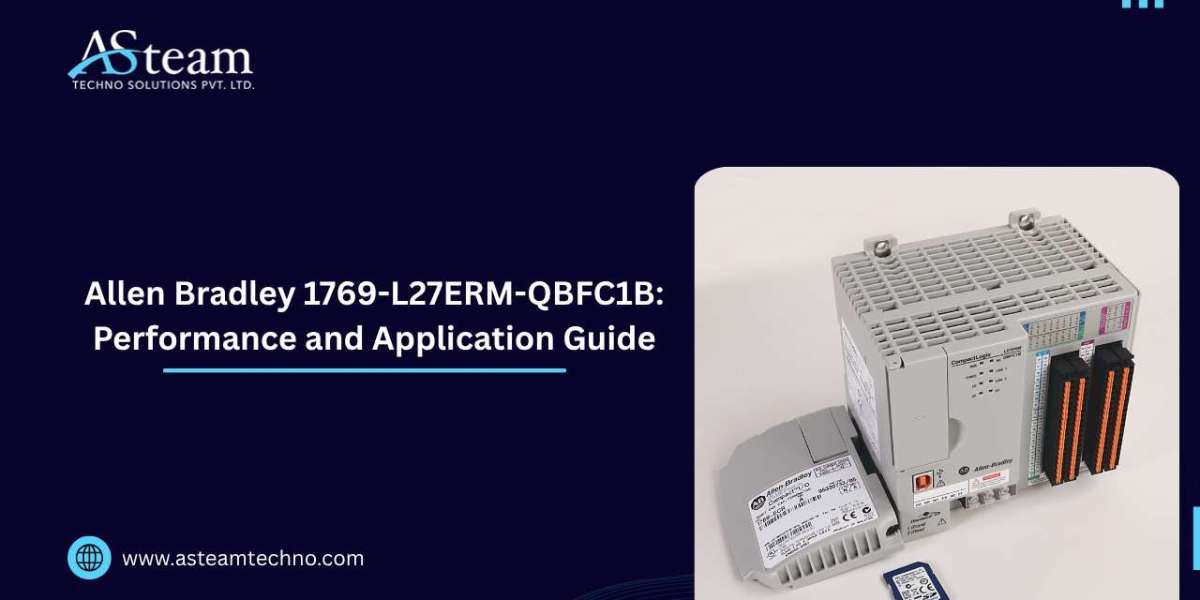

Industrial automation systems require PLCs that can process control logic efficiently, communicate reliably with field devices, and handle expanding I/O requirements. The Allen-Bradley 1769-L30ER is a CompactLogix 5370 L3 controller designed for small- to medium-sized automation applications where dependable control and networking are essential. It provides 1 MB of user memory, dual EtherNet/IP ports with Device Level Ring (DLR) capability, support for up to eight local I/O expansion modules, and connectivity for up to 16 EtherNet/IP nodes.
But how exactly does this controller contribute to better PLC performance? Its combination of processing resources, networking capabilities, flexible I/O expansion, and integrated control architecture helps engineers develop responsive and scalable automation systems.
1. Efficient Processing for Control Applications
PLC performance depends heavily on how efficiently a controller executes application logic. The Allen-Bradley 1769-L30ER provides 1 MB of user memory, allowing engineers to accommodate control programs, tags, and application data within a compact controller platform. It also supports up to 32 controller tasks and up to 100 programs per task, providing flexibility for organizing complex control applications.
By separating application functions into appropriate tasks and programs, engineers can structure machine logic more efficiently. This can make troubleshooting easier and help applications maintain predictable execution behavior.
2. Faster and More Flexible EtherNet/IP Communication
Communication performance is another major factor affecting PLC operation. The Allen-Bradley 1769-L30ER includes dual embedded EtherNet/IP ports and supports Device Level Ring topology. This allows the controller to communicate with multiple industrial devices without requiring a separate communication module for basic EtherNet/IP connectivity.
The controller supports up to 16 EtherNet/IP nodes, making it suitable for applications containing distributed I/O, HMIs, drives, and other networked automation equipment. Efficient network communication can reduce unnecessary delays between the controller and connected devices.
The controller's EtherNet/IP architecture also supports connections and messaging for I/O, HMI, and other control-system communication requirements.
3. Improved Network Reliability With DLR
Unexpected network interruptions can affect machine availability and overall PLC performance. The 1769-L30ER supports Device Level Ring (DLR), a network topology designed for industrial Ethernet environments.
DLR can provide a resilient network structure for compatible devices. If a connection in the ring is interrupted, network traffic can be redirected through the other side of the ring. This can help reduce the impact of a single network-cable failure and improve system availability.
For manufacturing lines where continuous communication is important, this capability can be particularly valuable.
4. Scalable Local I/O Expansion
A controller should be able to grow with an automation application. The Allen-Bradley 1769-L30ER supports up to eight 1769 Compact I/O expansion modules. Its specifications also indicate support for up to 256 local expansion I/O points.
This flexibility allows engineers to add appropriate digital, analog, or specialty I/O modules as machine requirements change. Instead of replacing the controller when additional I/O is needed, the system can be expanded within the controller's supported architecture.
This scalability can help maintain efficient system design while reducing unnecessary hardware changes.
5. Better Integration With Automation Devices
Modern PLC systems rarely operate independently. Controllers typically exchange information with HMIs, drives, remote I/O, sensors, and other intelligent devices. The Allen-Bradley 1769-L30ER uses integrated EtherNet/IP connectivity to support this type of connected architecture.
For example, an HMI can exchange operational data with the controller while networked I/O and other devices provide machine feedback. Keeping these devices connected through an industrial Ethernet infrastructure can simplify system architecture and reduce the need for additional communication hardware.
6. Compact Architecture for Efficient Control Systems
Physical system design also influences automation efficiency. The 1769-L30ER has a compact package measuring approximately 55 mm wide, 118 mm high, and 105 mm deep.
Its compact design makes it practical for control panels where available space is limited. At the same time, its local expansion capability allows engineers to build a reasonably capable control system without using a large controller platform.
Conclusion
The Allen-Bradley 1769-L30ER improves PLC performance by combining processing flexibility, integrated EtherNet/IP communication, network resilience, and scalable I/O expansion in a compact controller. Its 1 MB memory, support for 32 controller tasks, dual Ethernet ports, DLR capability, and support for up to eight local expansion modules make it well suited to many small- and medium-sized industrial automation applications.
For engineers designing an automation system, performance is not simply about processor speed. Reliable communication, efficient program organization, expandable I/O, and network architecture all contribute to how effectively a PLC-based system operates. By bringing these capabilities together, the 1769-L30ER provides a practical platform for developing dependable and scalable industrial control applications.
FAQs
1. What is the Allen-Bradley 1769-L30ER?
The Allen-Bradley 1769-L30ER is a CompactLogix 5370 L3 programmable controller with 1 MB of user memory, dual EtherNet/IP ports, DLR capability, and support for up to eight local I/O expansion modules.
2. How much memory does the 1769-L30ER have?
The 1769-L30ER provides 1 MB of user memory, which can be used for application programs and controller data.
3. Does the 1769-L30ER support EtherNet/IP?
Yes. The controller features dual embedded EtherNet/IP ports and supports up to 16 EtherNet/IP nodes.
4. How many I/O modules can the 1769-L30ER support?
The controller supports up to eight 1769 Compact I/O expansion modules, providing flexibility for expanding an automation system.
5. Can the 1769-L30ER improve network reliability?
Yes. Its support for Device Level Ring (DLR) can provide a resilient Ethernet network architecture for compatible industrial devices, helping reduce the impact of certain network connection failures.
Reach Us
Looking for a reliable industrial automation partner? Asteam Techno Solutions Pvt. Ltd. helps manufacturers, OEMs, system integrators, and industrial businesses streamline operations with advanced automation solutions and expert technical support.
As an AVEVA (formerly Wonderware) Registered System Integrator, we specialize in HMI/SCADA, Historian, MES, PLC, VFD, HMI, Panel PC, industrial networking, and control system solutions. Our team delivers end-to-end support, from product selection and system design to implementation and after-sales service.
Whether you need a single automation component or a complete industrial automation solution, we are ready to help you reduce downtime, improve productivity, and optimize operational efficiency.
Contact our experts today for product availability, technical consultation, pricing, or project support. : contact@asteamtechno.com