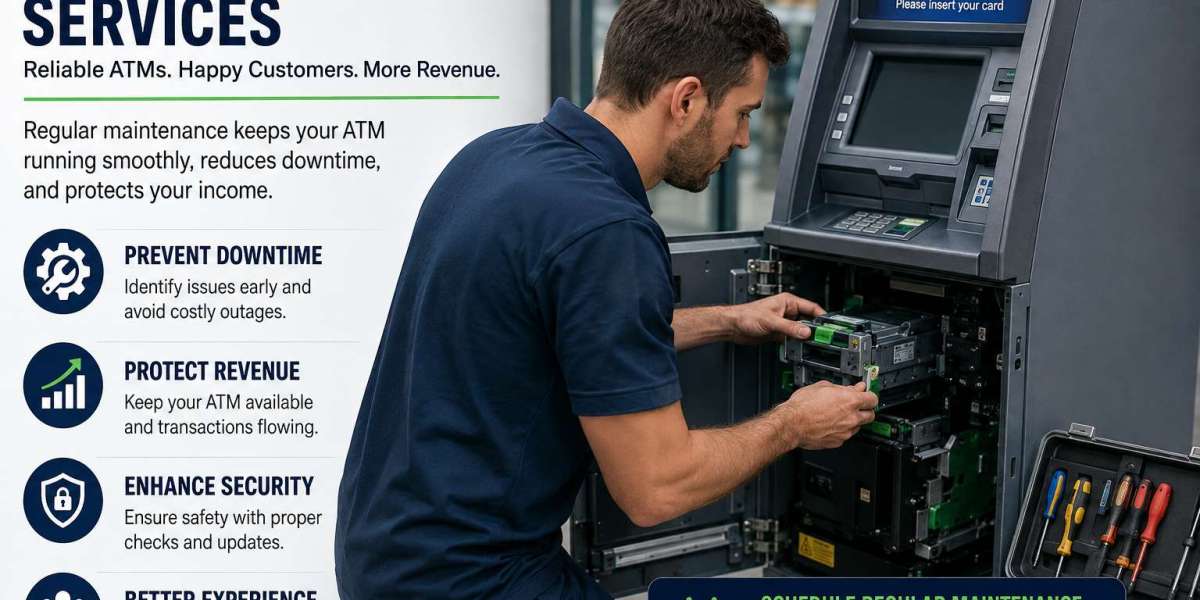

An ATM is more than a machine that dispenses cash. For businesses that operate ATMs, it is a customer-service tool, a potential source of transaction revenue, and an important part of the overall payment experience. When an ATM stops working because of a card-reader issue, cash dispenser fault, software problem, network failure, or neglected component, the result can be frustrated customers, missed transactions, service calls, and lost revenue.
That is why ATM maintenance services should be treated as an ongoing operational requirement rather than something to consider only after a machine breaks down. Regular inspections and preventive servicing can identify developing problems before they become major failures, while professional ATM machine maintenance helps keep hardware, software, security features, and transaction functions operating reliably.
For businesses that depend on ATM availability, the objective is simple: prevent avoidable downtime, extend equipment life, maintain a secure transaction environment, and provide customers with a dependable machine whenever they need cash.
What Are ATM Maintenance Services?
ATM maintenance services are the preventive and corrective activities performed to keep an automated teller machine functioning safely, reliably, and efficiently.
Depending on the machine, service provider, and operating environment, maintenance may include:
Cleaning internal and external ATM components
Inspecting card readers and card-entry mechanisms
Testing the cash dispenser
Checking receipt printers
Inspecting the display and keypad
Examining power supplies and connections
Testing network and communication components
Checking sensors and door mechanisms
Reviewing software and error logs
Inspecting security-related components
Replacing worn or failing parts
Performing diagnostic tests
Responding to equipment faults
Testing the machine after repairs
Preventive maintenance is particularly important because some ATM failures develop gradually. A card reader may begin producing intermittent errors before failing completely. A receipt printer can show signs of paper-feed problems before becoming unusable. Likewise, repeated cash-dispensing errors may indicate a component that needs attention rather than an isolated transaction problem.
A structured maintenance program helps operators identify these warning signs early.
Why Regular ATM Machine Maintenance Matters
The cost of an ATM problem is not limited to the repair bill. A machine that remains unavailable can affect customer satisfaction, transaction volume, and the perceived reliability of the business hosting it.
Regular ATM machine maintenance addresses several important operational risks.
1. It Reduces Unexpected Downtime
Preventive servicing allows technicians to identify worn components, connection problems, recurring errors, and other issues before they cause a complete outage.
For example, suppose an ATM begins experiencing occasional card-reader errors. Ignoring the issue may eventually result in a machine that cannot accept cards at all. Identifying the problem during a scheduled inspection can potentially prevent a much longer service interruption.
The goal of maintenance is not to guarantee that an ATM will never fail. No mechanical or electronic system can provide that guarantee. Instead, effective maintenance reduces preventable failures and helps operators respond more quickly when problems occur.
2. It Protects Transaction Revenue
For businesses that earn revenue from ATM transactions, availability directly affects the machine's ability to generate transactions.
If an ATM is unavailable during a busy period, customers may simply use another machine. The business may lose the transaction opportunity, while the customer may also become less likely to rely on that ATM in the future.
Regular servicing helps keep the machine operational and reduces the likelihood that a preventable technical problem will interrupt revenue-generating activity.
3. It Extends Equipment Life
ATMs contain numerous mechanical and electronic components that experience regular use. Cleaning, inspection, adjustment, and timely replacement of worn parts can help prevent small issues from causing additional component damage.
Good maintenance can therefore support a longer useful operating life, although the actual lifespan of an ATM depends on its model, usage, environment, parts availability, software support, and maintenance history.
4. It Improves the Customer Experience
Customers expect an ATM to work when they approach it.
A failed card reader, unreadable display, jammed cash dispenser, or malfunctioning receipt printer can turn a routine transaction into a frustrating experience.
A well-maintained ATM is more likely to provide:
Consistent transaction processing
Reliable card acceptance
Accurate cash dispensing
Functional receipt printing
Responsive controls
Clear transaction instructions
A clean and professional appearance
For a business hosting an ATM, that reliability can contribute to a better overall customer experience.
What Is Included in Professional ATM Maintenance?
The exact scope varies by ATM model and service agreement, but a comprehensive maintenance program should look beyond simply restarting a machine when it goes offline.