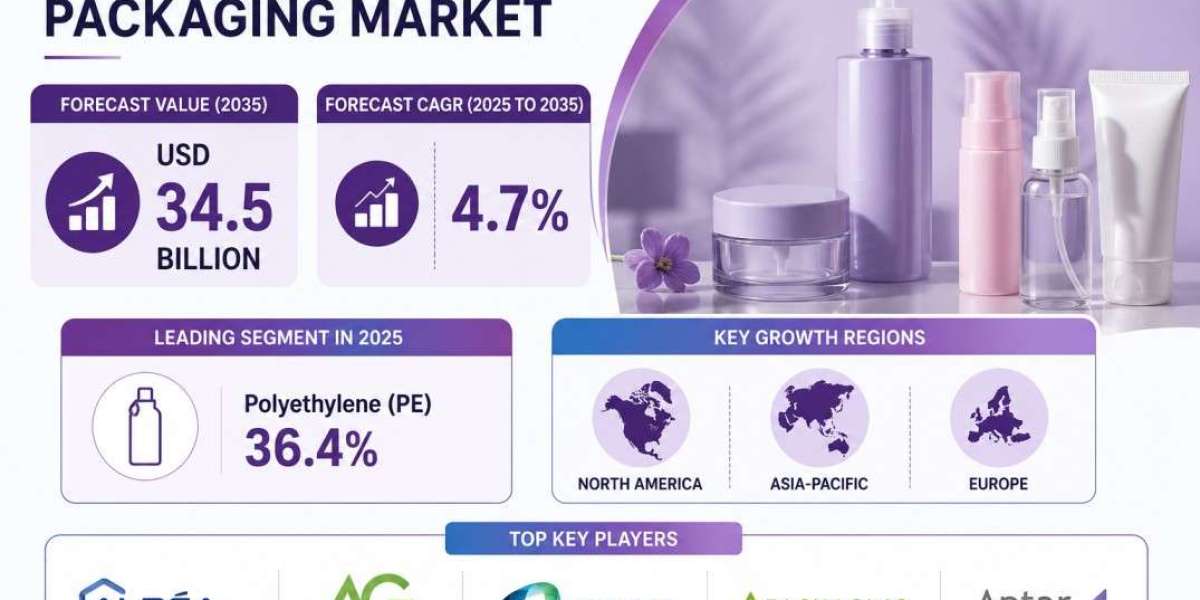

The cosmetic plastic packaging market is projected to increase from USD 21.8 billion in 2025 to USD 34.5 billion by 2035, advancing at a 4.7% CAGR during the forecast period. The market is expected to add USD 12.7 billion over the decade as beauty and personal care brands increase their use of lightweight, durable and design-focused packaging.
The growth reflects rising demand for skincare, haircare, makeup and other personal care products. Packaging plays a direct role in product protection, hygiene, portability and shelf presentation, while e-commerce and social media are increasing the importance of visually distinctive formats.
Get Access of Report Sample: https://www.futuremarketinsights.com/reports/sample/rep-gb-24868
Cosmetic Plastic Packaging Market Growth Supported by Beauty Demand
The market is expected to follow a steady growth path. Market value is projected to rise from USD 21.8 billion in 2025 to USD 22.8 billion in 2026 and reach USD 25 billion by 2028. Consumer preference for convenient and visually appealing packaging is supporting this expansion. Plastic remains widely used because it combines lightweight construction with molding flexibility, allowing manufacturers to produce bottles, tubes, jars, containers, pumps and closures in varied shapes and sizes.
Cosmetic plastic packaging is a packaging category that supplies bottles, tubes, jars, containers, pumps, dispensers, caps and closures for beauty and personal care products.
The shift toward sustainable packaging is also influencing material development. Brands are increasingly evaluating recyclable plastics, post-consumer resin technologies, refillable formats and reusable containers as they respond to changing consumer expectations and packaging regulations.
Polyethylene Leads the Cosmetic Plastic Packaging Market
Polyethylene (PE) is projected to account for 36.4% of the market in 2025, making it the leading material segment. PE is widely used because of its flexibility, durability, moisture resistance and chemical resistance.
The material can also be molded into complex shapes, supporting packaging designs used by mass-market and premium cosmetic brands. Growing interest in recycled PE provides another avenue for manufacturers seeking to align packaging materials with circular economy objectives.
Bottles are forecast to lead the product type segment with a 29.7% share in 2025. Their versatility supports applications across creams, lotions, serums and liquid cosmetics. Pump, spray and dropper compatibility also allows brands to address dosing and convenience requirements.
Skin care is expected to represent the largest application category, accounting for 33.1% of the market in 2025. Cleansers, moisturizers, serums and sunscreens require packaging that supports hygiene, product preservation and controlled dispensing.
Sustainable and Refillable Formats Create New Opportunities
Sustainability is becoming an important development area for cosmetic packaging manufacturers. Recyclable plastics, refillable containers and modular designs are gaining attention across premium and mass-market product categories.
Refillable packaging can support repeat purchasing while reducing the need for complete container replacement. Manufacturers are also developing dispensing systems, airtight containers and multi-functional formats that combine product protection with consumer convenience.
Personalization is another notable trend. Cosmetic brands are using custom printing, distinctive shapes, color variations and premium finishes to strengthen product differentiation.
Smart packaging is also emerging. QR codes and NFC technologies can support authentication and consumer engagement, giving packaging an expanded role beyond product containment.
Asia-Pacific Strengthens Market Expansion
China is projected to record the fastest growth among the major markets covered, with a 6.3% CAGR from 2025 to 2035. Rising disposable incomes, online beauty retail and demand for skincare and luxury cosmetics are supporting packaging consumption.
India follows with a 5.9% CAGR, supported by expanding beauty, personal care and wellness industries. Urban retail growth and e-commerce are increasing demand for lightweight and visually appealing packaging.
Germany is forecast to grow at 5.4% CAGR, while France is projected to advance at 4.9% CAGR. The United Kingdom is expected to record a 4.5% CAGR, supported by premium personal care and online retail.
The USA is forecast to grow at 4.0% CAGR, with demand supported by luxury cosmetics, personal care products, e-commerce and innovation in dispensing systems.
Market Faces Material Cost and Compliance Challenges
Despite steady expansion, cosmetic plastic packaging manufacturers face higher raw material costs, particularly for specialty polymers and high-quality plastics. Premium sustainable formats can also carry additional costs, potentially limiting adoption among price-sensitive brands.
Regulatory requirements create another challenge. Safety, recyclability and chemical migration requirements vary across markets, increasing compliance demands for packaging producers serving international customers.
Manufacturing intricate designs and multi-component formats can also require tighter quality control. Producers therefore need to balance design flexibility with consistent manufacturing performance and cost efficiency.
Get Access of Report Sample: https://www.futuremarketinsights.com/reports/sample/rep-gb-24868
Competitive Landscape
The competitive landscape includes Albea, AG Poly Packs, Amcor, APackaging Group, Aptar Group, Berry Global, Blakelin Plastics, Cosmopacks, Gerresheimer, Green Earth Packaging, Guangzhou Keyuan Plasticware, Harman Packaging, Jarsking, Libocosmetics, Plastoworld India, Prempac, Silgan Holdings, Smurfit Kappa, Vimal Plastics, Visonpack, and Weltrade.
Companies are competing through material innovation, packaging customization, dispensing technology and sustainable product development.
Albea emphasizes modular and customizable packaging formats, while Amcor focuses on packaging performance, barrier properties and sustainability. Aptar Group competes through pumps, sprays and dispensing systems designed around consumer convenience and product preservation.
Regional suppliers are also expanding their roles. Guangzhou Keyuan Plasticware, Jarsking and Vimal Plastics focus on scalable manufacturing and cost-efficient solutions, while specialized suppliers continue to develop packaging formats for premium and mass-market cosmetic brands.
Market Outlook
The cosmetic plastic packaging market is projected to reach USD 34.5 billion by 2035, rising from USD 21.8 billion in 2025 at a 4.7% CAGR.
Demand will remain closely connected to growth in skincare, haircare, fragrances and personal care products. At the same time, recyclable materials, refillable formats, personalized designs and smart packaging technologies are expected to influence product development.
For packaging suppliers, the opportunity will depend on combining visual differentiation with product protection, consumer convenience and evolving sustainability requirements.
Why FMI: https://www.futuremarketinsights.com/why-fmi
Have a Look at Related Research Reports on the Packaging Domain:
Labels Market: https://www.futuremarketinsights.com/reports/labels-market
Specialty Tin Cans Market: https://www.futuremarketinsights.com/reports/specialty-tin-cans-market
Multi Pocket Holders Market: https://www.futuremarketinsights.com/reports/multi-pocket-holders-market
Contact Us:
Future Market Insights Inc.
Christiana Corporate, 200 Continental Drive,
Suite 401, Newark, Delaware - 19713, USA
T: +1-347-918-3531
For Sales Enquiries: sales@futuremarketinsights.com
Website: https://www.futuremarketinsights.com
About Future Market Insights (FMI)
Future Market Insights, Inc. (FMI) is an ESOMAR-certified, ISO 9001:2015 market research and consulting organization, trusted by Fortune 500 clients and global enterprises. With operations in the U.S., UK, India, and Dubai, FMI provides data-backed insights and strategic intelligence across 30+ industries and 1200 markets worldwide.