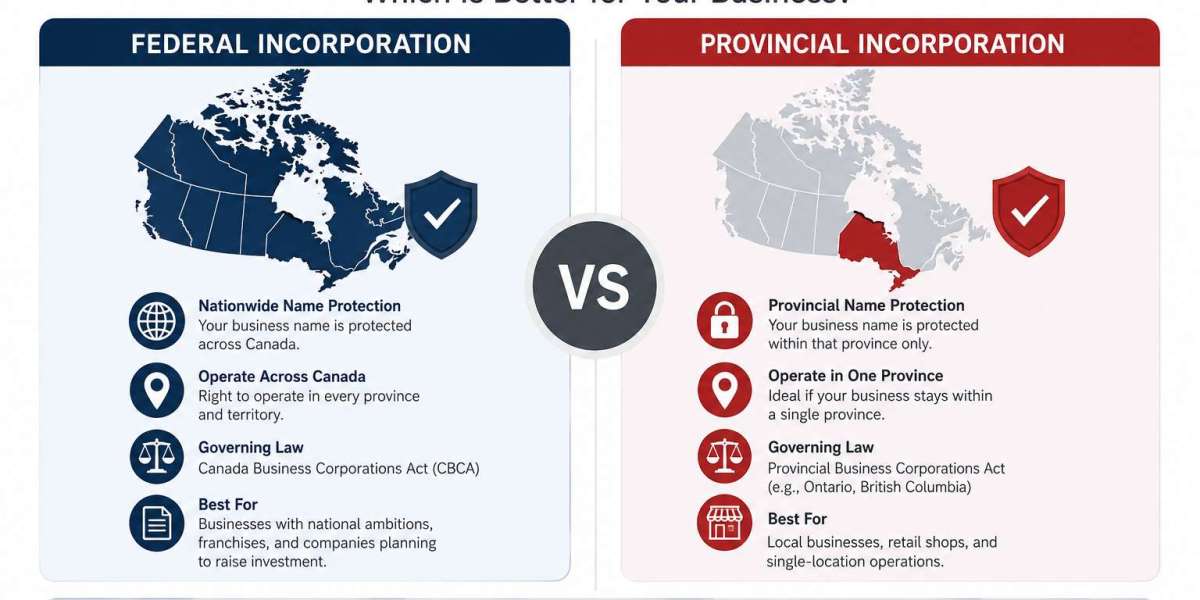

Choosing between federal vs provincial incorporatio n is one of the first major legal decisions a Canadian business owner has to make, and it shapes everything from name protection to where you can operate. Both routes create a legally recognized corporation, but they differ in scope, cost, and administrative requirements. This guide breaks down how federal incorporation Canada compares to provincial incorporation , so you can decide which structure fits your business plans.
What Is the Difference Between Federal and Provincial Incorporation?
Federal incorporation registers your business under the Canada Business Corporations Act (CBCA), giving you the right to operate under your corporate name in every province and territory. Provincial incorporation registers your business under the corporate statute of a single province, such as Ontario's Business Corporations Act or British Columbia's Business Corporations Act, and generally limits strong name protection to that province.
Both structures give you limited liability, a separate legal entity, and access to corporate tax rates. The real differences show up in name protection, extra-provincial registration requirements, and administrative overhead.
Name Protection: A Key Factor When You Incorporate Federally or Provincially
One of the biggest reasons businesses choose to incorporate federally or provincially comes down to name protection.
- Federal incorporation grants your corporate name a higher degree of protection across Canada, making it harder for another business to register an identical or confusingly similar name in any province.
- Provincial incorporation only protects your name within that province's corporate registry, so a similarly named business could incorporate in another province without conflict.
If brand consistency across the country matters to you, federal incorporation offers a meaningful advantage here.
Where You Plan to Operate Matters
Operating in One Province
If your business will only ever operate, hire, and sell within a single province, provincial incorporation is often simpler and less expensive. You avoid the extra step of registering as an extra-provincial corporation, and you deal with only one regulatory body for ongoing compliance.
Operating Across Multiple Provinces
If you plan to expand into other provinces, federal incorporation can save you administrative headaches later. However, it's important to understand a common misconception: federal incorporation does not eliminate provincial registration . A federally incorporated business must still register as an extra-provincial corporation in each province where it carries on business, though this process is typically straightforward once the federal charter is in place.
Cost and Administrative Considerations
Incorporation Fees
Provincial incorporation fees vary by province and are sometimes lower than federal incorporation fees, though this isn't universal. Federal incorporation carries its own government filing fee, separate from any provincial extra-provincial registration fees you may need to pay afterward.
Ongoing Compliance
Both federal and provincial corporations must file annual returns and maintain corporate records, including a registered office address, director and shareholder information, and minute books. Federally incorporated businesses file an annual return with Corporations Canada, while provincially incorporated businesses file with their respective provincial registry. If you register extra-provincially, you'll typically have annual filing obligations in each of those provinces as well, which can add complexity for federally incorporated companies operating nationally.
Which Structure Suits Different Types of Businesses?
Local service businesses, retail shops, and single-location operations often find provincial incorporation sufficient. The lower complexity and narrower regulatory scope align well with a business that isn't planning rapid multi-province growth.
Businesses with national ambitions, franchises, and companies planning to raise investment from across Canada frequently lean toward federal incorporation. The stronger name protection and consistent legal recognition across provinces support long-term brand building and can simplify conversations with investors or partners located outside your home province.
Professional corporations (law, accounting, medicine, and similar regulated professions) are usually required to incorporate provincially, since these professions are governed by provincial regulatory bodies rather than federal statute.
Practical Guidance for Making the Decision
Before you incorporate federally or provincially, consider asking yourself:
- Will my business operate in more than one province within the next few years?
- How important is exclusive use of my business name across Canada?
- Am I in a regulated profession with provincial licensing requirements?
- What's my budget for incorporation and ongoing extra-provincial registration fees?
- Do I plan to seek investment from parties outside my home province?
Answering these honestly will usually point clearly towards one structure or the other. Many small, single-province businesses start with provincial incorporation and later transition to federal incorporation if their growth plans expand — this transition, called continuance, is a recognized legal process available under Canadian corporate law.
Conclusion
There's no universally "better" choice between federal vs provincial incorporation — the right answer depends on where you operate, how much name protection you need, and your growth trajectory. Provincial incorporation suits businesses staying within one province, while federal incorporation benefits companies with national ambitions or strong brand protection needs. Whichever path you choose, consulting a corporate lawyer or accountant familiar with your specific province's requirements can help you avoid costly missteps.
Frequently Asked Questions
Is federal incorporation more expensive than provincial incorporation?
Federal incorporation fees are often comparable to provincial fees, but if you operate in multiple provinces, you'll also pay extra-provincial registration fees in each one, which can make federal incorporation more costly overall for multi-province businesses.
Can I switch from provincial to federal incorporation later?
Yes, this process is called continuance, and it allows an existing provincial corporation to become a federal corporation (or vice versa) without dissolving and re-forming the business.
Do I need federal incorporation to do business in another province?
No, but if you're provincially incorporated and want to operate in another province, you'll need to register there as an extra-provincial corporation, similar to what a federal corporation must do.