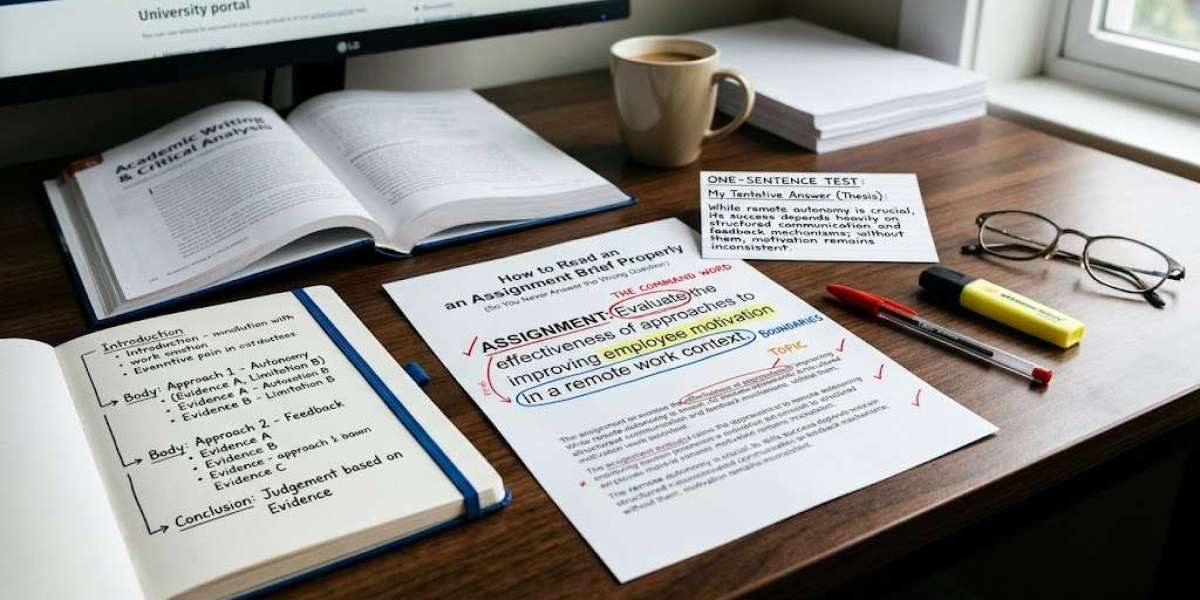

Ever finished an essay, felt genuinely proud of it… and then got a grade that made no sense?
You did the reading. You took solid notes. You know the topic better than half the class. And yet the feedback says something like "doesn't fully address the question" or "descriptive rather than analytical."
Here's the uncomfortable truth: that's not a writing problem. It's a reading problem.
Somewhere between opening the brief and typing your first paragraph, you answered a slightly different question than the one your tutor actually asked. And here's the part almost nobody talks about you can write a flawless, well-referenced, confidently argued essay… on the wrong question entirely.
Let's fix that, for good.
The One Word That Quietly Wrecks Essays
Most students read a brief and lock onto the topic first. Employee motivation. Climate policy. AI in healthcare. Whatever it is, they start Googling and note-taking immediately.
That instinct isn't wrong it's just incomplete.
Because buried in that same sentence is a much more important word, one that quietly decides your entire grade: the command word.
Look at these two questions side by side:
- "Explain the factors that influence employee motivation."
- "Evaluate the effectiveness of approaches to improving employee motivation."
Same topic. Completely different job. One wants you to explain. The other wants you to judge, weigh evidence, and take a position. Miss that distinction and you can write two thousand well-researched words that still miss the mark.
Explain, describe, analyse, compare, assess, evaluate these are not synonyms. They're instructions. Learn to spot them before you open a single source, because everything else in your essay flows from that one word.
And don't stop there. Briefs often hide extra boundaries too a specific company, time period, population, or theory you're meant to stick to. Step outside that fence, even accidentally, and you're no longer answering the question that was actually set.
Why Knowing "Too Much" Can Backfire
Here's a twist nobody warns you about: the more you know about a subject, the easier it becomes to drift off-topic.
The deeper you dig, the more you find another study, another angle, another theory worth mentioning. Your essay grows. It feels productive. But quantity of information is not the same as relevance to the question.
This shows up constantly in essays that are asked to evaluate something. You might write three beautifully accurate paragraphs describing what an approach is and where it came from and still never actually answer whether it works.
So here's a sharper question to ask yourself every time you write a paragraph:
"Does this sentence move me closer to answering the actual question or does it just sound relevant?"
If you can't answer that clearly, you've probably found background information that's overstayed its welcome.
Let the Marking Criteria Do the Talking
Most students read the question and skip straight past the marking rubric. Big mistake the rubric is basically the answer key to how you should structure your response.
If "critical analysis" and "application of theory" carry serious weight in the criteria, but your plan is four pages of context and one rushed paragraph of actual analysis, that imbalance will show up in your grade before your tutor even finishes reading.
A trick that works every time: lay your planned sections next to the marking criteria. If a heavily weighted criterion barely appears anywhere in your outline, that's your early warning sign catch it now, not after submission.
The same logic applies to research. Finding ten sources that all say the same thing isn't progress. Three sources that let you genuinely test an argument are worth more than a stack of repetition. A good source should do one of four jobs: set context, support a claim, provide evidence, or challenge an assumption. If it isn't doing one of those, it's just noise.
This applies even when looking through commercial search terms or external study materials; typing Buy Academic Assignments UK into a search bar might yield endless sample papers or topic guides, but those raw resources will never tell you how to address your specific rubric.
Build Your Structure Around the Answer, Not the Topic
Don't start planning by picking seven impressive headings. Start by asking: based on what I know so far, what do I think the answer actually is?
That answer is allowed to change completely once you start researching in fact, it should be tested, not just confirmed. But having a rough position gives your reading a target instead of letting it wander.
Try this simple stress test on your plan: remove one section and see what breaks.
- If nothing changes, that section probably wasn't earning its place.
- If removing it leaves a hole in your argument, it was doing real work.
A plan covered in detailed headings can look thorough while hiding a shallow argument underneath. Structure should follow thinking, not decoration.
The Silent Mistakes That Cause Essays to Drift
Most essays don't go wrong in one dramatic moment they drift, slowly, one interesting tangent at a time.
A few drift-traps worth knowing by name:
- Mistaking "critical" for "negative." Critical thinking isn't complaining about a theory's flaws. It's weighing where an argument holds up, where it doesn't, and why one explanation is more convincing than another under specific conditions.
- Confusing complex language with complex thinking. A sentence stuffed with "this highlights the significance of…" can say almost nothing. One plain sentence explaining why a piece of evidence changes an argument usually does more intellectual heavy lifting than an entire paragraph of academic-sounding filler.
- Refusing to cut research you enjoyed finding. If you spent an afternoon reading six papers, deleting three from your final draft can feel wasteful. It isn't. Research exists to help you decide what belongs not to be displayed in full.
The One-Sentence Test That Exposes Confusion Instantly
Here's the single most useful trick in this entire guide, and it takes thirty seconds.
Before you write your essay, write one sentence that actually answers the question.
Not "This essay will discuss…" that's a description of your plan, not an answer.
Give the real answer. If you're evaluating an approach, your sentence might be: "It works well under specific conditions, but the evidence weakens once you factor in X." If you're comparing two theories, it might be: "Theory A explains the short-term pattern better, but Theory B accounts for variables the first one ignores."
If you can't write that sentence, you don't fully understand the question yet and no amount of confident writing will fix that. Figure this out before you write three thousand words around a guess.
The Final Check: Read Your Draft Against the Original Question
Before you submit anything, place your finished draft next to the original brief and read them together, section by section.
Ask honestly:
- Where have I actually answered the question, and where have I just explained the topic?
- Is my evidence supporting an argument, or just sitting there because it's technically relevant?
- Has my conclusion earned itself, or did I just declare it?
You'll probably find at least one paragraph you're proud of that simply doesn't belong. Cut it anyway. A beautifully written paragraph that answers the wrong question is still wrong no matter how good the sentences sound.
The Bottom Line
Every strong assignment has the same quiet fingerprint: you can tell exactly what question it's answering, even without the question printed at the top of the page.
The command word tells you what kind of thinking is required. The marking criteria tell you what that thinking needs to prove. The research gives you the evidence to prove it. And the one-sentence test tells you, before you've wasted a single hour, whether you actually understood the assignment in the first place.
Master that sequence once, and you'll never again write a great essay that answers the wrong question.