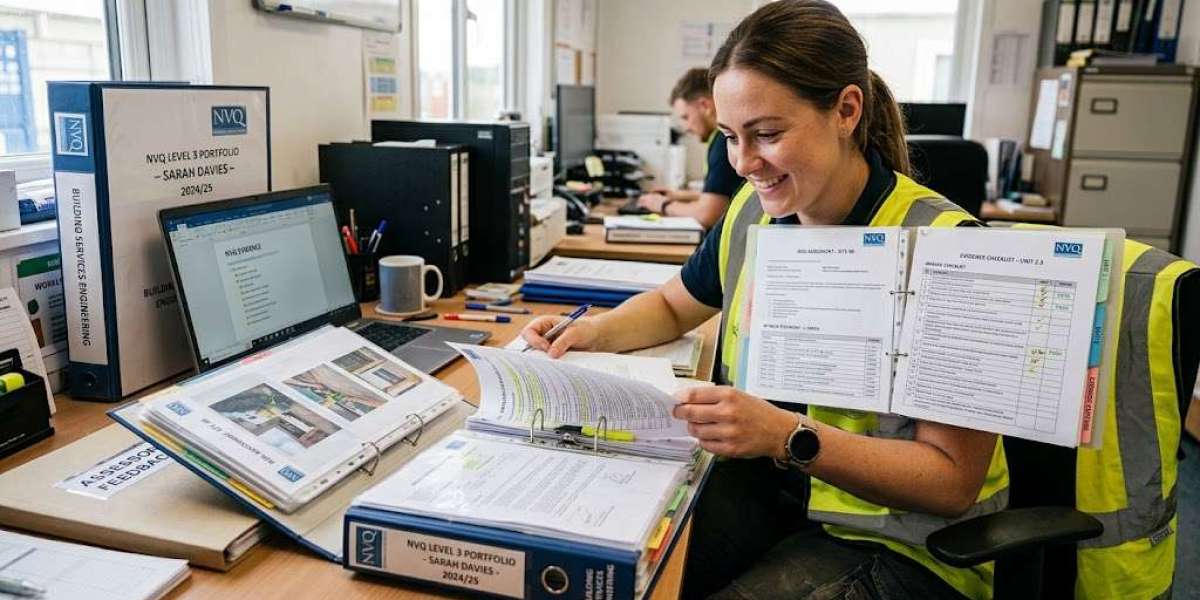

Here's the thing nobody tells you when you sign up for an NVQ: it isn't a writing test. You could be the best writer in your building, string together the most eloquent paragraph anyone's ever read, and it still won't save you if you can't prove you did the work. Assessors aren't grading your prose. They're checking one thing and one thing only did you perform to the national standard, on the job, for real?
That single fact trips up more candidates than any tricky unit or confusing criterion ever will. Not because people lack the skill. Most candidates are already doing the job competently, day in and day out. The problem is translation turning what happens at your desk, on your site, or in your meetings into something an assessor can actually put a tick against.
Let's fix that.
Competence Isn't Something You Describe. It's Something You Prove.
If you came into this expecting something like coursework, unlearn that fast. Summarizing a policy or explaining what "should" happen in a textbook scenario gets you nowhere. Assessors want primary evidence the raw, unedited proof that you personally did the thing, to standard, without anyone dressing it up for you.
That means things like:
- Direct observations from your assessor
- Signed witness statements from your manager or supervisor
- Logs, registers, risk assessments the paperwork you'd be producing anyway
- Redacted emails and correspondence from your actual working week
Reflective accounts and professional discussions still matter, but think of them as the glue, not the evidence itself. Their job is to connect the dots between the documents and explain why you did what you did. Once you separate these two categories in your head proof versus explanation the whole process gets a lot less overwhelming.
Why So Many Candidates Stall Out
There's a pattern that shows up again and again, and it has almost nothing to do with ability.
They try to gather evidence after the fact. Six months after a project wraps, you sit down to build your portfolio and realize the emails are archived, the logs are buried three folders deep in a shared drive, and you can't quite remember how you actually handled that one difficult conversation. Evidence has a shelf life. Wait too long and it evaporates.
They write pages with nothing behind them. A beautifully written account of how you handled a tense stakeholder meeting is worth very little on its own. Where's the agenda? The anonymous minutes? A line from your manager confirming you were the one running the room? Without something tangible attached, it's just a story.
Or they go the opposite direction and dump everything. Forty unlabelled PDFs with no explanation of what maps to what isn't diligence it's a burden you've handed to your assessor. If they can't see the connection between a document and a specific criterion in about five seconds, that unit is going straight back to you.
The fix for all three sits in the same place: capture as you go, and always show your working.
The Five Tests Every Piece of Evidence Has to Pass
Assessors run everything you submit through the same filter, usually called VACSR. Get familiar with it, because it decides what stays in your folder and what gets binned.
| Standard | What it's really asking |
|---|---|
| Validity | Does this sincerely match the outcome the unit is asking for? |
| Authenticity | Is this unmistakably your work, not your team's? |
| Currency | Is this recent, within your active registration period? |
| Sufficiency | Is one example enough, or do you need to show a pattern over time? |
| Reliability | Would this hold up as a fair, professional standard if repeated? |
A quick habit worth building: before you save anything into a unit folder, run it past these five questions. It takes ten seconds and saves you from submitting evidence that looks fine but doesn't actually stand up.
Smart evidence selection also comes down to recognizing efficiency. Whether you are building files for health and safety units or assembling documentation across various Nvqs coursework , you don't need a separate file for every learning outcome. Big workplace moments, like chairing a cross-team meeting or steering a project through a tricky phase, often satisfy three or four units at once if you evidence them properly. Look for the moments that do double or triple duty before you go hunting for anything smaller.
Turning Your Actual Job Into Evidence, Without It Eating Your Life
Nobody has the time to treat portfolio-building like a second job, and you shouldn't have to. The trick is making evidence collection something that happens alongside your work, not after it.
Build a live index before you need it. Set up folders by unit number ahead of time. The moment you produce an email, a report, an audit sheet, or a schedule that fits a criterion, it goes straight in. No pile-up, no scramble later.
Annotate while it's still obvious to you. A document doesn't explain itself six months down the line, and it definitely won't explain itself to someone who's never set foot in your workplace. A short note "this section shows how I ran the site risk assessment against current safety regs" does more work than people realise.
Write your reflection while it's still fresh. Something happened Tuesday? Get the reflective account down by Thursday, not next month. Cover what happened, why you made the call you made, what policy or legislation shaped that decision, and how it actually played out.
Get sign-offs monthly, not annually. Don't leave witness statements until the end. Ask for them while the work is still recent in your manager's mind they'll remember the detail, and you won't be chasing three people for six months of signatures in one panicked week.
The Mistakes That Get Units Sent Straight Back
Writing in "we" instead of "I." Phrases like "we decided" or "the team handled it" hide exactly the thing an assessor needs to see your role. Rewrite everything in the active voice, and make your involvement unmissable: I reviewed the schedule. I chaired the meeting. I made the call on resourcing.
Forgetting to edit. Client names, financial figures, anything commercially sensitive none of it belongs in your portfolio unedited. It's not just a formatting issue; it's a data protection one, and assessors will bounce it back without hesitation. "Client A" and "Project X" exist for a reason use them.
Turning reflection into storytelling. A vivid account of a hectic afternoon is nice to read, but it isn’t evidence of competence unless you connect it back to why the policy, the legislation, the professional judgment behind the decision. Reflection without reasoning is just a diary entry.
The Cold-Read Test, Before You Hit Submit
Before you send a unit off, take a step back and read it as if you were a stranger someone who's never met you, never seen your workplace, and has no context beyond what's on the page.
Ask yourself:
- Can this stranger tell exactly what I did, just from the evidence attached?
- Have I explained my reasoning, especially for the moments that didn't go to plan?
- Is every reference to legislation or policy actually current and correct?
- Is it obvious which document supports which criterion, without me having to explain it out loud?
If the answer's yes across the board, you're not just ready to submit you've built something that'll hold up under real scrutiny, not just a quick skim.
The Bottom Line
An NVQ was never about proving you know the theory. It's about proving you can do the job, consistently, to standard, and show your working while you do it. Build the capture habit early, keep your annotations honest and specific, and tie every reflection back to something real and by the time submission rolls around, you won't be scrambling. The portfolio will already be sitting there, done.