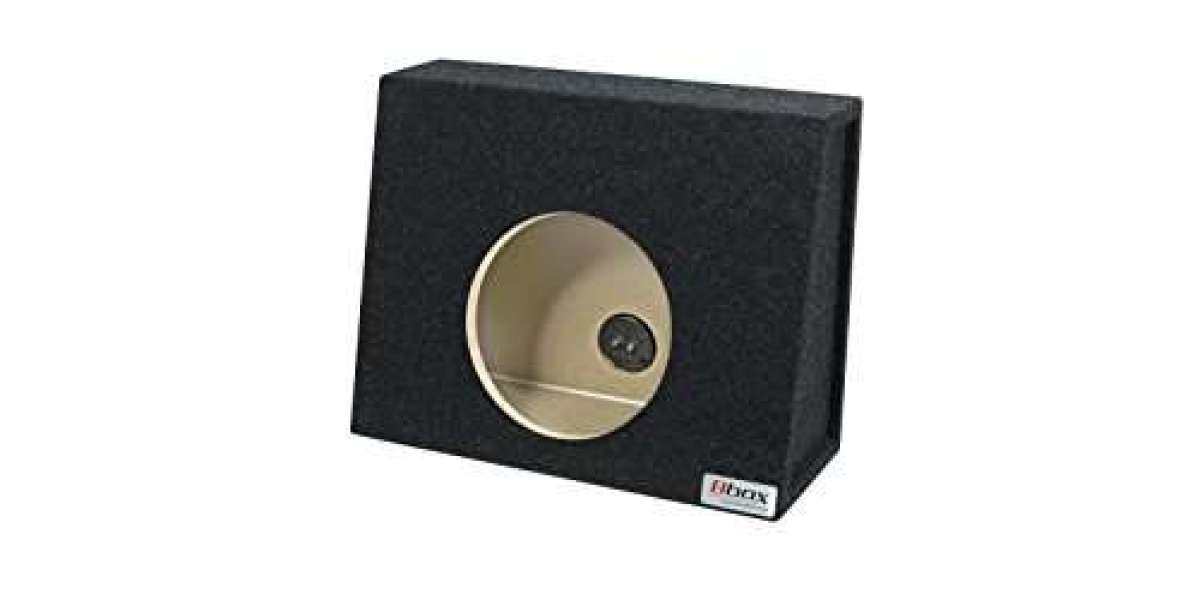

A sealed 12 inch subwoofer box can give a vehicle audio system a stronger low-frequency foundation without demanding the footprint of a large enclosure. Its enclosed design creates a controlled environment for the subwoofer, helping produce bass that feels deep, focused, and responsive. For drivers who want noticeable low-end impact while keeping the sound balanced, a properly matched sealed enclosure can be a practical upgrade.
The enclosure is more than a container for the woofer. Its internal air volume, construction quality, mounting surface, and overall dimensions influence how the subwoofer behaves. When those elements are matched to the driver's specifications, the result can be bass that integrates naturally with the rest of the system instead of simply adding overwhelming low-frequency volume.
This makes sealed designs especially interesting for daily-driven vehicles. Trunks, truck cabs, hatchbacks, and compact cargo areas often have limited room, so every inch matters. A thoughtfully selected enclosure can provide the desired bass response while preserving useful interior space.
What Gives a Sealed Enclosure Its Distinct Sound?
The defining feature of a sealed enclosure is its closed internal chamber. When the subwoofer cone moves, the air trapped inside the cabinet pushes back against that movement. This interaction helps control the driver's motion and contributes to the characteristic response associated with sealed designs.
Many listeners appreciate this approach because it can produce bass with a clean and controlled character. Rather than focusing only on maximum output, the design lends itself to accurate reproduction of individual low-frequency notes.
The actual result still depends on the subwoofer, enclosure volume, amplifier, vehicle acoustics, and tuning. The cabinet provides the environment, but the entire system determines how that environment ultimately sounds.
Choosing the Right 12-Inch Driver
A 12-inch subwoofer is not automatically compatible with every sealed cabinet designed for a 12-inch driver. Physical diameter is only one part of the equation.
Before selecting an enclosure, review the subwoofer manufacturer's recommended sealed enclosure volume and other installation requirements. Parameters such as mounting depth, cutout diameter, impedance, power handling, and mechanical clearance should all be considered.
A good match allows the driver and enclosure to work as a coordinated system. Choosing the box first and attempting to make an unrelated woofer fit afterward can lead to compromises that could have been avoided through proper planning.
Enclosure Volume Has a Direct Role
The amount of air inside the cabinet affects the mechanical environment surrounding the subwoofer. This means internal volume deserves careful attention rather than being treated as a secondary specification.
A box that is too large or too small for a particular driver can alter the intended response. Manufacturers provide enclosure recommendations for a reason, and those figures should be used as a starting point when planning an installation.
Remember that usable internal volume is different from the enclosure's outside dimensions. Wall thickness, bracing, terminals, and the space occupied by the driver can all affect the actual air volume available inside the cabinet.
Compact Doesn't Mean Compromised
One of the practical benefits of a sealed design is its ability to deliver useful bass without requiring a ported enclosure and its associated tuning space. This can make it easier to integrate into vehicles where cargo capacity is important.
For a truck owner, the available area behind or beneath seating may be limited. In a sedan, trunk space can be equally valuable. An appropriately sized sealed cabinet allows the system designer to work within those physical boundaries rather than sacrificing everyday usability.
A successful installation should leave enough clearance for passengers, storage, vehicle components, and routine access. Audio performance is important, but the enclosure also has to make sense in the environment where it will be used.
Strong Construction Supports Consistent Performance
Subwoofers generate substantial mechanical movement. The enclosure needs to remain rigid while the driver is operating so that unwanted cabinet movement does not become part of the problem.
Quality panel construction, secure joints, appropriate reinforcement, and a stable mounting surface all contribute to a dependable enclosure. A cabinet that flexes, separates, or develops loose components over time can introduce unwanted noise and reduce confidence in the installation.
Durability is particularly important in vehicles because the enclosure is exposed to vibration, temperature changes, road impacts, and everyday movement. A well-built box should be able to handle those conditions without compromising its structural integrity.
An Airtight Cabinet Matters
A sealed enclosure depends on maintaining a closed air chamber. Even relatively small leaks around seams, terminals, or the subwoofer mounting area can affect the enclosure's intended behavior.
The driver should be mounted firmly, with appropriate sealing at the mounting interface. Cabinet joints should also be constructed carefully so that air is not escaping through unintended gaps.
This attention to detail may not be visible once the installation is complete, but it can make a meaningful difference to how effectively the enclosure performs its intended function.
Amplifier Matching Is Part of the Equation
A capable enclosure cannot compensate for an unsuitable amplifier setup. The amplifier should be compatible with the subwoofer's impedance and power requirements while providing clean, appropriately controlled output.
More power is not automatically better. Gain settings, signal quality, impedance, and amplifier capability all affect how the system behaves. An improperly configured amplifier can introduce distortion or place unnecessary stress on the subwoofer.
Instead of treating the amplifier as an afterthought, consider it part of the enclosure selection process. The driver, box, and amplifier should form a balanced combination.
Bass Precision Depends on the Entire Vehicle
A subwoofer does not operate in isolation from the cabin. The interior acts as an acoustic environment, with seats, panels, glass, carpeting, and other surfaces influencing how low frequencies travel and reflect.
Placement can therefore affect the perceived bass response. An enclosure that works well in one vehicle may produce a different result when installed in another because cabin dimensions and construction vary.
Experimenting with practical placement options can help determine where the enclosure integrates most effectively. Whatever location is chosen, the box should be secured firmly to prevent movement during acceleration, braking, cornering, or uneven road conditions.
Don't Ignore Interior Rattles
Increasing low-frequency output can expose noises that were barely noticeable with a factory system. Door trim, trunk panels, plastic clips, license plates, storage compartments, and other components may vibrate when exposed to stronger bass.
These noises can distract from an otherwise well-tuned system. Identifying and treating the specific source is usually more effective than simply turning the subwoofer down.
Targeted sound-deadening treatment can help control problematic panel vibration. The objective is not to cover every surface unnecessarily, but to address areas that contribute unwanted resonance or rattling.
Sealed and Ported Enclosures Serve Different Goals
Choosing between sealed and ported designs should begin with the desired listening experience and the requirements of the selected driver.
A sealed enclosure is often chosen when controlled response, compact packaging, and straightforward integration are priorities. A ported enclosure uses a tuned port to influence the system's low-frequency response and can be appropriate when a different balance of output and efficiency is desired.
Neither approach automatically suits every listener or vehicle. The enclosure should be selected around the driver, available space, amplifier, music preferences, and overall system objectives.
Make the Subwoofer Part of the Whole System
Deep bass works best when it complements the rest of the audio spectrum. If the subwoofer is dramatically louder than the door speakers, the system may sound disconnected rather than balanced.
Crossover settings can help divide responsibilities between the subwoofer and full-range speakers. Gain, equalization, phase, and other tuning adjustments can then be used to refine how the components interact.
The goal is a seamless transition from low bass into the midrange rather than an obvious point where the subwoofer takes over. When properly integrated, the added low frequency can make the entire system feel fuller without dominating the music.
Installation Details That Affect Long-Term Results
Before mounting the enclosure, confirm that the available space accommodates its complete dimensions, including terminals and wiring. Check for seat movement, storage access, ventilation requirements, and nearby components that could interfere with installation.
Power and speaker wiring should be routed carefully and protected from abrasion, crushing, excessive heat, and moving components. Connections should be secure and appropriate for the system's electrical requirements.
Once installed, periodically inspect mounting hardware and connections, particularly in vehicles that regularly encounter rough roads. Preventing movement and loose hardware can help maintain a quieter and more reliable installation.
A Better Approach to Compact Bass
The real advantage of a sealed 12-inch system is not simply the amount of bass it can produce. It is the opportunity to build a controlled low-frequency foundation without allowing the enclosure to consume more vehicle space than necessary.
Start with the subwoofer's specifications, select an appropriate internal volume, prioritize rigid and airtight construction, and match the amplifier carefully. Then consider placement, cabin acoustics, vibration control, and system tuning.
When these elements are treated as parts of one design, a compact sealed enclosure can deliver bass that feels substantial while remaining controlled and musically useful. That balance of depth, precision, and practicality is what makes the sealed 12-inch format such a popular choice for vehicle audio upgrades.