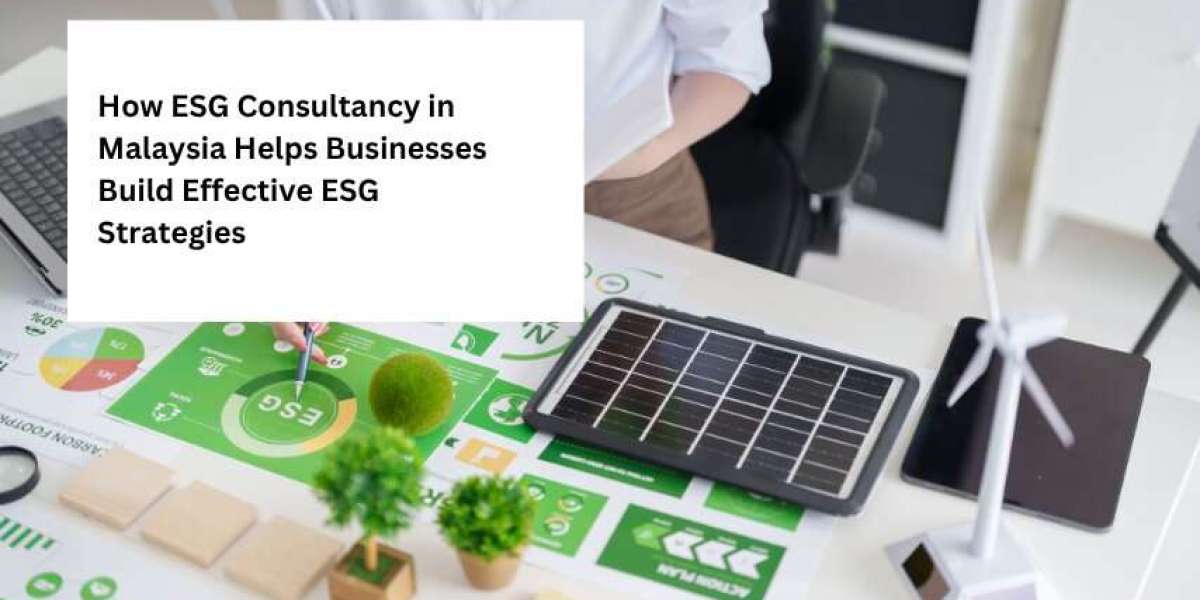

ESG adoption among Malaysian SMEs has moved faster in the past two years than almost anyone expected: awareness climbed from 14 percent in 2023 to 80 percent in 2025, and actual adoption rose from 28 percent to 60 percent over the same period, according to Alliance Bank's ESG 2.0 report. Yet within that adoption figure, only 32 percent of SMEs qualify as full adopters who have genuinely integrated ESG into core operations, while the rest remain partial at best. That gap between adopting something and building a strategy around it is exactly where ESG consultancy in Malaysia does its most valuable work.
What Does ESG Consultancy in Malaysia Actually Involve?
ESG consultancy in Malaysia involves helping businesses design, implement, and operationalize environmental, social, and governance strategies that align with national regulatory requirements, industry-specific risks, and the commercial realities of operating in the Malaysian market, rather than simply producing a compliance document. The distinction between strategy and compliance is central to how effective ESG consultancy is defined in practice.
This work typically spans identifying which ESG issues are genuinely material to a specific business, translating those priorities into concrete targets and initiatives, and building the internal governance and reporting processes needed to sustain progress over time. KPMG's Director of Sustainability Advisory Services in Malaysia has specifically framed this distinction as the difference between companies that treat ESG as a strategic driver of value and those that treat it as compliance alone, noting that the former group consistently performs better. ESG consultancy in Malaysia exists largely to help businesses land in that first category rather than the second.
Why Do Malaysian Businesses Need Dedicated ESG Strategy Support Right Now?
Malaysian businesses need dedicated ESG strategy support right now because regulatory pressure, supply chain requirements, and market expectations are converging on companies of every size simultaneously, and businesses without a coherent strategy risk reacting to each new requirement individually rather than building capability that serves them across all of them at once. Piecemeal compliance is proving to be a considerably more expensive path than a coordinated strategy.
The scale of this shift is significant. Malaysia's more than 1.1 million SMEs and MSMEs accounted for 96.9 percent of all business establishments in 2024, contributing 39.5 percent of national GDP, or RM652.4 billion, and generating RM196.8 billion in exports while providing nearly half of total national employment. With Bursa Malaysia's ESG disclosure mandates now reaching listed companies and rippling down through their supply chains, even unlisted SMEs are increasingly expected to demonstrate ESG alignment to retain vendor status or win tenders. Given this scale, ESG consultancy in Malaysia is no longer a service confined to large public-listed companies; it has become relevant to a very large share of the national economy.
How Do ESG Consultants in Malaysia Help Businesses Move Beyond Superficial Adoption?
ESG consultants in Malaysia help businesses move beyond superficial adoption by identifying where current practices are cosmetic rather than structural, then building the specific operational changes, targets, and governance mechanisms needed to close that gap. This distinction matters because national data shows a persistent gap between broad ESG awareness and genuinely embedded practice.
Research from ICAEW-backed analysis of Malaysian SMEs found that despite rising adoption figures, deep integration remains limited: only 19 percent of Malaysian SMEs had adopted environmentally friendly production processes, and just 12 percent were running structured ESG governance processes, even as headline adoption rates climbed. This pattern mirrors the full-versus-partial-adopter split found in Alliance Bank's own research, where only 32 percent of SMEs qualified as full adopters against 28 percent classified as partial. ESG consultants use this kind of internal benchmarking specifically to help a business understand which category it genuinely falls into, since a company that believes it has "adopted ESG" based on a handful of surface-level initiatives is often working from a false sense of security about how prepared it actually is.
What Makes an ESG Strategy Effective Rather Than Just Compliant?
An ESG strategy is effective rather than merely compliant when it is treated as a driver of business value, incorporating proactive risk management, supply chain transparency, and technology investment, rather than existing solely to satisfy a disclosure requirement or a customer's ESG questionnaire. This distinction, made explicitly by sustainability advisory leaders in Malaysia, separates strategies that create lasting competitive advantage from those that exist purely on paper.
KPMG's 2026 ESG outlook for Malaysia specifically recommends that SMEs pursue practical, incremental actions, such as energy efficiency and responsible business practices, that strengthen operational resilience and protect margins while building toward genuine competitive advantage. This mirrors findings from Malaysia's SME sector directly: among SMEs that adopted meaningful ESG practices, 38 percent reported revenue growth above 50 percent, driven by increased customer demand and improved market access. ESG consultancy in Malaysia built around this evidence tends to frame sustainability not as a cost center to be minimized, but as a lever tied directly to commercial outcomes a business already cares about.
How Do ESG Consultants Address the Cost Barrier That Holds Back SME Adoption?
Expert ESG consultants such as Wellkinetics address the cost barrier holding back SME adoption by helping businesses prioritize the ESG initiatives with the clearest and fastest financial return, sequencing lower-cost, high-impact actions ahead of larger investments, and connecting clients to available government incentives and simplified disclosure pathways designed specifically for smaller businesses. Cost remains one of the most consistently cited obstacles to ESG adoption among Malaysian SMEs, and addressing it directly is central to effective consultancy in this market.
Government and industry stakeholders have acknowledged this barrier explicitly; one Sabah-based engineering consultant described ESG adoption for SMEs as functioning like an additional cost similar to e-invoicing, arguing that uptake depends heavily on government support and incentives. Academic research into MSME ESG adoption in Malaysia has similarly identified a lack of funding, expertise, and knowledge as core obstacles, compounded by the fact that many smaller businesses find it genuinely difficult to meet the same standards expected of larger companies given their size and narrower operational scope. ESG consultants working with these businesses increasingly lean on frameworks such as the Simplified ESG Disclosure Guide (SEDG) to give SMEs a lower-cost, tiered entry point rather than requiring them to build a full-scale ESG program from the outset.
Why Does Governance Deserve as Much Attention as Environmental Strategy?
Governance deserves as much attention as environmental strategy because weak governance, particularly around corruption, bribery, and the absence of whistleblowing mechanisms, represents one of the most persistent risk areas identified in Malaysia's corporate sector, and a strategy that focuses heavily on environmental initiatives while neglecting governance leaves a significant blind spot. ESG consultants who treat governance as an afterthought are addressing only part of the risk a business actually carries.
Industry commentary from Grant Thornton in Malaysia has specifically flagged corruption and bribery as key governance risks in the corporate sector, emphasizing the importance of whistleblowing policies and the role auditors play in identifying and reporting unethical practices to protect stakeholders. The same commentary recommends Malaysian businesses start ESG disclosure with basic indicators such as gender diversity and resource usage, then scale initiatives over time, an approach that deliberately builds governance and social indicators into the strategy from the earliest stage rather than treating them as secondary to environmental metrics. Effective ESG consultancy in Malaysia generally reflects this same balance, since an environmentally strong company with weak governance controls remains materially exposed to exactly the kind of risk ESG frameworks are designed to surface.
Is ESG Strategy Support Only Necessary for Businesses Facing Regulatory Deadlines?
No, ESG strategy support is not only necessary for businesses facing direct regulatory deadlines, since supply chain pressure, market access, and financing considerations are pulling companies without any formal reporting obligation into the same conversation, often well before regulation would otherwise require it. Malaysia's Bursa Malaysia mandate technically applies only to listed companies, but its practical reach extends much further.
Analysis aimed at Malaysian SMEs has been explicit on this point: while most SMEs are not listed and therefore not directly subject to Bursa Malaysia's ESG disclosure mandate, that requirement ripples through supply chains as larger, listed buyers push ESG expectations down to their vendors, meaning SMEs that wait for direct regulation to apply to them risk losing ground to competitors who prepared earlier. This dynamic is reinforced regionally too, with Malaysia collaborating with ASEAN partners to launch the ASEAN Centre of Excellence for MSMEs in the green transition, signaling that this pressure is regional rather than confined to Malaysia's domestic listed-company rules alone. ESG consultants generally advise clients against waiting for a formal mandate before building strategy, since the commercial pressure frequently arrives well before the regulatory one does.
How Should Malaysian Businesses Structure the Process of Building an ESG Strategy?
Malaysian businesses should structure ESG strategy development by first assessing current practice honestly against full-versus-partial adoption benchmarks, then identifying which ESG issues carry the greatest commercial and regulatory relevance for their specific industry, and finally building a phased implementation plan that starts with practical, resource-appropriate actions before scaling toward more comprehensive integration.
What Should Be the First Step in Building an ESG Strategy?
The first step should generally be an honest internal assessment of where the business currently sits, distinguishing genuine, structural ESG practices from superficial or partial ones, since strategy built on an inflated sense of existing progress tends to underestimate the work still required.
How Long Does It Take to Move From Partial to Full ESG Adoption?
There is no fixed timeline, but moving from partial to full adoption, meaning ESG genuinely integrated into core operations rather than applied superficially, typically requires sustained effort across multiple years, since it depends on building internal governance structures, staff capability, and data systems rather than simply completing a checklist of initiatives.
What Are the Different Perspectives on How ESG Strategy Should Be Prioritized in Malaysia?
Perspectives differ on how Malaysian businesses, particularly SMEs, should prioritize ESG strategy development: some argue that businesses should focus narrowly on the specific ESG requirements directly relevant to their immediate customers and regulators, while sustainability advisory leaders generally argue that businesses benefit more from building broader, integrated ESG capability that anticipates future requirements rather than reacting to each new one individually.
The case for a narrow, targeted approach reflects genuine resource constraints; smaller businesses interviewed on ESG adoption barriers consistently cite a lack of funding, expertise, and knowledge, and an SME with limited capacity may reasonably choose to focus first on whatever a single major buyer or regulator specifically requires. The case for a broader strategic approach rests on evidence that businesses treating ESG as a value driver, rather than a reactive compliance exercise, tend to outperform on both resilience and revenue growth, with over a third of ESG-adopting SMEs in one Malaysian study reporting revenue growth above 50 percent. A reasonable middle path, and one many ESG consultants in Malaysia recommend to resource-constrained clients, is to begin with the specific requirements most immediately relevant to a business's largest customers or nearest regulatory obligation, while deliberately building those initial actions on a foundation broad enough to expand into a fuller strategy as capacity allows.
Conclusion
ESG consultancy in Malaysia matters for strategy, not just disclosure, because the national data makes clear that awareness and even basic adoption are no longer the primary obstacle; the real gap sits between adopting ESG on paper and genuinely embedding it into how a business operates and competes. With SME awareness at 80 percent but full adoption still sitting around 32 percent, the work ahead for most Malaysian businesses is less about learning that ESG matters and more about building the strategy that actually closes that distance.
As regulatory requirements, supply chain expectations, and financing considerations continue reinforcing one another across Malaysia's economy, ESG consultancy focused on genuine strategy, rather than one-off disclosure support, is positioned to help the country's businesses, and particularly its more than one million SMEs, turn ESG from a compliance obligation into the kind of durable competitive advantage the data increasingly shows it can become.
References
- New Straits Times, Reframing ESG as Commercial Opportunities for SMEs — https://www.nst.com.my/amp/business/esg/2026/01/1351977/reframing-esg-commercial-opportunities-smes
- Azeus Convene, Driving Sustainable Growth: ESG Strategies for Malaysian Businesses — https://www.azeusconvene.com/esg/strategies-for-malaysian-businesses-whitepaper
- USIM (Universiti Sains Islam Malaysia), Challenges Faced by MSMEs to Adopt ESG — https://epiiecons.usim.edu.my/index.php/eproceeding/article/download/129/101
- KPMG Malaysia, 2026 ESG Outlook: Risks and Realities — https://kpmg.com/my/en/media-press-releases/2026/01/2026-esg-outlook--risks-and-realities.html
- Malaysia SME, 10 Essential ESG Facts Every SME in Malaysia Should Understand (ICAEW) — https://www.malaysiasme.com.my/?p=6581
- The Sun Malaysia, Grant Thornton on ESG Governance Risks and SME Adoption in Malaysia — https://thesun.my/?p=167965
- Bernama, SMEs Shift Toward Sustainable Practices With Advisory Support — https://www.bernama.com/en/news.php?id=2502544
- The Borneo Post, Sedia Engages Businesses to Boost ESG Adoption Among SMEs — https://www.theborneopost.com/2026/04/14/sedia-engages-businesses-to-boost-esg-adoption-among-smes/