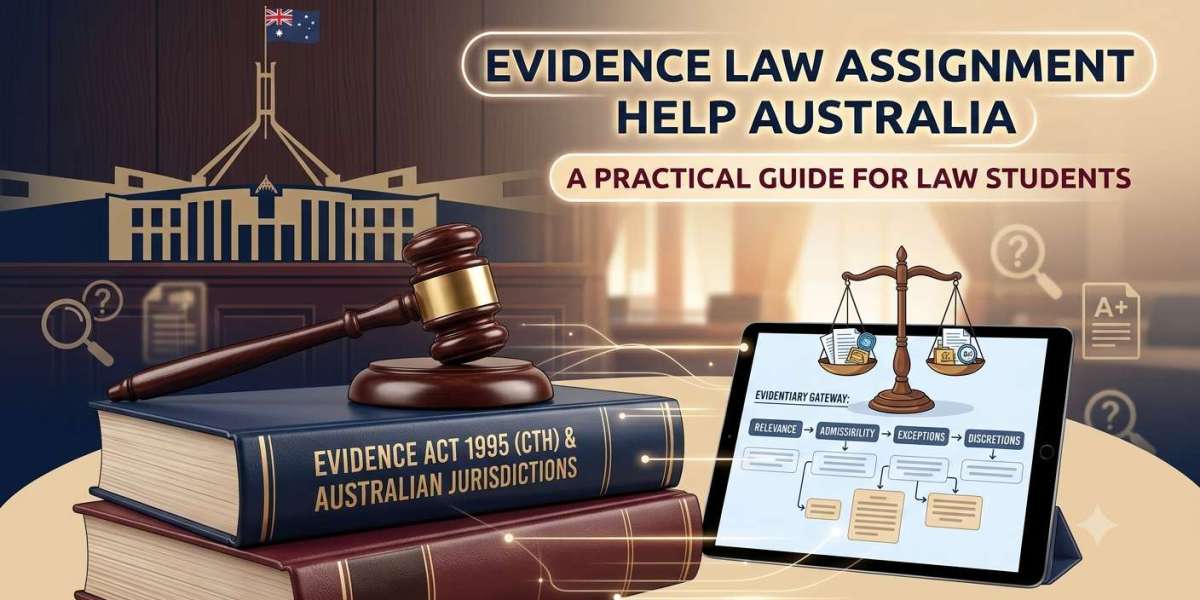

Evidence law is an important part of legal study in Australia, but it can also be one of the subjects where students find it difficult to connect legal rules with practical facts. An assignment may require you to examine whether evidence is relevant, decide whether it is admissible, identify an applicable exception, and support your argument with legislation and case law.
This is why many students look for Evidence Law Assignment Help Australia when they are dealing with complex problem questions, legal research or assignment writing. Evidence courses commonly develop skills in statutory interpretation, case analysis and applying evidence rules to hypothetical factual situations.
What Does Evidence Law Cover?
Evidence law is concerned with the information that can be presented during legal proceedings and how that information may be used by a court.
Australian university evidence courses can cover areas such as:
Relevance and admissibility
Hearsay evidence
Opinion evidence
Documentary evidence
Witness testimony
Identification evidence
Tendency and coincidence evidence
Character evidence
Privilege
Burden and standard of proof
Examination and cross-examination of witnesses
For example, the ANU Law School's Evidence course identifies relevance, credibility, hearsay, opinion, tendency and coincidence, identification and character evidence, privileges and judicial discretions among its subject areas.
Why Are Evidence Law Assignments Challenging?
The difficulty with evidence assignments is that students usually cannot answer a problem question by simply defining a legal concept.
You need to work out which rule applies to the particular facts.
Suppose an assignment gives you a statement made by a witness. You might need to ask:
Is the statement relevant?
What is the purpose for which the statement is being offered?
Does the hearsay rule apply?
Is there an applicable exception?
Does another exclusionary rule apply?
Is there a discretionary basis for excluding the evidence?
This step-by-step approach is much more useful than simply writing a general explanation of hearsay.
Start With the Facts in Issue
Before researching cases, read the question carefully and identify the facts that actually need to be established.
Evidence law is closely connected with fact-finding. University courses often require students to determine what evidence may be presented, how it can be used and whether it can be challenged.
Create a simple list of the important facts before beginning your legal analysis.
For example:
Fact in issue: Did the accused make the statement?
Evidence: A witness says they heard the accused make the statement.
Legal question: Can the witness's evidence be admitted for the purpose identified in the problem?
This approach gives your research a clear direction.
Understand Relevance Before Admissibility
Relevance is an important starting point when analysing evidence.
However, relevant evidence is not necessarily automatically admissible. Other rules may restrict whether evidence can be used in a proceeding.
This distinction is important because a strong assignment should show the progression of the analysis rather than jumping from "relevant" to "admissible."
A useful framework is:
Relevance → Applicable rule → Exception or exclusion → Conclusion
This keeps your answer organised and helps prevent important legal issues from being overlooked.
Hearsay Evidence
Hearsay is one of the topics that frequently appears in Evidence Law assignments.
The analysis can become complicated because you need to consider not only what was said, but also the purpose for which the evidence is being introduced.
When dealing with a hearsay problem, consider:
What was the representation?
Who made it?
Who is presenting it to the court?
For what purpose is it being used?
Does the hearsay rule apply?
Is there an exception?
Are any other evidence rules relevant?
Rather than simply stating that something is hearsay, explain each stage of your reasoning.
Opinion Evidence
Opinion evidence can raise another set of questions.
For instance, a witness may provide evidence that includes an opinion rather than a direct description of something they personally perceived.
If your assignment involves an expert, the analysis may require additional consideration of the requirements governing expert evidence.
The key is to identify the exact legal rule that applies and then connect it to the facts instead of treating all opinions as automatically inadmissible or admissible.
Tendency and Coincidence Evidence
Tendency and coincidence evidence can be particularly demanding because the assignment may require you to analyse how particular evidence is being used.
You should identify:
What the evidence is intended to establish
Why it is being introduced
Which statutory provisions are relevant
Whether the required conditions are satisfied
Whether any exclusionary considerations arise
Your answer should also distinguish between what the legislation actually provides and your own application of that law to the facts.
How to Structure an Evidence Law Assignment
A clear structure can make a complicated legal problem much easier to manage.
Introduction
Briefly explain the main legal issues that will be considered.
Avoid rewriting the entire problem question.
Identify the Issues
Break the question into individual legal issues.
For example:
Is the evidence relevant?
Does hearsay apply?
Is an exception available?
Is opinion evidence involved?
Does privilege arise?
Is another exclusionary provision relevant?
Explain the Law
Use the relevant legislation and authoritative cases to establish the legal principles.
Keep your explanation focused on the particular issue.
Apply the Law
This is where you analyse the facts.
Explain why the evidence does or does not satisfy the relevant legal requirements. If there are competing interpretations, discuss them rather than ignoring them.
Conclusion
Finish each issue with a concise conclusion and then provide an overall answer where appropriate.
Use Australian Legislation Carefully
One of the most important things to check before starting an Evidence Law assignment is the jurisdiction.
The uniform evidence law applies through the Evidence Act 1995 (Cth) and corresponding legislation in several Australian jurisdictions, while other jurisdictions use different evidence legislation. ANU's course materials, for example, identify the Uniform Evidence Law framework and its application across several jurisdictions.
Therefore, do not automatically use a provision simply because you found it in an Australian legal database.
Check:
The state or territory in the question
Whether Commonwealth legislation applies
The current version of the legislation
Relevant amendments
The cases applicable to that jurisdiction
Using the wrong statutory framework can affect the entire analysis.
Support Your Argument With Case Law
Case law should be used to establish and explain legal principles, not simply to make an assignment look well researched.
A useful pattern is:
Case → Principle → Application
For example, introduce the case, explain the relevant principle established or applied by the court, and then show how that principle relates to the facts in your assignment.
This approach demonstrates legal reasoning rather than simple case summarisation.
Common Mistakes Students Make
Several mistakes can weaken an Evidence Law assignment.
Focusing Only on Definitions
Defining hearsay, relevance or opinion evidence is not enough. You must apply the relevant rule to the facts.
Using the Wrong Jurisdiction
Always check which legislation applies before relying on a statutory provision.
Listing Too Many Cases
A smaller number of relevant authorities can be more useful than a long list of cases that are never properly analysed.
Ignoring Exceptions
After identifying a general exclusionary rule, check whether an exception or alternative basis for admissibility needs to be considered.
Repeating the Facts
Your assignment should analyse the facts rather than simply retelling the scenario.
How Evidence Law Assignment Help Australia Can Assist
Students seeking Evidence Law Assignment Help Australia may require assistance with different parts of their coursework.
Academic support can help with:
Understanding difficult evidence law concepts
Breaking down problem questions
Identifying relevant legal issues
Researching legislation and case law
Understanding admissibility questions
Developing a logical assignment structure
Applying evidence rules to hypothetical facts
Improving legal arguments
Checking citations and referencing
Reviewing grammar and academic presentation
The most useful approach is to use academic support to understand the reasoning process and improve your own ability to analyse evidence law problems.
Final Thoughts
Evidence Law assignments require careful research and precise legal reasoning. The strongest answers do more than describe legal rules. They show how those rules connect with the facts and explain why a particular conclusion follows.
Start by identifying the jurisdiction and facts in issue. Then consider relevance, admissibility, exclusionary rules and possible exceptions. Support each important proposition with appropriate legislation and case law, and make sure your analysis remains focused on the question.
With a structured approach, even a complicated Evidence Law problem can be broken into manageable legal issues.