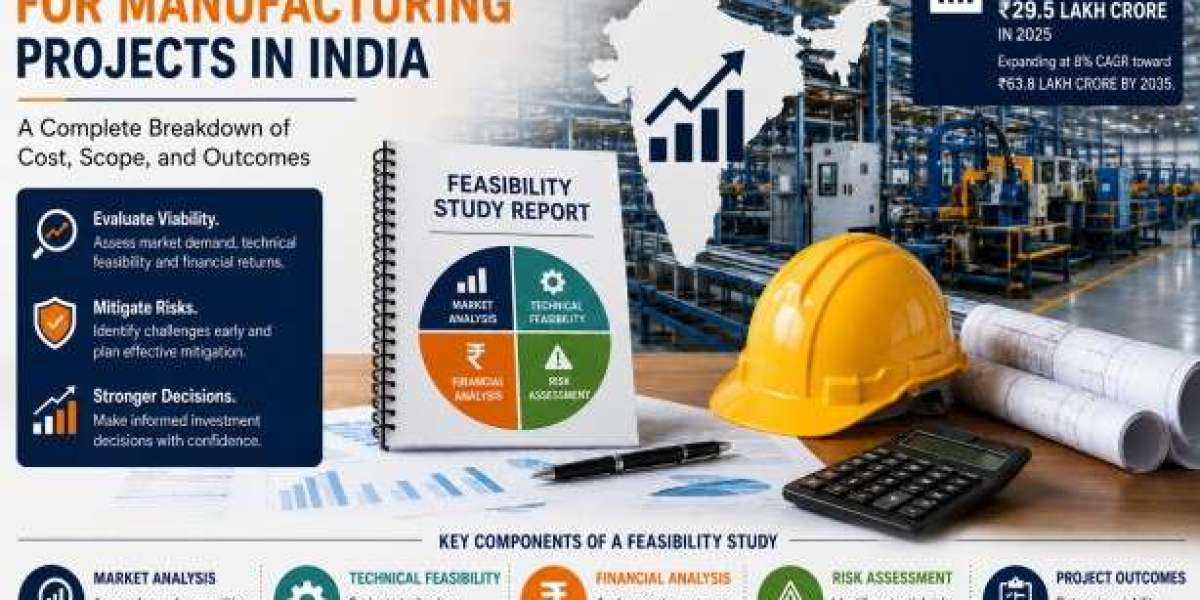

Expanding an existing manufacturing plant can appear straightforward when demand is rising and current production is approaching its limits. But adding a production line, extending a building, or increasing utility capacity does not automatically create a viable investment.
A Feasibility Study for Plant Expansion ,determines whether the proposed increase in capacity can be achieved technically, commercially, financially, operationally, and within applicable regulatory requirements. It also helps identify whether the better solution is full expansion, debottlenecking, equipment replacement, or investment in a new facility.
For context, the Reserve Bank of India's manufacturing capacity-utilisation survey reported seasonally adjusted capacity utilisation of 75.8% in Q1 FY2024-25, alongside increased year-on-year growth in new orders. This makes capacity planning relevant, but utilisation alone is not enough to justify new investment.
Why Is a Feasibility Study Important Before Plant Expansion?
A brownfield expansion must work around infrastructure and production systems that already exist. The feasibility study therefore needs to answer more than "How much additional capacity is required?"
It should establish:
- Whether additional capacity is actually needed
- Where the existing production bottleneck occurs
- Whether the current site can accommodate expansion
- Whether utilities can support the proposed load
- What investment is required
- How expansion will affect operating costs
- What regulatory approvals may be triggered
- How production will continue during construction
- Whether expected returns justify the investment
- What could make the project financially or operationally unsuccessful
The outcome should be a decision-ready basis for moving into detailed engineering, procurement, financing, and execution.
1. Assess Existing Capacity Before Adding New Capacity
The first step is to understand how the existing plant is performing.
A plant operating below its potential may not need a completely new production line. Its constraint could be a particular machine, process step, changeover, inspection stage, warehouse, or utility.
The assessment should examine:
- Installed versus actual production capacity
- Capacity utilisation
- Production cycle time
- Overall equipment effectiveness
- Downtime and maintenance losses
- Changeover duration
- Rejection and rework
- Batch-size limitations
- Production bottlenecks
- Seasonal production requirements
A useful approach is to map the entire production flow and identify the constraint that limits saleable output.
For example, increasing reactor capacity will not solve a problem if downstream filtration or packaging is already operating at its practical limit.
2. Validate Market Demand for Additional Capacity
Additional capacity only creates value when the market can absorb the output.
A feasibility study should therefore examine both current demand and the quality of demand visibility.
Consider:
- Existing order book
- Customer forecasts
- Contracted volumes
- Historical sales
- Market growth
- Competitor capacity
- Product pricing
- Export opportunities
- New customer pipeline
- Expected utilisation during ramp-up
The study should distinguish between theoretical market opportunity and reasonably supportable demand.
A useful scenario model can test conservative, base, and higher-demand cases instead of assuming that the expanded plant will immediately operate at full capacity.
3. Compare Expansion Options, Not Just One Proposal
One of the most valuable parts of a feasibility study is comparing alternatives.
Possible options include:
- Optimising the existing process
- Debottlenecking selected equipment
- Replacing inefficient equipment
- Adding equipment within the existing building
- Installing an additional production line
- Expanding the existing building
- Developing an additional site or new plant
Each option should be compared for:
- Additional capacity
- CAPEX
- Incremental OPEX
- Implementation period
- Utility requirements
- Production disruption
- Regulatory implications
- Working-capital requirement
- Financial returns
- Technical and execution risk
This prevents the expansion decision from becoming an equipment-purchase decision before the underlying business case has been established.
4. Evaluate Technical and Equipment Feasibility
Existing equipment should be assessed before determining what needs to be added.
The technical review can cover:
- Equipment age and condition
- Rated versus actual capacity
- Remaining useful life
- Maintenance history
- Process compatibility
- Equipment redundancy
- Spare-parts availability
- Automation compatibility
- Integration requirements
- Foundation and structural requirements
The process flow should also be reviewed after expansion. A new machine may increase throughput at one stage while creating a bottleneck elsewhere.
For brownfield projects, equipment access is another practical consideration. Existing walls, columns, pipe racks, production areas, and operating machinery can affect installation methods and project schedules.
5. Check Plant Layout, Building, and Site Constraints
A site may appear to have vacant space but still lack practical expansion capacity.
The feasibility assessment should examine:
- Available floor area
- Equipment footprint
- Floor loading
- Equipment height
- Foundation requirements
- Material movement
- Personnel movement
- Maintenance access
- Emergency exits
- Fire access
- Storage requirements
- Truck movement
- Drainage
- Future expansion space
The important question is not simply "Is there space?" but "Can the proposed expansion fit without creating unsafe, inefficient, or operationally disruptive conditions?"
6. Assess Utility Capacity Before Finalising Equipment
Utility constraints can become hidden capacity constraints.
The study should compare existing capacity and projected demand for:
- Electrical power
- Transformers
- DG backup
- Steam
- Compressed air
- Chilled water
- Cooling water
- Process water
- RO/DM water
- HVAC
- Fuel or gas
- Nitrogen
- ETP/STP capacity
- Fire-water systems
The calculation should consider existing peak demand plus the incremental requirement from the expansion, rather than comparing equipment nameplate ratings alone.
Energy intensity should also be considered. For designated consumers under India's Perform, Achieve and Trade framework, energy-intensive industries have defined energy-management and audit obligations.
7. Build a Complete CAPEX and OPEX Estimate
An equipment quotation is not the same as total project cost.
A plant expansion CAPEX model should consider:
- Process equipment
- Civil and structural works
- Electrical systems
- Instrumentation and automation
- Utilities
- HVAC
- Fire protection
- ETP/STP modifications
- Material-handling systems
- Installation
- Engineering
- Project management
- Testing and commissioning
- Contingency
- Pre-operative expenses
Incremental OPEX should include raw materials, utilities, labour, maintenance, consumables, quality costs, waste treatment, packaging, and logistics.
This distinction is essential because an apparently attractive equipment price can produce a very different project economics once installation and infrastructure costs are included.
8. Test Financial Viability Under Different Scenarios
The financial model should translate the technical proposal into an investment case.
Key measures can include:
| Measure | What it helps assess |
|---|---|
| CAPEX | Initial project investment |
| Incremental OPEX | Additional operating cost |
| Revenue | Potential additional sales |
| EBITDA | Operating contribution |
| NPV | Value created over the project period |
| IRR | Project return |
| Payback | Capital recovery period |
| DSCR | Debt-servicing capacity |
| Break-even | Minimum required operating level |
The model should also account for ramp-up rather than assuming full production from commissioning.
Most importantly, test the effect of changes in:
- Selling price
- Utilisation
- Raw-material costs
- Energy costs
- CAPEX
- Project delays
- Production yield
- Working capital
Sensitivity analysis can reveal which assumptions have the greatest influence on the investment case.
9. Calculate the Additional Working-Capital Requirement
Expansion funding is not limited to machinery and construction.
Higher production can increase:
- Raw-material inventory
- Work-in-progress
- Finished goods
- Receivables
- Packaging inventory
- Maintenance spares
Therefore, the investment model should distinguish between project CAPEX and incremental working capital.
A project that requires substantial additional working capital can have very different cash-flow characteristics from one with similar equipment costs but lower operating requirements.
Speak With An Expert: https://www.imarcengineering.com/contact?service=feasibility-study-business-planning
10. Review Regulatory and Environmental Implications
Regulatory requirements should be assessed during feasibility rather than after detailed engineering has begun.
Depending on the project, sector, location, capacity increase, and process, the review may cover environmental clearance, pollution-control consent, factory requirements, fire approvals, waste management, water requirements, hazardous materials, and product-specific regulations.
PARIVESH maintains the central framework and notifications associated with environmental clearance and the EIA regime.
CPCB's 2025 consent framework specifically addresses industrial plants undertaking expansion or modernisation before commissioning, reinforcing the need to evaluate consent implications as part of project planning.
The exact approval pathway should therefore be determined from the project's actual characteristics rather than assumed from another plant or location.
11. Plan for Production Continuity During Brownfield Expansion
This is a major difference between greenfield and brownfield projects.
Construction may occur alongside active manufacturing, creating risks involving:
- Shutdowns
- Equipment tie-ins
- Temporary utilities
- Material movement
- Contractor access
- Dust and noise
- Safety
- Equipment relocation
- Commissioning
- Production losses
The feasibility study should establish whether the work can be phased around production.
Potential production loss should also be translated into financial terms so that management can compare a faster but more expensive execution strategy with a slower approach that minimises disruption.
12. Evaluate Workforce and Supply-Chain Readiness
New capacity requires more than machinery.
The study should assess whether the organisation has sufficient:
- Operators
- Maintenance technicians
- Production supervisors
- Quality personnel
- EHS resources
- Engineers
- Utility operators
- Automation specialists
Training, recruitment, shift changes, and technical staffing may need to form part of the expansion plan.
At the same time, suppliers should be assessed for their ability to support the increased production volume. A capacity increase can be constrained by a single critical raw material, long lead-time component, or logistics bottleneck.
A Practical Plant Expansion Feasibility Checklist
Before approving investment, management should be able to answer:
- Demand: Is there sufficient evidence for additional capacity?
- Capacity: What is the actual bottleneck?
- Technology: Can existing systems support integration?
- Site: Can the expansion physically fit?
- Utilities: Can power, water, steam and other services support it?
- Cost: What is the realistic total project cost?
- Operations: Can production continue during implementation?
- Regulation: What approvals or modifications may be required?
- People: Are skills and manpower available?
- Finance: What happens to NPV, IRR, cash flow and payback under downside scenarios?
- Risk: Which assumptions could materially change the investment case?
If several of these questions remain unanswered, the project may not yet be ready for full-scale investment.
How IMARC Engineering Can Help
IMARC Engineering can support plant expansion feasibility through existing-plant assessment, capacity and bottleneck analysis, technical evaluation, layout and utility assessment, CAPEX/OPEX estimation, equipment and vendor evaluation, regulatory review, financial feasibility, risk analysis, and expansion planning. The objective is to connect engineering realities with investment decisions so that companies can compare expansion options before committing significant capital to a brownfield project.
Conclusion
A plant expansion feasibility study should establish whether additional capacity is needed, technically achievable, operationally manageable, financially justified, and compliant with applicable requirements. The strongest studies do not simply validate a predetermined expansion plan; they compare alternatives, identify constraints, test assumptions, and expose risks before capital is committed. For manufacturing companies, this approach can turn expansion planning from a capacity-addition exercise into a structured investment decision supported by evidence, engineering analysis, and realistic financial modelling.
Contact Us:
IMARC Engineering
Phone: +91-120-433-0800
Email: sales@imarcengineering.com
India: C-130, Sector 2, Noida, Uttar Pradesh 201301
LinkedIn: https://www.linkedin.com/showcase/imarc-engineering/