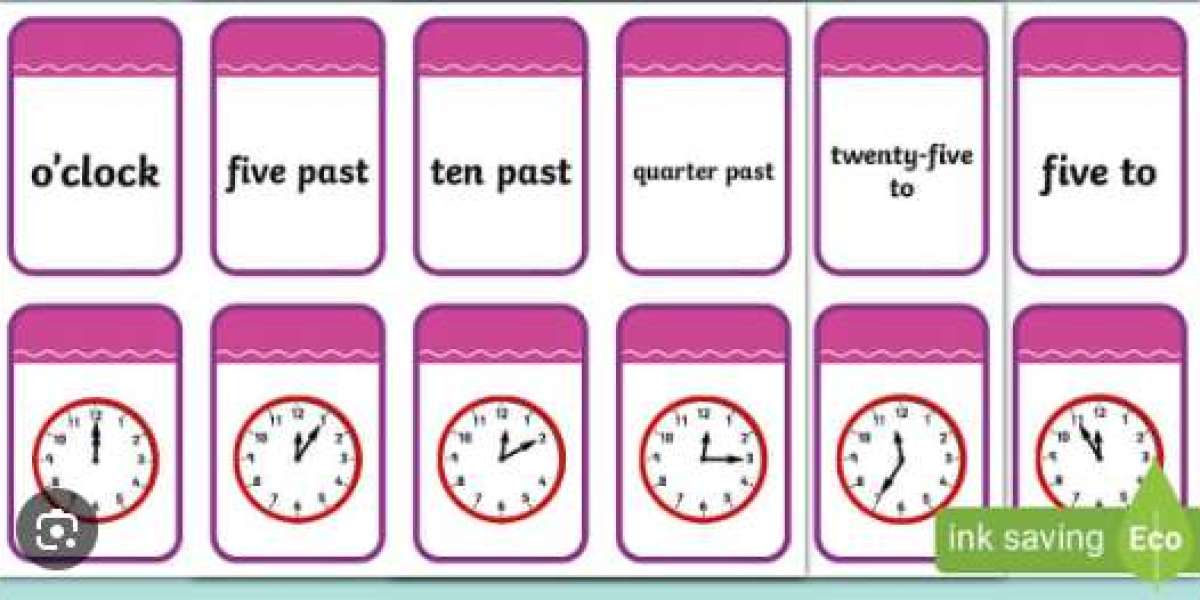

Learning to tell time is an important skill for children. It helps them understand daily routines, become more independent, and develop an awareness of schedules and responsibilities. However, reading an analog clock can sometimes be confusing for young learners. Children need to understand numbers, clock hands, hours, and minutes before they can confidently tell the time.
One of the easiest ways to make this learning process more enjoyable is by using flashcards. Time flashcards provide children with visual examples that they can study, compare, and practice repeatedly. They can also be used for games and activities, making lessons more interactive and less stressful. With patience and regular practice, flashcards can help children develop strong time-telling skills.
Introduce Children to the Clock
How to Teach Kids Telling Time With Flashcards beginning with flashcards, make sure your child understands the basic parts of an analog clock. Show them a real clock, toy clock, or teaching clock and point out the numbers from 1 to 12.
Explain that the clock has two main hands. The short hand represents the hour, while the long hand represents the minutes. Use simple language and repeat the explanation several times.
Ask your child to point to different numbers on the clock. For example, say, “Can you find number 4?” or “Where is number 12?” This simple activity helps children become familiar with the clock face.
You can also explain that the numbers appear in the same order every time. Understanding this pattern makes it easier for children to recognize different times later.
Begin With O’Clock Times
The best way to introduce time flashcards is to begin with whole-hour times. These include 1:00, 3:00, 5:00, 7:00, and 10:00.
Choose flashcards where the minute hand points directly to 12. Explain that when the long hand is pointing at 12, the time is exactly on the hour.
Show your child one flashcard and ask, “What time is it?” Give them enough time to look at both hands before answering.
For example, if the short hand points to 4 and the long hand points to 12, the answer is 4 o’clock.
Repeat this activity with different flashcards. Repetition helps children recognize the relationship between the hour hand and the numbers.
Help Kids Recognize the Two Hands
Children often confuse the hour and minute hands when they first begin learning. Flashcards can provide repeated visual practice to help solve this problem.
Show a flashcard and ask your child, “Which hand is the short hand?” Then ask, “Which hand is the long hand?”
You can create a simple memory phrase such as “short hand for hours, long hand for minutes.” Repeating this phrase while practicing can help children remember the difference.
Once your child can identify both hands, encourage them to explain how they know the time. Asking them to explain their answer helps develop understanding instead of simple memorization.
Introduce Half-Hour Times
After your child understands whole hours, introduce half-hour times. Examples include 2:30, 5:30, and 8:30.
Explain that when the minute hand points to 6, it means 30 minutes have passed. You can describe 30 minutes as half of an hour.
Use several flashcards to show different half-hour times. Ask your child to identify the hour hand first and then look at the minute hand.
For example, if the hour hand is between 3 and 4 and the minute hand is pointing to 6, the time is 3:30.
Practice different examples until your child becomes comfortable with the pattern.
Teach Quarter Past and Quarter To
Once your child understands half-hours, you can introduce quarter-hour times. Explain that an hour has 60 minutes, so 15 minutes is one quarter of an hour.
Use flashcards showing times such as 2:15, 5:15, 7:45, and 10:45.
Teach the expressions “quarter past” and “quarter to” gradually. For example, 3:15 can be described as a quarter past 3, while 3:45 can be described as a quarter to 4.
Children may need additional practice with these expressions because they require them to think about both the current hour and the next hour.
Turn Flashcards Into Games
Games can make time practice much more enjoyable. Instead of simply asking children to identify flashcards, create activities that involve movement, competition, and problem-solving.
For example, place several flashcards face down on a table. Ask your child to choose a card, turn it over, and tell you the time. Give them a point for each correct answer.
Another activity is a matching game. Prepare one set of cards with clock faces and another set with written times. Ask your child to match each clock with the correct written time.
You can also create a “time challenge.” Set a small number of cards in front of your child and ask them to identify as many as they can correctly within a certain amount of time. Keep the activity light and fun rather than making speed the main goal.
Connect Time to Daily Routines
One of the most effective ways to help children understand time is to connect flashcards with activities they already know.
For example, show your child a card displaying 7:00 and ask, “What do you usually do at seven o’clock?” They might answer, “I wake up,” “I eat breakfast,” or “I get ready for school.”
You can create cards related to common daily activities, such as waking up, going to school, eating lunch, doing homework, playing, eating dinner, and going to bed.
This helps children understand why learning to tell time is useful. Instead of seeing time as an abstract math concept, they begin to understand how it fits into their everyday lives.
Gradually Introduce Five-Minute Intervals
After your child has mastered whole hours, half-hours, and quarter-hours, introduce five-minute intervals.
Explain that each number on an analog clock represents five minutes when you are counting minutes. For example, 1 represents 5 minutes, 2 represents 10 minutes, 3 represents 15 minutes, and so on.
Use flashcards to practice times such as 4:05, 6:20, 8:35, and 10:50.
Do not introduce too many new times at once. Give your child plenty of opportunities to practice each stage before moving forward.
Practice for a Few Minutes Every Day
Regular practice is more helpful than long, tiring lessons. Try spending about 5–10 minutes each day reviewing time flashcards.
Begin with familiar cards and then introduce one or two new examples. If your child is struggling, return to easier times and build confidence before continuing.
Short daily practice sessions keep learning manageable and help children remember what they have learned.
Encourage Mistakes and Celebrate Progress
Children may make mistakes while learning to tell time, and that is completely normal. Instead of focusing on incorrect answers, use mistakes as opportunities to teach.
If your child gives the wrong answer, ask them to look at the short and long hands again. Encourage them to explain what each hand is showing.
Praise their effort and improvement. Simple encouragement such as “Good job!” or “You looked carefully at the clock” can motivate children to continue practicing.
Conclusion
How to Teach Kids Telling Time With Flashcards to tell time does not have to be difficult or boring. Flashcards provide a simple, flexible, and interactive way to help children understand clock faces and recognize different times.
Start with whole hours and gradually move to half-hours, quarter-hours, and five-minute intervals. Turn flashcards into games, connect them with daily routines, and practice for a few minutes each day.
Most importantly, make the learning experience positive and enjoyable. With repetition, encouragement, and age-appropriate activities, children can gradually build the confidence they need to read clocks and understand time in their everyday lives.