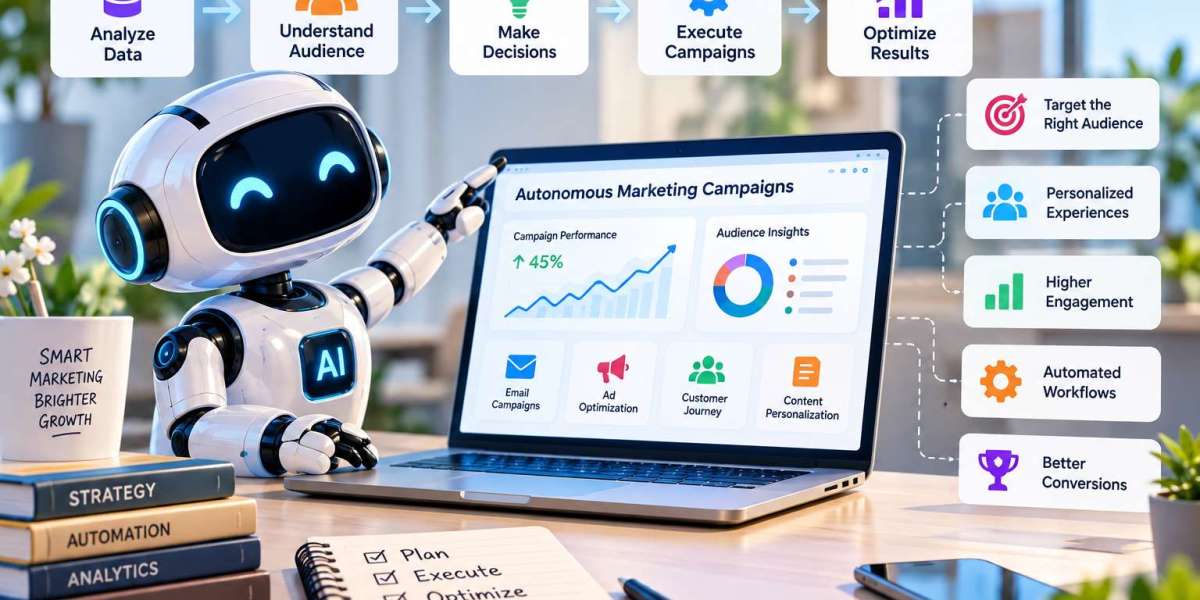

Marketing has always involved a series of decisions. Which audience should see an offer? When should an email be sent? Which creative deserves more budget? Traditionally, teams answer these questions manually by reviewing reports and adjusting campaigns. Agentic Marketing Services are changing that process by giving AI systems the ability to analyze information, make decisions, take action, and learn from results.
The difference is important. Standard automation follows predefined rules. An agentic system can evaluate changing conditions and select the next action based on a defined objective. It brings planning, execution, and optimization closer together.
What Is Agentic Marketing?
Agentic Marketing refers to a marketing approach in which AI-powered agents can perform multi-step tasks with limited human intervention. Instead of simply executing a workflow, an agent can assess campaign data, identify an opportunity, select an appropriate action, and measure what happens next.
Think of it like a sports team responding to the match rather than following a fixed playbook for all four quarters. The strategy still matters, but the next move depends on what is happening on the field.
An agentic marketing system may connect customer data, advertising platforms, CRM software, analytics tools, content systems, and communication channels. This creates a connected environment where decisions can be made using current information.
How AI-Powered Decision-Making Works
The foundation of an autonomous campaign is not simply artificial intelligence. It is the combination of data, goals, rules, tools, and feedback.
A typical system can follow a cycle such as:
Observe: Collect campaign, customer, and behavioral data.
Interpret: Identify patterns, changes, and opportunities.
Plan: Determine the next suitable action.
Act: Execute the approved marketing task.
Measure: Track the outcome.
Learn: Use performance data to improve future decisions.
This approach can reduce the gap between discovering a problem and responding to it. For example, if a campaign begins attracting clicks but produces fewer conversions, an AI system can flag the change and investigate possible causes instead of waiting for a weekly performance meeting.
The Role of AI Marketing Automation
AI Marketing Automation extends conventional automation by adding data-driven reasoning to workflows. Traditional automation might send an abandoned-cart email after a fixed period. An AI-driven workflow could consider the customer's previous purchases, engagement history, product value, and recent interactions before determining the most appropriate follow-up.
That does not mean every decision should be handed to a machine. Human oversight remains important, particularly for brand messaging, sensitive customer information, compliance, and high-value business decisions.
The strongest approach combines machine speed with human judgment.
AI Marketing Agents and Their Responsibilities
AI Marketing Agents can be designed for specific responsibilities instead of trying to operate an entire marketing department through one system.
Examples include:
Content Agents
These agents can research topics, identify content opportunities, prepare drafts, and recommend updates based on search performance. Human editors can then review the material for accuracy, originality, brand voice, and usefulness.
Campaign Optimization Agents
These systems can monitor advertising performance and identify changes in cost, engagement, conversions, or audience behavior. Depending on the permissions provided, they may recommend or execute budget and targeting adjustments.
Customer Engagement Agents
An engagement agent can analyze customer interactions and determine appropriate follow-up actions. It may help personalize messages based on a customer's stage in the buying journey.
Analytics Agents
Analytics-focused agents can turn large datasets into practical observations. Instead of presenting another dashboard full of numbers, they can highlight unusual movements and explain which metrics deserve attention.
Building Automated Marketing Campaigns
Automated Marketing Campaigns become more powerful when they are designed around objectives rather than isolated actions.
A useful campaign architecture starts with a measurable goal. That could be increasing qualified leads, improving customer retention, reducing acquisition costs, or increasing repeat purchases.
The next step is establishing boundaries. An autonomous system should know what it can change, what requires approval, and what actions are prohibited.
For example, a company might allow an agent to adjust ad targeting within predefined limits but require human approval before changing the overall campaign budget.
This creates a practical balance between autonomy and control.
Where Agentic Marketing Can Deliver Value
Agentic systems are particularly useful in environments where marketing teams deal with large volumes of data and frequent changes.
Potential applications include:
Personalized customer journeys
Lead qualification and routing
Campaign performance monitoring
Content recommendations
Audience segmentation
Advertising optimization
Email timing and personalization
Customer retention workflows
Marketing reporting
Conversion-rate analysis
The value is not simply doing more work with fewer people. A well-designed system can help teams spend more time on strategy, creative thinking, experimentation, and customer understanding.
Intelligent Marketing Solutions Need Strong Foundations
Intelligent Marketing Solutions work best when the underlying data is reliable. Poor customer records, disconnected platforms, unclear objectives, or inconsistent tracking can lead an AI system toward poor decisions.
Before introducing autonomous workflows, businesses should examine their marketing infrastructure.
Key questions include:
Is customer data accurate and properly organized?
Are important events tracked consistently?
Can marketing platforms share relevant information?
Are campaign objectives clearly defined?
Are approval rules documented?
Can decisions be audited after they are made?
Data quality deserves as much attention as the AI model itself. A sophisticated system cannot compensate for unreliable inputs.
Human Oversight Still Matters
Autonomy should not mean removing people from the process. Marketing involves context that data cannot always capture.
A sudden change in sales could result from a competitor's move, a supply problem, a news event, or a change in customer sentiment. An AI system may detect the pattern quickly, but a marketing professional may be better positioned to understand its broader meaning.
A sensible operating model separates routine decisions from strategic ones.
AI can handle repetitive monitoring and predefined actions. People can review unusual situations, approve sensitive changes, and shape the broader marketing strategy.
Measuring the Performance of Agentic Systems
The success of an agentic workflow should be measured using business outcomes, not simply the number of automated tasks completed.
Useful metrics can include:
Conversion rate
Customer acquisition cost
Return on advertising spend
Qualified lead volume
Customer retention
Revenue per customer
Campaign response time
Marketing productivity
It is also useful to track decision quality. Did the system make an appropriate recommendation? Did the action produce the intended result? How often did humans need to intervene?
These measurements provide a clearer picture of whether automation is creating meaningful value.
How Businesses Can Get Started
Companies do not need to automate their entire marketing operation at once. A focused pilot is often easier to manage.
Start with one repeatable process that has clear inputs and measurable outcomes. Campaign reporting, lead routing, audience analysis, or content recommendations can be suitable starting points.
Document the workflow before automating it. Define the goal, available data, decision rules, permitted actions, approval requirements, and success metrics.
Once the system performs reliably, the workflow can be expanded to additional channels.
The Future of Autonomous Marketing
The next stage of digital marketing will likely involve closer cooperation between human teams and AI systems. Instead of marketers manually checking every platform, autonomous agents can continuously monitor information and bring meaningful changes to their attention.
This creates a different working rhythm. Humans establish objectives and guardrails. AI systems handle repetitive analysis and execution. Both sides contribute to optimization.
For businesses exploring Online digital Services, this shift also creates opportunities to connect marketing with sales, customer service, analytics, and broader digital operations.
The central lesson is simple. Autonomous marketing is not about handing the entire marketing function to AI. It is about giving intelligent systems enough context and authority to handle the right decisions while keeping humans responsible for the decisions that require judgment.
Businesses interested in exploring this approach can learn more about HyprForge's Agentic Marketing Services and assess how AI-driven workflows can fit into their existing digital strategy.
Frequently Asked Questions
1. What is agentic marketing?
Agentic marketing uses AI agents to analyze marketing information, make decisions, perform defined tasks, and learn from campaign outcomes. Unlike basic automation, it can respond to changing conditions instead of relying only on fixed rules.
2. How is agentic marketing different from traditional marketing automation?
Traditional automation generally follows predefined instructions. Agentic systems can evaluate data, determine a suitable next step, and adapt their actions according to goals, constraints, and feedback.
3. Can AI agents manage complete marketing campaigns?
AI agents can manage selected campaign activities such as monitoring performance, segmenting audiences, recommending content, and optimizing workflows. Human oversight remains important for strategic decisions, sensitive information, brand standards, and compliance.
4. What data does an agentic marketing system need?
Depending on its purpose, a system may use customer profiles, website behavior, campaign performance, CRM records, conversion data, engagement history, and other business information. Accurate and well-structured data improves decision quality.
5. How should a business start using agentic marketing?
Start with one clearly defined, measurable workflow. Establish the objective, data sources, decision boundaries, approval rules, and performance metrics before expanding automation to additional marketing activities.