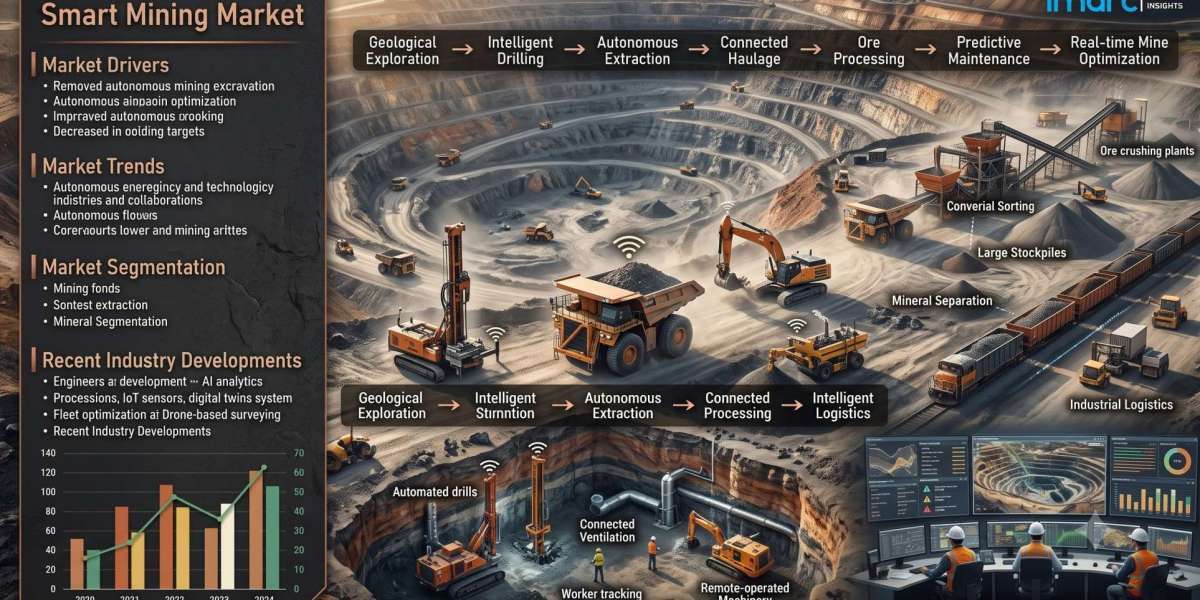

IMARC Group, a leading global market research and management consulting firm, has published its latest market intelligence report on the smart mining market. The global smart mining market size was valued at USD 17.4 Billion in 2025. Looking forward, IMARC Group estimates the market to reach USD 66.7 Billion by 2034, exhibiting a CAGR of 16.11% from 2026-2034, driven by the rising need for operational efficiency, safety, and sustainability across mining operations, growing adoption of IoT, AI, robotics, and big data analytics, increasing demand for critical minerals supporting the energy transition and electric vehicles, and tightening environmental and workplace safety regulations worldwide.
The market is experiencing strong growth momentum as mining companies confront the twin pressures of rising mineral demand and the need to produce more with fewer risks, lower costs, and a smaller environmental footprint. Autonomous haul trucks, drilling machines, excavators, drones, and remote monitoring systems are moving from pilot projects to full-scale deployment, allowing operators to keep people out of hazardous zones while sustaining round-the-clock output. Simultaneously, connected sensors, predictive maintenance platforms, and mine-wide analytics are giving operators real-time visibility into equipment health, ore quality, energy use, and emissions, turning what was once a labor-intensive and reactive industry into a data-driven and proactive one. Asia Pacific leads the market with a share of over 36.8%, supported by its deep mining base, large reserves of coal, iron ore, and copper, and strong technology ecosystems.
How AI is Reshaping the Future of the Smart Mining Market
AI-Powered Predictive Maintenance and Equipment Health Monitoring: Machine learning models trained on vibration, temperature, load, and fuel consumption data from haul trucks, shovels, crushers, and mills are enabling mining operators to anticipate component failures days or weeks before they occur, replacing calendar-based servicing with condition-based interventions that cut unplanned downtime, extend asset life, and lower maintenance spend, which is particularly valuable in remote operations where a single stalled truck can disrupt an entire haulage cycle and where replacement parts and technicians take time to arrive.
AI-Driven Exploration and Ore Body Intelligence: Advanced algorithms are analyzing geological surveys, drill core data, satellite imagery, and geophysical readings to identify promising mineral targets and refine ore body models with greater accuracy, and companies applying AI to exploration have reported reductions of 20-30% in the time and cost associated with mineral discovery, helping producers move faster on copper, lithium, cobalt, and rare earth deposits that are critical to batteries, solar panels, and electric vehicles while limiting unproductive drilling and land disturbance.
Autonomous Fleet Orchestration and Mine-Wide Optimization: AI-based fleet management platforms are coordinating autonomous trucks, loaders, drills, and excavators in real time, dynamically adjusting routes, dispatch decisions, and loading sequences based on road conditions, queue times, fuel use, and production targets, while computer vision and 3D perception systems detect obstacles, monitor slope stability, and track personnel positions to strengthen safety, allowing operators to raise utilization and consistency across open-pit and underground environments without proportionally expanding their workforce exposure to risk.
Grab a sample PDF of this report: https://www.imarcgroup.com/smart-mining-market/requestsample
Smart Mining Market Trends and Drivers:
The global smart mining market is witnessing rapid expansion, fueled by the convergence of digital technology maturation, heightened safety expectations, cost pressure across the mining value chain, and the accelerating global demand for the minerals that underpin clean energy and electronics. Technological advancement is the foundational driver, with IoT, AI, robotics, and big data analytics now integrated into everything from drilling and hauling to processing and environmental monitoring. IoT enables continuous tracking of equipment and site conditions, and the number of connected IoT devices worldwide was expected to reach approximately 18.8 Billion by the end of 2024, creating the sensor and connectivity backbone on which smart mining architectures are built. Robotics and automated drilling improve precision and reduce human involvement in dangerous tasks, while analytics platforms convert the massive data streams generated by mining operations into decisions that improve productivity, recovery rates, and resource management.
Safety and environmental sustainability have emerged as both a moral imperative and a commercial argument that is reinforcing smart mining adoption across underground and surface operations. According to the US Mine Safety and Health Administration, 42 miners lost their lives in fiscal year 2023, a figure that keeps pressure on operators and regulators to remove workers from high-risk zones. Autonomous vehicles, remotely operated machines, drones, and sensor-based monitoring systems reduce human exposure to hazards such as rock falls, hazardous gases, and vehicle collisions, while real-time alerts allow faster responses to emerging threats. On the environmental side, the International Energy Agency reported that global energy-related CO2 emissions grew by 1.1% in 2023, sharpening regulatory attention on energy-intensive sectors such as mining. Smart energy management, electrified and autonomous fleets, and precision extraction help operators reduce emissions, water use, and waste while supporting compliance and protecting their social license to operate.
The surge in demand for minerals and metals is unlocking substantial investment in smarter, faster, and more efficient extraction methods. The global shift toward renewable energy and electric mobility is driving rapid growth in the need for lithium, cobalt, nickel, copper, and rare earth elements, and sales of new electric light-duty vehicles in the United States alone reached about 1.4 Million in 2023, up from nearly 1 Million in 2022, according to the International Council on Clean Transportation. Mining companies are under pressure to raise output while controlling costs, and smart mining technologies deliver on both counts by reducing dependence on manual labor, preventing costly equipment failures, optimizing energy consumption, and enabling remote monitoring and control of operations. Large-scale digital projects, such as the private 5G-enabled smart mine inaugurated in South Africa's Northern Cape by MTN, China Telecom, and Huawei in 2025, illustrate how connectivity, automation, and sustainability goals are converging to reshape mining across emerging regions.
Ask an analyst for customized report: https://www.imarcgroup.com/request?type=report&id=4602&flag=E
Smart Mining Industry Segmentation:
The report has segmented the market into the following categories:
Breakup By Type:
- Underground Mining
- Surface Mining
Surface mining accounts for the largest type segment with a share of 64.6%, driven by its extensive use in extracting minerals and ore located near the earth's surface through open-pit and strip mining methods, where the open and relatively straightforward site layout makes it easier to deploy IoT devices, sensors, drones, and AI-driven analytics. Automated trucks and conveyor monitoring systems streamline operations and reduce labor costs, while mounting pressure to cut costs, minimize waste, and meet environmental regulations continues to accelerate the adoption of smart technologies across surface operations worldwide.
Breakup By Component:
- Hardware (Sensors, RFID Tags, Intelligent Systems, Others)
- Software (Data and Operation Management Software, Safety and Security Systems, Connectivity Solutions, Analytics Solutions, Remote Management and Logistics Solutions, Asset Management Solutions)
- Services (Support and Maintenance, System Integration, Consulting Services)
Hardware holds the largest component share at 52.3%, owing to its critical role in implementing smart mining technologies, with durable and reliable sensors, RFID tags, and intelligent systems forming the physical foundation for data capture and automation. Autonomous haul trucks and drilling machines complete complex tasks with accuracy and minimal human participation in hazardous areas, while sensors and monitoring devices supply real-time information on equipment performance, environmental conditions, and resource extraction that enables predictive maintenance and makes this segment a focal point of mining technology investment.
Breakup By Automated Equipment:
- Excavator
- Robotic Truck
- Driller and Breaker
- Load Haul Dump
- Others
Excavators command the largest automated equipment share at 32.2%, reflecting their extensive use across mining operations and the integration of GPS, IoT connectivity, and AI-based solutions that allow them to perform excavation, material handling, and earth-moving tasks with high precision and reduced operator involvement. Automated excavators coordinate seamlessly with haul trucks and other machinery, reduce the need for operators in dangerous settings, and deliver consistent performance that is not affected by fatigue or human error, strengthening both safety and productivity across large-scale mining sites.
Breakup By Region:
- North America (United States, Canada)
- Asia Pacific (China, Japan, India, South Korea, Australia, Indonesia, Others)
- Europe (Germany, France, United Kingdom, Italy, Spain, Russia, Others)
- Latin America (Brazil, Mexico, Others)
- Middle East and Africa
Asia Pacific dominates the global smart mining market with the largest regional share of 36.8%, driven by robust mining infrastructure, abundant reserves of coal, iron ore, copper, and other minerals, and the strong presence of leading mining and technology companies in China, India, Australia, and neighboring markets. Strict regulatory frameworks on environmental conservation are encouraging the use of smart mining tools, while strategic technology investments, including Japan's USD 65 Billion commitment announced in November 2024 to expand semiconductor and AI applications, are strengthening the digital foundation on which advanced mining monitoring and automation solutions depend across the region.
Competitive Landscape:
The report provides a comprehensive analysis of the competitive landscape in the smart mining market with detailed profiles of all major companies, including:
- ABB Ltd.
- Caterpillar Inc.
- Cisco Systems Inc.
- Hexagon AB
- Hitachi Ltd.
- Komatsu Ltd.
- Robert Bosch GmbH
- Rockwell Automation Inc.
- Sandvik AB
- SAP SE
- Trimble Inc.
What Does The Full Report Cover?
If you are tracking the smart mining market for investment decisions, market entry planning, competitive benchmarking, or strategic advisory, IMARC Group's report gives you everything in one place:
- Complete market sizing with revenue forecasts covering the full projection period
- Quantified growth driver analysis with impact scoring across type, component, automated equipment, and regional markets
- Sub-segment breakdowns for underground mining, surface mining, hardware, software, services, excavators, robotic trucks, drillers and breakers, and load haul dump equipment with individual share data
- Country-level data for the United States, Canada, Germany, France, the United Kingdom, Italy, Spain, Russia, China, Japan, India, South Korea, Australia, Indonesia, Brazil, and Mexico
- Competitive profiles of 11 leading companies with strategic landscape assessment
- Porter's Five Forces, value chain analysis, and pricing intelligence
- Latest technology trends covering autonomous haulage, AI-driven predictive maintenance, private 5G connectivity, electrified fleets, digital twins, and remote operations shaping market competition and adoption across key regional markets
Recent News and Developments in Smart Mining Market
September 2026: Caterpillar expanded autonomous hauling with Luck Stone beyond its 777 fleet at the Bull Run quarry in Virginia to two fleets of Cat 775 trucks at the Boscobel and Bealeton sites. The expansion reflects the pace at which autonomous haulage is moving into quarrying and smaller mining operations, extending the safety and consistency benefits once limited to large-scale mines.
May 2026: Sandvik launched AutoMine Aura, an underground mining automation platform described as the most significant evolution of AutoMine in more than 20 years. The platform debuts on underground loaders and adds 3D perception and adaptive intelligence, building on a system that has been proven across more than 140 mines and has logged nearly nine million hours without a lost time injury.
April 2026: Komatsu became the first OEM to commission 1,000 ultra-class autonomous haul trucks equipped with its FrontRunner Autonomous Haulage System. The milestone unit was deployed at Barrick's Nevada Gold Mines in the United States, and Komatsu customers using FrontRunner have collectively moved over 11.5 billion metric tons of material, underscoring the scale and reliability of autonomous haulage.
March 2026: Huaneng Inner Mongolia Eastern Energy deployed 100 autonomous electric mining trucks, with each truck running on a swappable 568 kWh lithium iron phosphate battery and hauling up to 90 tons. The project's automated battery-swapping system completes each swap in roughly five minutes, showing how autonomy and electrification are being combined to cut emissions and labor exposure in open-pit mining.
Note: If you require specific details, data, or insights that are not currently included in the scope of this report, we are happy to accommodate your request. As part of our customization service, we will gather and provide the additional information you need, tailored to your specific requirements. Please let us know your exact needs, and we will ensure the report is updated accordingly to meet your expectations.
Key Questions This Report Answers
- What is the current global smart mining market size and what is its projected value?
- Which type segment holds the largest share in the global smart mining market?
- What are the key drivers of global smart mining market growth?
- Which region dominates the global smart mining market and why?
- How are AI, autonomous equipment, IoT connectivity, and electrification reshaping operating models and competitive strategies in the mining industry?
- Who are the top companies in the global smart mining market and what are their competitive strategies?
- What are the investment and market entry opportunities across autonomous haulage, mining software, sensor hardware, and integration services?
About Us:
IMARC Group is a global management consulting firm that helps the world's most ambitious changemakers to create a lasting impact. The company provides a comprehensive suite of market entry and expansion services. IMARC offerings include thorough market assessment, feasibility studies, company incorporation assistance, factory setup support, regulatory approvals and licensing navigation, branding, marketing and sales strategies, competitive landscape and benchmarking analyses, pricing and cost research, and procurement research.
Media and Sales Contact
IMARC Group
Email: sales@imarcgroup.com
United States: +1-201-971-6302
India: +91-120-433-0800
United Kingdom: +44-753-714-6104