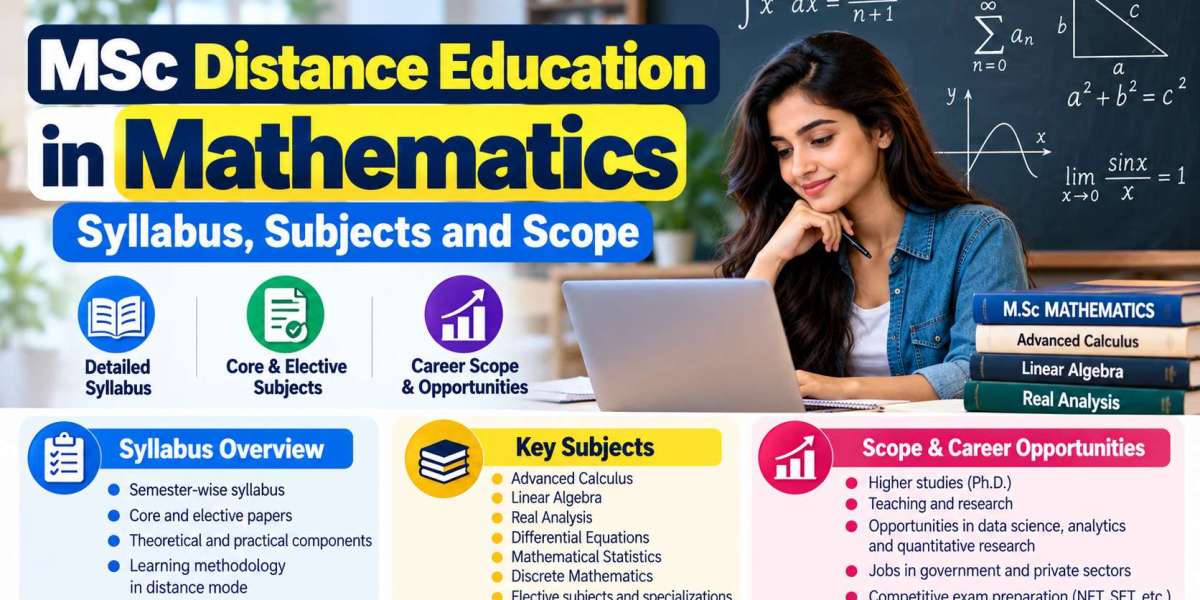

Mathematics is the most widely offered subject in MSc Distance Education, and it is easy to see why. It needs no laboratory, it rewards steady self-study, and it leads to careers in teaching, data, finance, and research. If you hold a bachelor’s degree with Mathematics and want a postgraduate qualification without leaving your job, this program deserves a serious look.
This guide explains what you will study in an M.Sc Distance Education in Mathematics, how the syllabus is structured, who can apply, what it costs, and where the degree can take you. If you are comparing options for a Distance Education MSc, this article will help you judge whether Mathematics is the right fit.
What Is MSc Distance Education in Mathematics?
An M.Sc in Mathematics through distance mode is a two-year postgraduate program that covers pure and applied mathematics. The content is the same kind of material taught in a regular program, but you learn through self-learning modules, online or recorded lectures, assignments, and term-end exams instead of daily classroom attendance.
Because Mathematics depends on theory and problem solving rather than lab equipment, it adapts to distance learning better than most science subjects. This is why many universities, including IGNOU and several state open universities, offer it. Programs differ in name and emphasis. Some are titled simply M.Sc Mathematics, while others focus on applications, such as Mathematics with Applications in Computer Science. Approvals change each session, so always confirm the current list on the UGC-DEB website.
Who Should Choose MSc Distance Education in Mathematics?
This program is a good match if you:
- Are a school teacher who needs a postgraduate degree for promotion
- Are a working professional moving toward data, analytics, or finance
- Want to prepare for UGC NET, CSIR NET, or other competitive exams
- Plan to pursue a PhD later and need a strong foundation
- Enjoy problem solving and can study independently
It is less suitable if you need constant guidance from teachers or if you struggle to keep a regular study routine without supervision.
Eligibility for MSc Distance Education in Mathematics
Eligibility rules vary slightly by university, but these are the common requirements.
Bachelor’s degree. A B.Sc with Mathematics as a subject, and in some universities as a major or honours subject. Certain universities also accept B.Tech, B.E., or BCA graduates.
Minimum marks. Often 45 to 50 percent in graduation, with relaxation for reserved categories. Some universities only require a pass.
Entrance exam. Usually not required. Admission is generally based on graduation marks.
Age limit. Typically none.
Always read the prospectus of your chosen university, since rules differ.
Course Duration
The standard duration of a Distance Education MSc in Mathematics is two years. Some universities divide it into four semesters, while others use two annual cycles. Distance learners are usually allowed extra time, commonly up to four years in total, to clear all papers.
Typical Syllabus Structure
Most programs combine core papers, elective papers, and sometimes a project. The exact structure depends on the university, but a common pattern looks like this.
First year. Foundation papers in advanced mathematics, usually compulsory for all students.
Second year. Advanced core papers, electives that let you specialize, and in some programs a project or dissertation.
Download the official syllabus from each university you are considering and compare them, since the topics and the depth of coverage can differ.
Core Subjects You Will Study
These subjects appear in most M.Sc Mathematics programs.
Real analysis. A rigorous study of limits, continuity, differentiation, integration, sequences, and series of real numbers. It builds the logical foundation for advanced mathematics.
Complex analysis. Functions of a complex variable, analytic functions, contour integration, and residue theory. It is widely used in physics and engineering.
Abstract algebra. Groups, rings, fields, and their properties. It is central to pure mathematics and has applications in cryptography and coding theory.
Linear algebra. Vector spaces, linear transformations, eigenvalues, and matrix theory. It supports almost every applied field, including machine learning.
Topology. The study of spaces and continuity in a general setting, including open sets, compactness, and connectedness.
Differential equations. Ordinary and partial differential equations and their solutions, which are essential for modelling real-world systems.
Numerical analysis. Methods for solving mathematical problems using approximation and computation, including interpolation, numerical integration, and solving equations.
Measure theory and functional analysis. Advanced topics found in many second-year programs, forming a base for research.
Elective and Specialization Papers
Many universities let you choose electives in the second year. Common options include:
- Operations research and optimization
- Mathematical modelling
- Probability and statistics
- Discrete mathematics and graph theory
- Number theory
- Differential geometry
- Fluid mechanics
- Programming for mathematics, using languages such as Python or C
- Cryptography
- Financial mathematics
Choose electives that support your career plan. If you want data roles, pick probability, statistics, and programming. If you aim for research, lean toward analysis, algebra, and topology.
Practicals and Projects
Mathematics has little or no lab work, but some programs include computer-based practicals, where you use software such as MATLAB, Mathematica, Python, or R. Others require a project report or dissertation in the final year.
If your program has a practical or project component, check how it is evaluated, whether you must attend a study center, and whether there are separate fees.
Assignments and Examinations
Distance programs usually combine continuous and final assessment.
Assignments. You submit them during the year, and they often carry a portion of the final marks, commonly 20 to 30 percent.
Term-end exams. These are held at designated centers, and some universities now offer online proctored exams. The pattern usually includes a mix of short-answer and long-answer questions.
Passing marks. Many universities require around 40 to 50 percent in each paper, but this varies.
Mathematics exams reward practice, so solving previous years’ papers is one of the best ways to prepare.
Learning Resources You Can Expect
A good program provides:
- Self-learning modules, in print or digital form
- Recorded video lectures and live sessions
- Discussion forums and doubt-clearing support
- Previous question papers
- Counselling or contact classes at study centers
- Access to an online library
Some students also add free or paid online resources, such as video lectures and problem-solving platforms, to strengthen weak areas.
Fees for MSc Distance Education in Mathematics
As a general estimate, public and open universities charge roughly 10,000 to 40,000 rupees per year, while private or deemed universities may charge more. Exam fees, study material, and re-registration charges can be extra, so always calculate the full two-year cost. Fees change each session, so confirm the latest amount on the official website.
Career Scope After MSc Distance Education in Mathematics
A Mathematics postgraduate degree is valued because it builds strong logical and analytical skills. Here are the main paths.
Teaching. Many graduates become school teachers or tutors. For college and university lecturer posts, you generally need to qualify UGC NET or a State Eligibility Test. A degree from a recognized university in distance mode is generally accepted for these exams, but check the latest rules.
Data and analytics. Mathematics graduates with programming and statistics skills can work as data analysts, business analysts, or machine learning associates.
Banking and finance. Roles in risk analysis, quantitative analysis, and financial modelling often prefer mathematical training.
Actuarial science. Passing actuarial exams alongside your degree can lead to roles in insurance and pension planning.
Government jobs. Many exams and recruitments accept postgraduate Mathematics degrees. Read each notification to confirm that distance degrees are accepted.
Research and PhD. A distance degree can lead to PhD programs, but individual universities set their own rules, so check before applying.
Software and IT. Strong mathematical skills are valuable in algorithm design, cryptography, and scientific computing, especially when combined with coding skills.
Boosting Your Career With Extra Skills
A degree alone is rarely enough. You can improve your prospects by adding:
- Programming skills in Python, R, or C
- Data analysis and machine learning courses
- Certifications in data science or analytics
- Actuarial exam preparation
- Practice for UGC NET, CSIR NET, or GATE
- Projects or internships that show applied work
Students who combine a Distance Education MSc in Mathematics with practical skills often stand out in job applications.
Is It Valid for Competitive Exams and PhD?
A degree from a UGC-DEB approved university is generally valid for further studies and many exams. However, the final decision rests with the exam body, employer, or university department. Before you enroll, check the eligibility rules of any exam you plan to take, including UGC NET, CSIR NET, GATE, and state-level recruitments, and confirm that distance degrees qualify.
Tips to Succeed in MSc Mathematics Through Distance Mode
Study a little every day. Mathematics needs regular practice, and cramming rarely works.
Solve problems, do not just read. Work through examples and exercises on paper.
Master the basics first. Weak foundations in analysis and algebra make later topics harder.
Make a weekly plan. Divide each paper into units and set deadlines.
Use previous papers. They show the exam pattern and the topics asked most often.
Join study groups. Online communities help you clear doubts and stay motivated.
Seek help early. Use helplines, forums, and contact classes instead of getting stuck alone.
Revise often. Keep short notes of theorems and formulas for quick revision.
Common Mistakes to Avoid
- Enrolling without checking UGC-DEB approval for the program
- Ignoring the syllabus and choosing electives randomly
- Postponing study until the exam is near
- Skipping assignments, which affect your marks
- Memorizing proofs without understanding them
- Not checking whether your target exam or job accepts distance degrees
Final Thoughts
An MSc Distance Education in Mathematics is one of the most practical postgraduate options for working professionals. It needs no lab, fits a flexible schedule, and builds skills that apply to teaching, data, finance, and research. Success depends on consistent practice, a recognized university, and a clear career plan.
Before you apply, verify UGC-DEB approval, compare syllabi, and confirm the fee structure. With steady effort, your M.Sc Distance Education in Mathematics can become a strong foundation for the career you want.
https://www.inboxjournal.com/id/mcmglobaleducation
https://www.mcmglobaleducation.com/blog/is-pgdm-worth-it/
https://www.mcmacademy.in/graduation-degree-one-year-bangalore/
https://www.mcmacademy.in/b-ed-in-one-year/
https://www.mcmacademy.in/fast-track-courses/
https://www.mcmacademy.in/blog/top-10-llm-specializations-in-demand/
https://www.mcmacademy.in/blog/best-ece-colleges-in-india/
https://www.mcmacademy.in/bcom-distance-education/
https://www.mcmacademy.in/mcom-distance-education/
https://www.mcmacademy.in/part-time-phd/
https://www.mcmacademy.in/ba-distance-education/