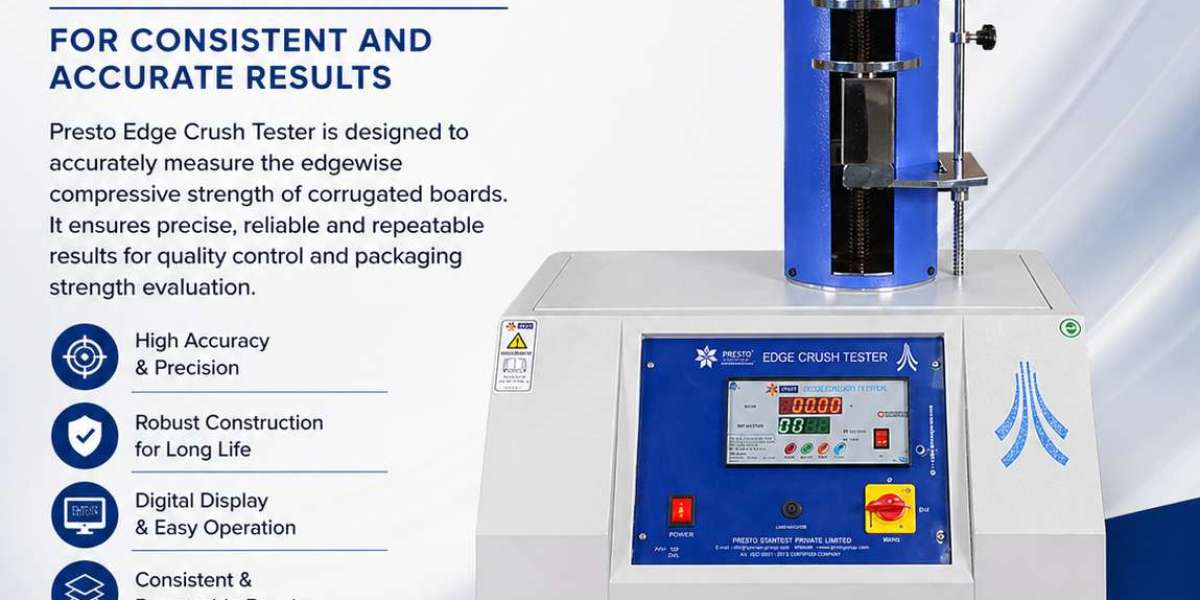

Packaging strength is essential for protecting products during storage, handling, and transportation. Corrugated boxes must withstand stacking pressure and maintain their structural integrity throughout the supply chain. One important parameter used to evaluate corrugated board strength is its resistance to edgewise compression. This is where an edge crush tester becomes an important instrument for packaging manufacturers and quality control laboratories.
An edge crush test machine helps measure the compressive strength of corrugated board by applying force to a prepared test specimen positioned on its edge. The results help manufacturers evaluate packaging performance, maintain quality standards, and select suitable materials for different applications.
In this blog, we will explain the working principle, test procedure, applications, and important factors to consider when choosing an edge crush tester.
What Is an Edge Crush Tester?
An edge crush tester is a testing instrument used to determine the edgewise compressive strength of corrugated fibreboard. During testing, a small specimen of corrugated board is positioned vertically between two parallel compression plates. The machine applies a gradually increasing compressive force until the specimen fails or reaches the defined endpoint.
The result is commonly expressed as force per unit length, such as kilonewtons per metre (kN/m) or pounds per inch (lb/in), depending on the testing system.
Edge crush testing is important because corrugated board must resist compression when boxes are stacked on top of one another. A reliable edge crush tester helps packaging manufacturers assess board quality and maintain consistency between production batches.
Working Principle of an Edge Crush Test Machine
The working principle of an edge crush test machine is based on applying a controlled compressive load to the edge of a corrugated board specimen.
The machine typically consists of a load frame, compression plates, a load-measuring system, and a digital controller or display. Depending on the model, it may also include software for recording and analysing test results.
The process works as follows:
Specimen preparation: A corrugated board sample is cut to the dimensions specified by the applicable test method.
Sample positioning: The specimen is placed vertically between the compression plates, ensuring that its edges are aligned correctly.
Load application: The machine applies a steadily increasing compressive force at the specified test speed.
Failure detection: The instrument records the force at which the specimen buckles, crushes, or reaches the defined failure point.
Result calculation: The maximum recorded force is used to determine the edgewise compressive strength based on the specimen dimensions.
The testing procedure and specimen preparation must follow the applicable standard to obtain meaningful and comparable results.
Edge Crush Test Procedure
Following a consistent testing procedure helps improve the reliability and repeatability of edge crush test results. The exact procedure depends on the applicable standard and the equipment configuration.
Prepare the specimen: Cut a corrugated board sample to the dimensions specified by the selected test method. Ensure the edges are clean and undamaged.
Condition the sample: Condition the specimen under the required temperature and humidity conditions before testing.
Set up the machine: Check the compression plates, load measurement system, and required test settings.
Position the specimen: Place the sample vertically between the compression plates, with the flutes aligned correctly.
Apply compression: Start the machine and allow it to apply a controlled compressive load until the specimen fails.
Record the result: Record the maximum force and calculate the edge crush resistance using the specimen width.
Repeat the test: Test the required number of specimens and evaluate the results according to the selected standard.
Proper specimen preparation, alignment, and conditioning are essential to minimise testing errors.
Applications of an Edge Crush Tester
An edge crush tester is widely used wherever corrugated packaging must withstand compression during storage and transportation.
Corrugated box manufacturing: Evaluates board strength before boxes are converted and supplied to customers.
Paper and packaging industries: Helps maintain consistent quality across different corrugated board grades.
E-commerce packaging: Supports the development of boxes that can withstand stacking and distribution loads.
Food and beverage packaging: Helps assess the compression resistance of cartons used for packaging and shipping.
Pharmaceutical packaging: Supports quality checks for corrugated shipping cartons used to transport packaged products.
Quality control laboratories: Provides measurable results for comparing raw materials, production batches, and packaging designs.
ECT results can help inform packaging design decisions, although actual box performance also depends on factors such as box dimensions, board thickness, moisture, and storage conditions.
Important Standards for Edge Crush Testing
Manufacturers should select the applicable standard based on their product requirements and testing procedures. Commonly referenced standards include:
ISO 3037: Determination of edgewise crush resistance of corrugated fibreboard using the unwaxed edge method.
ISO 13821: Determination of edgewise crush resistance using the waxed edge method.
TAPPI T 811: Edgewise compressive strength testing of corrugated fibreboard using the short-column method.
TAPPI T 838 and TAPPI T 839: Additional methods for evaluating the edge crush resistance of corrugated fibreboard
Always verify the current edition and confirm that the machine, fixtures, and specimen preparation method meet the requirements of the selected standard.
How to Choose the Right Edge Crush Tester
Selecting the right edge crush tester depends on your laboratory's testing requirements, production volume, and quality control objectives.
1. Measurement accuracy: Choose a machine with suitable load measurement accuracy and repeatability for your required testing range.
2. Load capacity: Ensure the instrument can accommodate the expected compressive loads of your corrugated board samples.
3. Digital display and peak load detection: These features help operators monitor results and record the maximum force reached during testing.
4. Testing fixtures: Confirm that the equipment supports the required edge crush test method. Some machines also support ring crush and flat crush testing with separate fixtures.
5. Calibration and safety: Look for calibration facilities, appropriate safety mechanisms, and clear operating instructions.
6. Manufacturer support: Consider technical assistance, maintenance, spare parts availability, and after-sales service when comparing suppliers.
Why Choose Presto Stantest Pvt. Ltd.?
Presto Stantest Pvt. Ltd. provides testing instruments designed to support packaging quality control and material evaluation. Its RCT/FCT/Edge Crush Tester range is designed to measure the crushing resistance of corrugated fibreboard using appropriate testing fixtures.
Depending on the selected model, features may include a digital display, automatic peak load detection, an inbuilt calibration facility, and safety limit switches. Computerised configurations are also available for laboratories that require additional testing and reporting capabilities.
Presto Stantest can help businesses identify a suitable testing configuration based on their packaging materials, required standards, and laboratory needs.
Explore the Presto Stantest Edge Crush Tester to learn more about edge crush testing and its role in packaging quality control.
Conclusion
An edge crush tester is an important instrument for measuring the edgewise compressive strength of corrugated fibreboard. By following the correct test procedure and applicable standards, manufacturers can evaluate packaging material quality and make informed decisions about box design and performance.
When choosing an edge crush test machine, consider its accuracy, load capacity, testing fixtures, safety features, and manufacturer support. Presto Stantest Pvt. Ltd. offers testing solutions to help packaging manufacturers and laboratories maintain consistent quality and improve their packaging evaluation processes.