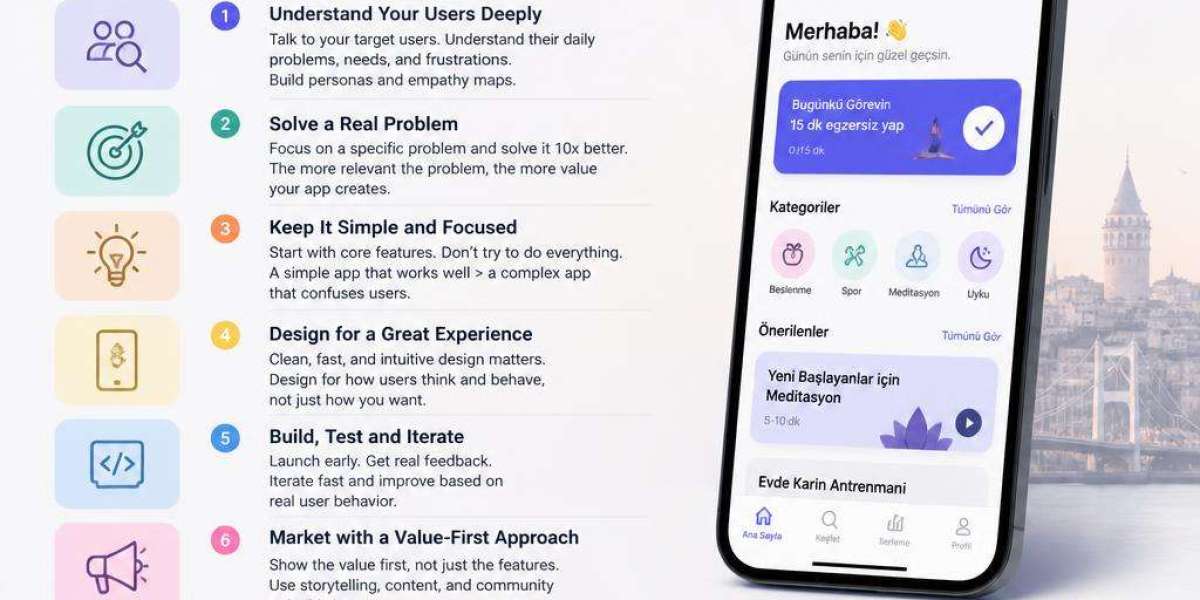

Across Turkey, startups in Istanbul, Ankara, Izmir, Bursa, and Antalya are exploring mobile technology to introduce new services, reach customers, and establish distinctive brands. However, an application that looks impressive during a demonstration may struggle after launch if its features do not match real customer needs.
The solution is to approach mobile app development in Turkey as a customer-focused process rather than simply a technical project. By combining market research, thoughtful design, useful functionality, and continuous improvement, startups can create applications that people genuinely enjoy using.
1. Start by Understanding What Your Customers Really Need
Before writing code or designing screens, identify the problem your application will solve. A strong product idea begins with a clear understanding of customer frustrations, daily routines, and unmet expectations.
For example, a startup in Istanbul might notice that local customers struggle to compare service providers. An entrepreneur in Ankara may identify difficulties with appointment scheduling, while a business in Izmir could discover an opportunity to simplify online ordering for independent retailers.
These observations can become the foundation of a useful mobile product.
Conduct meaningful customer research
Startups should speak directly with potential users instead of making assumptions about their preferences. Short interviews, online questionnaires, competitor reviews, and small discussion groups can reveal valuable insights.
Ask questions such as:
What difficulties do you currently experience with this service?
Which tools or applications do you already use?
What frustrates you about existing solutions?
Which features would save you time or effort?
What would encourage you to use a new application regularly?
Research should focus on actual behavior, not just hypothetical enthusiasm. Someone may express interest in an idea without being willing to use or pay for the finished product.
For startups targeting customers in Turkey, it is also useful to consider local purchasing habits, language preferences, payment expectations, and customer support requirements.
The objective is simple: develop an application that solves a recognizable problem rather than adding another product to an already crowded app marketplace.
2. Validate Your Idea Before Investing in Full Development
Once you understand the problem, test whether your proposed solution is worth building. Early validation helps startups avoid spending substantial resources on features that customers may never need.
A practical starting point is a minimum viable product (MVP). An MVP contains the essential functionality required to deliver the application's main benefit.
For example, a food ordering startup may initially need restaurant listings, menus, order placement, payment integration, and order status updates. Advanced loyalty programs or sophisticated recommendation systems could be introduced later if customers demonstrate a need for them.
How to validate an app concept
Create a simple landing page explaining the proposed service.
Share clickable design prototypes with prospective customers.
Invite a small group of users to test the main workflow.
Collect feedback about confusing steps and missing functionality.
Measure interest through registrations, trial participation, or other relevant actions.
This approach is especially useful for startups working with limited budgets.
A reliable custom mobile app development strategy in Turkey should allow businesses to test important assumptions before committing to a large development project. Early feedback can influence the product roadmap, reduce unnecessary complexity, and improve the likelihood of market acceptance.
3. Design an Experience That Feels Effortless
Even a useful application can lose customers if its interface is confusing. People generally prefer products that help them complete tasks without unnecessary steps or distractions.
A strong mobile app UI/UX design in Turkey should prioritize clarity, consistency, accessibility, and ease of navigation.
Consider the first experience a new user encounters. If registration requires too much information, menus are difficult to understand, or essential features are hidden, users may abandon the application before discovering its benefits.
Make everyday actions simple
Effective interface design involves more than selecting attractive colors and modern typography. It requires careful decisions about how information is organized and how users move through the application.
Important practices include:
Keep navigation consistent across screens.
Use clear labels instead of unfamiliar technical language.
Reduce unnecessary registration and checkout steps.
Make important buttons easy to identify.
Provide helpful error messages and confirmation notices.
Ensure readable text and accessible interactive elements.
For example, a booking application should allow users to find a service, select an available time, and confirm their appointment without navigating through unrelated screens.
Startups targeting mobile app users in Istanbul and other Turkish cities should also test their designs with people who reflect their intended audience. Real-world testing can expose problems that internal teams overlook.
An application feels intuitive when customers can concentrate on their goals instead of trying to understand the interface.
4. Choose Features That Deliver Real Value
One common startup mistake is attempting to launch with too many features. An overloaded application can increase development costs, complicate navigation, and delay the release date.
Instead, prioritize functionality according to customer needs and business objectives.
Essential features worth considering
Depending on the product, a startup may need:
Simple onboarding: Help users understand the application and begin using it quickly.
Secure authentication: Protect accounts without creating unnecessary friction.
Personalized dashboards: Display relevant information based on user needs.
Payment integration: Support appropriate and trustworthy transaction methods.
Push notifications: Deliver useful updates with user consent.
Customer support: Make it easy to ask questions or report problems.
Analytics integration: Measure product usage and identify opportunities for improvement.
Not every application requires every feature. A fitness platform, an e-commerce marketplace, and a business scheduling tool have different priorities.
For startups pursuing custom mobile application development in Turkey, feature selection should follow the validated product concept. Begin with the smallest useful set, observe how customers interact with it, and expand according to evidence.
This approach supports faster learning and helps businesses direct their budgets toward improvements that matter.
5. Select the Right Technology and Development Partner
Technology decisions affect an application's performance, maintainability, development cost, and ability to scale.
Some startups need native Android or iOS applications to support platform-specific capabilities. Others may benefit from cross-platform development, which can help share code across platforms and streamline maintenance.
The right choice depends on the application's functionality, available budget, delivery expectations, and future requirements.
What should startups evaluate?
When choosing a Mobile App Development Company in Turkey, entrepreneurs should assess more than the initial quotation.
Look for a provider that can demonstrate:
Relevant experience with comparable applications.
A structured discovery and planning process.
Clear project milestones and deliverables.
Practical recommendations about technology choices.
Strong testing and security practices.
Transparent communication throughout development.
Ongoing maintenance and post-launch support.
A dependable partner should explain the advantages and limitations of different approaches instead of recommending technology without understanding the business problem.
Startups should also clarify source-code ownership, intellectual property rights, third-party service costs, hosting arrangements, and data responsibilities before signing an agreement.
For entrepreneurs comparing mobile app developers in Istanbul and across Turkey, the best partner is one whose expertise, working style, and delivery process match the project's needs.
Five Programmers can be evaluated alongside other development providers by reviewing its project suitability, technical capabilities, communication standards, and support offerings.
6. Make Performance, Security, and Reliability a Priority
Customers expect applications to respond quickly and behave consistently. Slow loading, repeated crashes, failed payments, or unexpected errors can damage trust even when the underlying idea is valuable.
Professional Android and iOS app development in Turkey should include performance optimization and systematic testing throughout the development process.
Testing should cover different screen sizes, operating system versions, internet conditions, and common user journeys. Teams should also check how the application behaves when a network connection is interrupted or an external service becomes temporarily unavailable.
Protect customer information
Security is particularly important when an application processes personal details, payment information, or business records.
Startups should consider:
Appropriate encryption and secure communication.
Strong access controls and authentication.
Secure integration with payment providers.
Regular dependency updates and vulnerability checks.
Clear privacy notices and responsible data collection.
Compliance with applicable Turkish data protection legislation.
Collect only the information needed to provide the service. Limiting unnecessary data collection can simplify privacy management and reduce potential exposure.
For businesses serving customers across Turkey, dependable performance and responsible data handling are essential parts of a professional digital experience.
Quality assurance should not be treated as a final checkbox. It is an ongoing activity that helps protect customers and maintain product reliability as the application evolves.
7. Personalize the Experience Without Making It Intrusive
Customers appreciate applications that recognize their preferences and provide relevant information. However, personalization must be useful, transparent, and respectful of privacy.
With appropriate data and careful implementation, AI-powered mobile application development in Turkey can support intelligent search, automated assistance, personalized recommendations, and faster customer service.
For example, an online shopping application might suggest products based on a customer's browsing preferences. A travel platform could help users discover relevant activities, while a service application might direct common questions to an automated assistant.
These capabilities can reduce friction when they address a genuine need.
Apply AI thoughtfully
Startups should not introduce artificial intelligence simply to make an application appear innovative. First, identify a clear problem and determine whether AI offers a meaningful advantage over a simpler solution.
Useful safeguards include:
Explain automated recommendations when appropriate.
Avoid collecting personal information without a valid purpose.
Test AI-generated responses for accuracy.
Provide access to human support for complex issues.
Allow users to manage relevant personalization settings.
AI systems can make mistakes, so important information should be checked carefully, particularly when users rely on it to make consequential decisions.
A customer-focused application uses intelligent technology to make tasks easier, not to overwhelm people with unnecessary automation.
8. Launch Strategically and Learn From Real Users
An application launch marks the beginning of product learning, not the end of development.
Startups should introduce their products to a manageable group of users, monitor performance, and gather feedback before expanding their marketing efforts. A controlled launch can reveal technical issues and usability problems while they are still relatively easy to address.
Track meaningful performance indicators
Useful metrics depend on the application's purpose, but may include:
Activation rate: The percentage of new users who complete an important first action.
Retention rate: The proportion of users who return after a defined period.
Conversion rate: The percentage who complete a desired action, such as making a purchase.
Task completion rate: How often users successfully finish key workflows.
Crash rate: How frequently the application fails unexpectedly.
Customer satisfaction: Feedback gathered through surveys, reviews, or support interactions.
Downloads alone do not establish product success. An application can attract many installations while failing to retain active users.
For startups investing in mobile app development services in Turkey, ongoing analysis helps teams determine which features deserve improvement and which can be simplified or removed.
Regular updates, responsive support, and clear communication about improvements demonstrate that the business is listening to its customers.
9. Help Turkish Customers Discover and Trust Your App
Even a well-designed product needs an effective way to reach its intended audience. Startups should develop a launch strategy that reflects where potential customers search for information and how they evaluate unfamiliar services.
A practical promotional plan may include:
A clear website explaining the application's benefits.
An informative app store listing with relevant screenshots.
Helpful articles addressing common customer problems.
Social media content that demonstrates useful features.
Partnerships with relevant businesses or communities.
Customer testimonials collected with permission.
Referral incentives where they suit the business model.
For companies targeting startup customers in Turkey, localized communication can make the product easier to understand and more relevant to the intended audience. Turkish-language content may be essential for some audiences, while other products may need multilingual support for international customers.
Businesses should explain what the application does, who it helps, and how it improves an existing process. Honest descriptions and transparent pricing can build more confidence than exaggerated promises.
Frequently Asked Questions
1. How much does it cost to build a mobile app for a Turkish startup?
The budget depends on features, design complexity, platform selection, integrations, security requirements, and maintenance. A clearly defined MVP can help startups estimate costs before expanding the product.
2. How long does mobile app development usually take?
A simple application may take several weeks to a few months, while complex platforms can require substantially longer. Research, design, development, testing, and approval processes all influence the timeline.
3. Should a startup launch with an MVP or a complete application?
An MVP is often a sensible option when the startup needs to validate demand and learn from early users. A larger initial release may be appropriate when essential functionality or regulatory requirements make it necessary.
4. How can startups encourage customers to keep using their applications?
Provide consistent value, maintain reliable performance, simplify important tasks, respond to feedback, and introduce improvements based on actual user behavior. Useful notifications and relevant personalization can also support engagement when applied responsibly.
Conclusion: Build an App Around People, Not Just Technology
Turkish startups can improve their chances of success by understanding customer problems, validating ideas, prioritizing useful features, and investing in accessible design. Choosing appropriate technology, protecting user information, testing carefully, and improving the product after launch are equally important.
A successful application does not need to do everything from day one. It needs to solve a meaningful problem, deliver a dependable experience, and earn the confidence of the people it serves.
Five Programmers encourages startups to approach mobile product development with a clear strategy, practical expectations, and a commitment to customer value.
Ready to turn your startup idea into a customer-focused mobile application? Contact Us to discuss your requirements and Get a Free Quote Today.