
Fully Managed SOC: What Indian Retail Leaders Should Know Before Investing
Indian e-commerce and retail businesses face security pressure from every direction: payment fraud, account takeover, seasonal traffic spikes, third-party integrations and large volumes of customer data. A fully managed soc can be worth the investment when the cost of delayed detection, manual monitoring and incident disruption is higher than the price of continuous security operations. The decision should rest on business exposure, not on tool features alone.
Why retail security costs are often underestimated
Retail leaders usually compare a SOC proposal with the salary cost of hiring analysts. That comparison is incomplete. An in-house capability also requires security tooling, log storage, shift planning, training, escalation procedures and management attention.
The bigger cost often appears after an incident. A compromised customer account, fraudulent order pattern or payment application outage can interrupt revenue, create customer-service backlog and damage brand trust. During a festive sale, even a few hours of poor response can affect a disproportionate share of annual transactions.
Fully managed SOC cost for Indian e-commerce and retail should therefore be assessed against the value of protected revenue, customer data and operational continuity. A useful exercise is to estimate the business impact of a six-hour outage during a high-sale period, then compare it with the annual cost of continuous monitoring and response support.
What drives the cost of a fully managed SOC?
The cost of a fully managed SOC is driven mainly by monitoring scope, coverage hours, log volume, complexity of the environment and the level of response support required. A retailer with multiple websites, mobile apps, cloud workloads, payment integrations and store systems will usually need broader coverage than a single online store.
Service scope also matters. Basic alert monitoring costs less than a service that includes threat hunting, incident coordination, compliance reporting and regular detection tuning. Retailers should ask providers to separate these elements so the business can choose what it genuinely needs.
Where an in-house-only approach struggles
A small internal security team can be effective for policy, vulnerability management and coordination with engineering. The difficulty begins when the team must provide continuous coverage across websites, mobile applications, cloud platforms, payment systems, warehouses and physical stores.
Retail traffic is seasonal. During sale events, transaction volumes rise sharply, and so does the volume of security-relevant activity. An internal team that is already handling daily operations may not have the capacity to investigate every unusual pattern during peak periods.
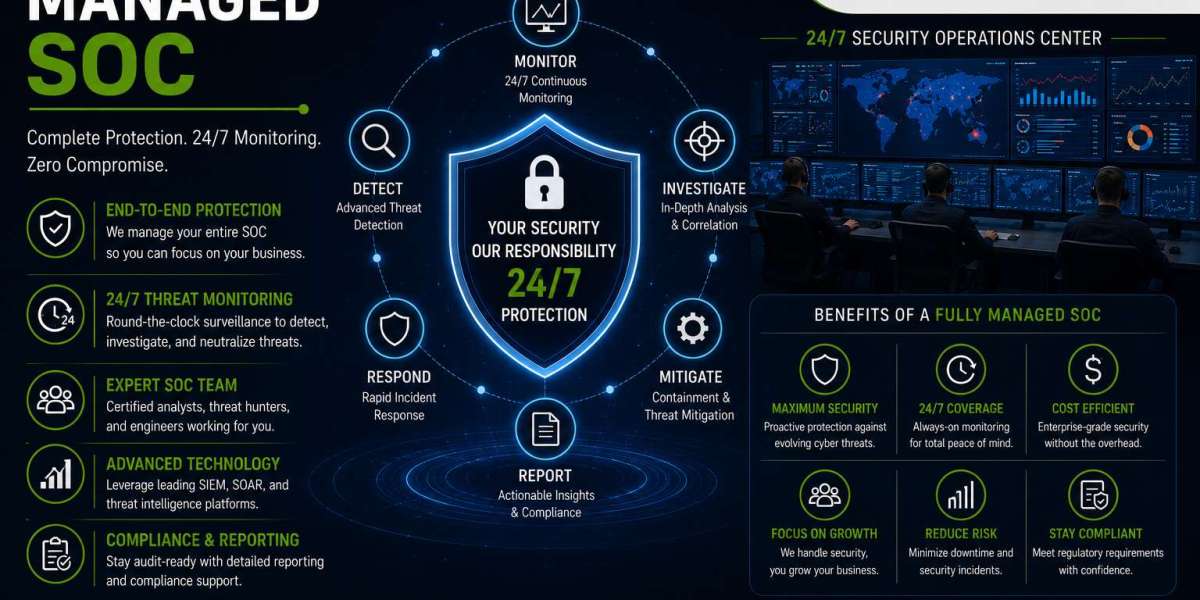
A fully managed SOC adds round-the-clock analyst capacity without requiring the retailer to recruit, train and retain a full shift-based team. The internal team keeps business context and decision authority, while the provider handles continuous triage, investigation and escalation support.
Cost and risk factor | In-house SOC model | Fully managed SOC model |
Staffing | Requires recruitment, training, retention and shift coverage | Provider supplies trained analysts and coverage capacity |
Tooling | Retailer selects, licenses and maintains security tools | Provider operates agreed monitoring and analysis capability |
Peak-season capacity | Limited by internal team size | Additional provider capacity can handle higher alert volumes |
Incident response | Depends on internal availability and documented process | Defined escalation workflow and continuous support |
Cost predictability | Salaries, tool licences and infrastructure costs continue | Usually a defined recurring service cost |
Business knowledge | Strong internal understanding of stores and systems | Depends on onboarding quality and regular collaboration |
Neither model is automatically better. The right choice depends on transaction volume, technology complexity, regulatory exposure and the retailer’s ability to maintain specialist staff.
How should retailers judge the value of managed SOC providers?
Retailers should judge managed SOC providers by the outcomes they deliver, not by the number of tools they use. Useful measures include faster escalation of credible threats, fewer false positives, clear incident documentation and better visibility across customer-facing and payment-related systems.
It also helps to ask how the provider handles seasonal peaks. A provider that can explain its approach to increased traffic, fraud-related alerts and temporary system changes is more likely to remain useful during the periods when retail risk is highest.
The retail risk that monitoring must address
Retail security is not only about preventing hackers from entering the network. It is about protecting the paths through which money, inventory and customer data move. These include online checkout flows, payment gateways, loyalty programmes, customer accounts, warehouse systems, vendor integrations and in-store point-of-sale environments.
Account takeover is a useful example. A criminal may test stolen credentials, change an account’s contact details and place high-value orders for resale. If monitoring only looks for malware, the pattern may be missed. A retail-aware SOC looks for unusual login behaviour, sudden account changes, abnormal order patterns and suspicious use of saved payment methods.
The same logic applies to internal risk. A warehouse system account that suddenly exports unusual inventory data, or an administrative account accessing customer records outside normal working patterns, deserves prompt review. Monitoring should connect these events to a response process rather than leaving them in a log.
Can a fully managed SOC reduce fraud-related losses?
A fully managed SOC can reduce fraud-related losses by identifying suspicious account, session and transaction-related activity earlier and escalating it for business action. It does not replace a fraud engine, but it adds security context around account compromise, credential misuse and system-level anomalies.
The strongest results come when the SOC works alongside fraud, risk and engineering teams. Security analysts can flag a compromised account pattern, while the retailer’s fraud rules decide whether to hold an order, require verification or block a transaction.
A practical retail scenario
Imagine an online retailer preparing for a major sale. Traffic rises, marketing campaigns launch and customer-service volumes increase. Around midnight, the SOC notices several customer accounts changing delivery addresses shortly after login from unfamiliar devices.
The analyst correlates the activity across accounts and identifies a common pattern. The provider escalates the issue to the retailer’s fraud and security contacts with evidence, affected-account details and suggested containment options. The retailer can require step-up verification, review recent orders and notify affected customers where appropriate.
Without that early signal, the retailer might discover the issue through chargebacks, customer complaints or refund requests days later. The managed model does not guarantee prevention, but it gives the business time to act before losses spread.
How to decide with confidence
Start by listing the retailer’s critical revenue paths and data stores. Include the website, mobile app, checkout flow, payment integrations, customer database, order management platform and store systems. Then identify who currently watches these systems after business hours.
Next, quantify the operational impact of a likely incident. Consider lost sales, refund processing, customer-support load, payment disruption and management time. After that, compare the cost of a managed service with the cost of building equivalent internal coverage, including the risk of key-person dependency.
Finally, ask each provider for a scoped onboarding plan. The plan should state which systems will be monitored, what alerts will be escalated, who receives them and how performance will be reviewed. A clear scope protects the retailer from paying for broad promises that do not match its actual environment.
Frequently asked questions
Is a fully managed SOC suitable for a mid-size Indian e-commerce business?
Yes, particularly when the business operates customer-facing applications, processes online payments or holds substantial customer data. A managed model provides continuous coverage without the fixed cost of a full internal shift-based team.
Does a fully managed SOC include fraud prevention?
Not necessarily. A SOC focuses on security monitoring, threat detection and incident response, while fraud prevention usually requires dedicated transaction rules and business controls. The two functions work best when they share alerts and context.
What should retailers review after the first few months of service?
Review escalation quality, response times, false-positive trends, coverage gaps and the usefulness of incident reports. These reviews help the retailer refine scope and ensure the service remains aligned with business risk.
IBN Technologies provides managed SOC and SIEM services that help Indian e-commerce and retail organisations improve threat visibility, incident response and protection across digital commerce and retail operations.
Contact Us
IBN Technologies
Phone: +91 20 6768 0404
Email: sales@ibntech.com