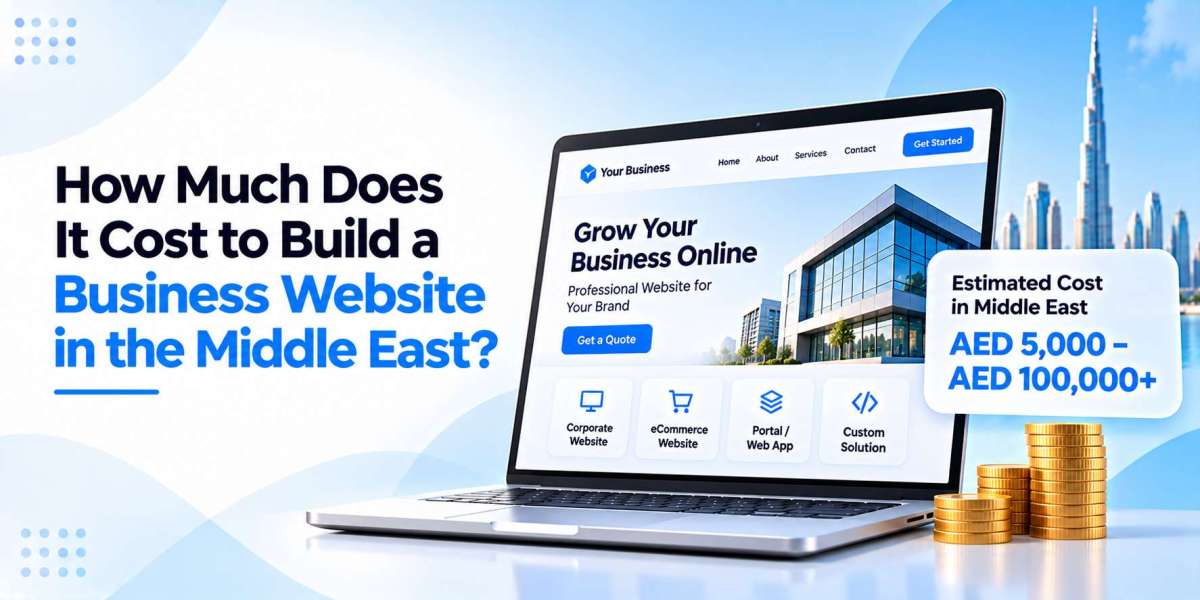

A business website is no longer a digital brochure. In the Middle East it is often the first place a customer checks before calling, ordering or visiting. Whether you run a clinic in Dubai, a trading company in Riyadh or a boutique in Doha, the question is the same: what will a proper website cost? The answer varies widely across the region, so this guide breaks down typical budget ranges, the features that move the price and the regional factors that many first-time buyers overlook.
Website Development Cost Ranges in the Middle East
The ranges below are indicative market figures for professionally built sites from agencies in the Gulf. Freelancers can be cheaper and large agencies more expensive, so treat them as planning numbers.
Website type | What it includes | Indicative cost (USD) | Timeline |
|---|---|---|---|
Basic business site | 5 to 8 pages, contact forms, mobile-friendly design, basic SEO setup | 3,000 – 8,000 | 3–6 weeks |
Corporate website | 10 to 25 pages, custom design, blog, CMS, bilingual support, analytics | 8,000 – 25,000 | 6 – 12 weeks |
eCommerce website | Product catalogue, cart, local payment gateways, delivery integration, admin dashboard | 15,000 – 60,000 | 3 – 6 months |
Custom web platform | Portals, booking systems, dashboards, integrations, multi-user roles | 40,000 – 150,000+ | 4 – 9 months |
In UAE dirhams, a corporate website therefore usually lands between roughly AED 30,000 and AED 90,000, while larger platforms move well into six figures.
Why Prices Differ Across the Region
The same website can be quoted very differently in Dubai, Riyadh, Doha or Kuwait City. Common reasons include:
- Agency location and overheads: teams based in the Gulf price in local salaries and office costs, while offshore teams may quote lower rates.
- Market maturity: Dubai and Riyadh have many experienced agencies, which creates a wide range of prices for similar work.
- Client expectations: enterprise and government buyers often require security reviews, documentation and support contracts that raise cost.
- Language requirements: a polished Arabic and English experience takes more effort than a single-language site.
Features That Influence the Price
Design. A template-based design is far cheaper than a custom design built around your brand. Custom design includes research, wireframes, visual concepts, revisions and a design system. For premium brands in the Gulf, custom design is usually worth the investment.
Arabic and English support. A bilingual site is a baseline expectation in much of the region. Proper right-to-left layout, Arabic typography, translated content and language switching add design and testing time, typically 15 to 30 percent over a single-language build.
Content management system. WordPress and similar platforms keep costs down and let your team update content. A custom CMS offers more control but takes longer to build.
eCommerce and payments. Online stores need product management, inventory, tax handling, delivery options and local payment methods. Depending on the country this can include cards, Apple Pay, mada in Saudi Arabia, KNET in Kuwait and buy-now-pay-later services. Each gateway adds integration and testing work.
Integrations. CRM, ERP, accounting, booking, WhatsApp and email marketing connections are common requests. Each one needs API work and ongoing maintenance.
Performance and security. Fast loading, SSL, secure hosting, backups, firewalls and regular updates protect your investment and your search rankings.
SEO foundations. Clean structure, metadata, schema markup, page speed and analytics setup give your site a head start on Google. Retrofitting SEO after launch usually costs more than including it from the start.
Regional Factors Buyers Often Miss
Data and hosting rules. Some sectors and countries have rules on where customer data can be stored and how it must be protected. Saudi Arabia, the UAE and Qatar all have personal data protection laws, so confirm what applies to your business and choose hosting accordingly.
Business licensing and domains. Country-specific domains such as .ae, .sa, .qa and .kw can have registration requirements. Allow time for documents and approvals.
cultural fit. Imagery, tone, colors and layout should respect local norms and audiences. A design that works in Europe may feel off in the Gulf.
Weekend and holiday calendars. Project schedules should account for Ramadan, Eid and national holidays, which can slow approvals and content delivery.
Hidden and Ongoing Costs
The development quote is only the start. Plan for:
- Domain registration and renewals
- Hosting, which can range from a few hundred to several thousand dollars a year
- Premium plugins, themes and licenses
- Content creation, photography and translation
- Maintenance and updates, usually 10 to 20 percent of the build cost per year
- Marketing and SEO to bring visitors to the site
How to Get Accurate Quotes
Write a short brief before contacting agencies. List your goals, target audience, languages, must-have features, example sites you admire and your budget range. Ask each agency for a breakdown that separates design, development, content, testing and project management, and ask what is not included. Quotes that look cheap often leave out content, SEO or post-launch support.
Businesses comparing providers often start with a specialist in website design and development services that can handle both the design and the technical build in one team. Those who want to understand the typical stages and decisions behind a project can consult the website design and development guide before approaching agencies.
Ways to Control the Budget
- Start with the essentials. Launch with core pages and add features later.
- Choose the right platform. A well-configured CMS covers most business needs.
- Prepare content early. Late content is the most common cause of delay and extra cost.
- Limit revision rounds. Agree on the number of design revisions up front.
- Plan for growth. A flexible structure lets you add pages and features without rebuilding.
Final Thoughts
A business website in the Middle East typically costs between USD 3,000 for a simple site and USD 150,000 or more for a custom platform. Design quality, bilingual support, eCommerce, integrations and security have the biggest influence on the final number. Define your goals, prepare your content and compare quotes line by line to get a website that earns its cost back.