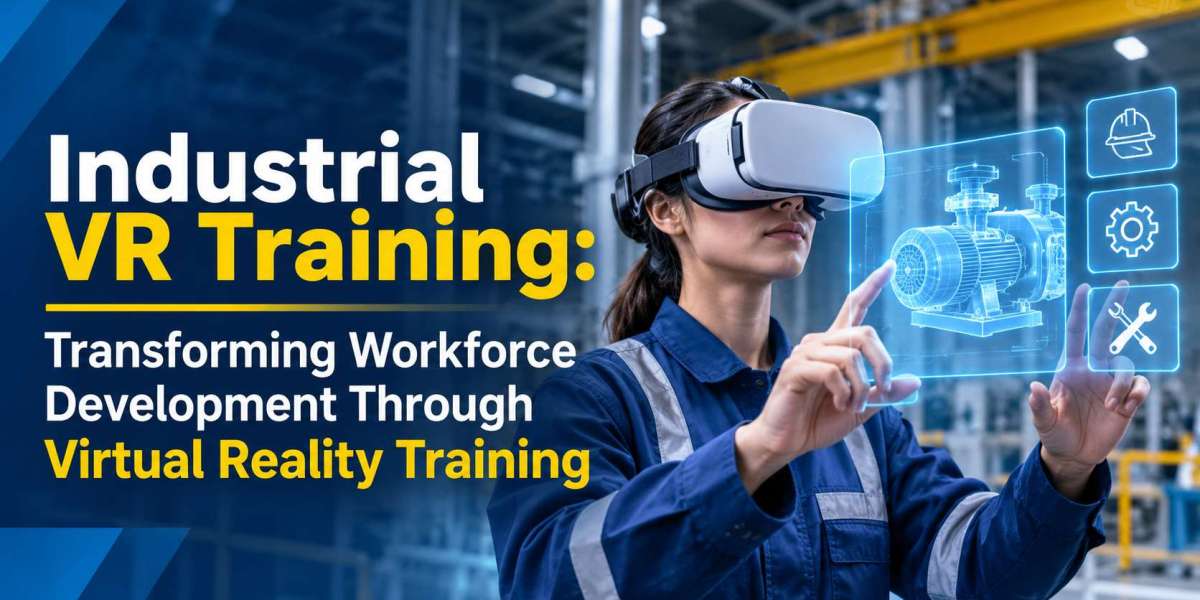

Industries are constantly evolving, and businesses need skilled employees who can adapt to new technologies, equipment, and workplace challenges. Traditional training methods often involve classroom sessions, printed manuals, and on-the-job demonstrations. While these approaches provide basic knowledge, they may not always prepare employees for real-world situations. This is where industrial VR training is transforming the way organizations educate, train, and develop their workforce.
By combining immersive technology with practical learning experiences, virtual reality training enables employees to learn new skills in a realistic, interactive, and risk-free environment. From manufacturing plants and construction sites to oil and gas facilities, VR technology is helping industries improve workforce readiness, workplace safety, and operational efficiency.
What Is Industrial VR Training?
Industrial VR training is a technology-driven learning approach that uses virtual reality headsets and interactive 3D environments to simulate real industrial workplaces. It allows employees to experience different work scenarios without physically entering an operational facility.
For example, a manufacturing employee can learn how to operate complex machinery in a virtual factory, while a construction worker can practice safety procedures on a simulated construction site.
Unlike traditional training, which primarily focuses on theoretical knowledge, industrial VR training provides hands-on learning experiences. Employees can interact with virtual equipment, follow step-by-step instructions, identify potential hazards, and practice essential procedures.
Why Is Virtual Reality Training Important for Industries?
Workplace training is essential for maintaining productivity, safety, and quality standards. However, traditional training methods can sometimes be expensive, time-consuming, and difficult to scale.
Virtual reality training addresses many of these challenges by providing immersive and repeatable learning experiences.
1. Safe Learning Environment
Industrial workplaces often involve heavy machinery, electrical systems, hazardous chemicals, and high-risk operations. Training employees in these environments can expose them to unnecessary risks.
With industrial VR training, employees can practice dangerous procedures in a simulated environment. They can learn how to respond to emergencies, identify workplace hazards, and follow safety protocols without putting themselves or others in danger.
2. Hands-On Practical Experience
Understanding a process theoretically is different from performing it practically. VR technology bridges this gap by allowing employees to interact with virtual machines, tools, and industrial equipment.
Employees can repeat procedures, correct mistakes, and improve their performance through realistic simulations.
3. Improved Employee Engagement
Traditional training sessions may become monotonous, particularly when employees are required to study lengthy manuals or watch instructional videos.
Virtual reality training creates an interactive learning environment where employees actively participate in different activities. This makes training more engaging and encourages better knowledge retention.
4. Cost-Effective Workforce Development
Industrial training can require expensive equipment, dedicated instructors, and access to operational facilities.
VR simulations can reduce the need for repeated physical demonstrations and minimize disruptions to daily operations. Training modules can also be reused for multiple employees and locations.
Key Applications of Industrial VR Training
Industrial VR training can be implemented across different sectors to improve employee skills and operational performance.
Manufacturing and Production
Manufacturing facilities depend on skilled employees who understand machinery, production processes, and quality standards.
VR training allows workers to practice machine operations, equipment maintenance, assembly procedures, and troubleshooting in a virtual factory environment.
Construction and Infrastructure
Construction sites involve several safety challenges, including working at heights, handling heavy equipment, and operating near hazardous areas.
Virtual reality training helps construction workers understand site safety procedures, identify potential hazards, and practice emergency response techniques.
Oil and Gas Industry
The oil and gas sector involves complex industrial processes and potentially dangerous working conditions.
VR simulations can train employees in emergency evacuation, equipment inspection, fire safety, and hazardous material handling without exposing them to actual operational risks.
Power and Energy Sector
Power plants and energy facilities require employees to follow strict operational and safety procedures.
VR-based training can simulate equipment maintenance, electrical safety, plant inspections, and emergency shutdown procedures.
Warehouse and Logistics
Warehouses require employees to understand material handling, inventory management, equipment operation, and workplace safety.
Virtual simulations can help workers practice forklift operations, warehouse navigation, loading procedures, and emergency responses.
Benefits of Implementing Virtual Reality Training
Adopting virtual reality training offers several advantages for businesses looking to modernize their employee development programs.
Some of the major benefits include:
Better knowledge retention: Immersive learning helps employees understand and remember complex procedures.
Reduced workplace risks: Employees can practice hazardous tasks in controlled virtual environments.
Consistent training: Every employee can receive the same standardized training experience.
Faster skill development: Interactive simulations allow employees to learn through practice and repetition.
Flexible learning: Training modules can be accessed at different locations and times, depending on the deployment setup.
Performance tracking: VR systems can record employee progress, task completion, and simulation performance.
Reduced operational interruptions: Employees can practice procedures without stopping actual production activities.
These advantages make VR technology a valuable investment for organizations focused on improving workforce capabilities.
How Does Industrial VR Training Work?
Industrial VR training typically involves a combination of hardware, software, and customized simulation content.
The process generally includes the following steps:
Identify training requirements: Determine which industrial processes, equipment, or safety procedures require training.
Develop virtual environments: Create realistic 3D simulations based on actual workplaces and operational conditions.
Integrate VR hardware: Use VR headsets and compatible controllers to enable immersive interaction.
Conduct training sessions: Allow employees to perform tasks, explore scenarios, and practice procedures.
Evaluate performance: Analyze employee activities, identify mistakes, and measure learning outcomes.
Improve training modules: Update simulations based on employee feedback and changing operational requirements.
This structured approach helps organizations create effective training programs that align with their business objectives.
The Future of Industrial VR Training
The future of industrial VR training looks promising as immersive technologies continue to advance. Artificial intelligence, augmented reality, digital twins, and advanced simulation platforms are creating new opportunities for industrial workforce development.
AI-powered VR environments can provide personalized learning experiences based on individual employee performance. Digital twins can create virtual representations of real industrial equipment and facilities, allowing employees to practice operating and maintaining complex systems.
Furthermore, organizations can combine VR and augmented reality to support both training and real-time workplace assistance.
As industries increasingly prioritize employee safety, productivity, and technical expertise, virtual reality training is expected to become an important part of modern workforce development strategies.
Conclusion
Industrial training is no longer limited to classroom presentations and traditional demonstrations. Businesses need innovative solutions that provide employees with practical knowledge, hands-on experience, and better preparation for real-world challenges.
Industrial VR training offers an effective way to achieve these goals by creating immersive, interactive, and risk-free learning environments. From manufacturing and construction to energy and logistics, virtual reality training is helping organizations improve employee capabilities while supporting safer and more efficient operations.
By investing in VR-based learning solutions, businesses can build a more skilled, confident, and future-ready workforce.