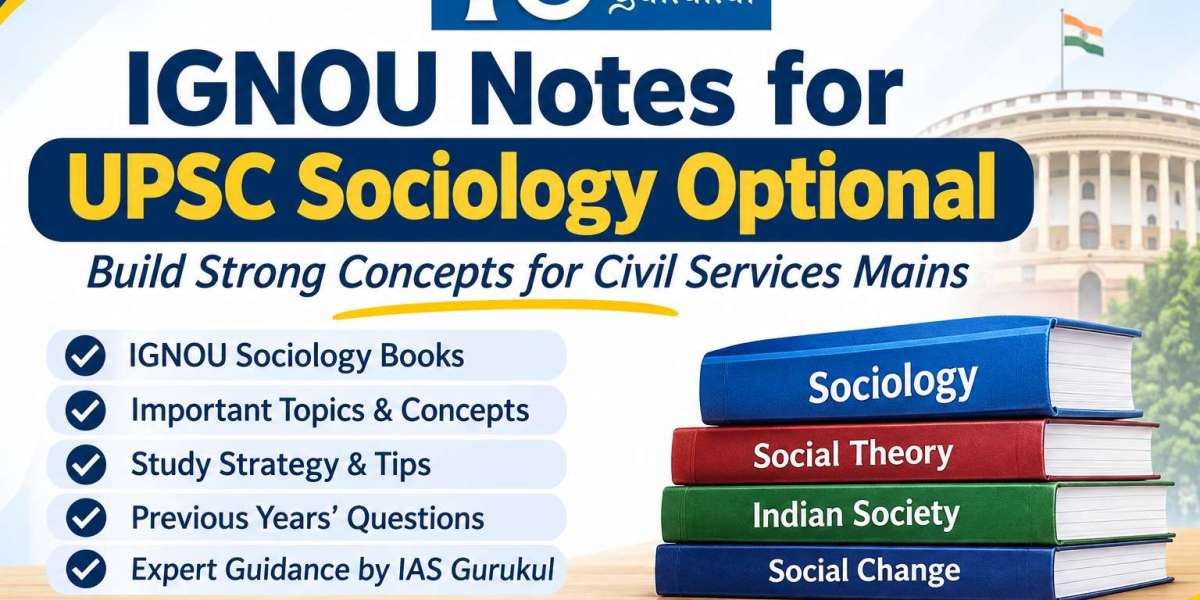

Useful IAS Gurukul Resources for UPSC Sociology Aspirants
If you are preparing for UPSC Sociology Optional, explore these resources from IAS Gurukul to support your learning, revision and answer-writing practice.
Preparing for Sociology Optional is an interesting journey, but it requires the right combination of reading, understanding and regular practice. Many UPSC aspirants find it difficult to decide which books to follow, especially when they come across several study materials recommended by different sources. In my view, the best approach is to begin with the syllabus and choose resources that genuinely improve your understanding of the subject.
One resource worth considering is IGNOU Sociology study material. It can help aspirants explore important sociological topics in greater detail and develop a stronger understanding of fundamental concepts.
Why Should UPSC Aspirants Consider IGNOU Sociology Books?
Sociology is not limited to learning definitions or remembering the names of famous thinkers. It involves understanding society, social relationships, institutions, behaviour and patterns of change.
IGNOU books can be useful supplementary resources because they provide explanations of different areas of sociology. Students can refer to relevant chapters when they need additional clarity on topics such as social institutions, stratification, social change, development and Indian society.
However, completing every IGNOU book is not necessary. The objective should be to understand relevant topics and connect them with the prescribed UPSC syllabus.
Develop a Strong Foundation in Paper I
Paper I introduces the fundamental concepts and theoretical perspectives of sociology. Aspirants should give sufficient attention to sociological thinkers, research methodology, social stratification, religion, politics and economic systems.
While studying thinkers, do not simply memorise their theories. Try to understand their central arguments, important concepts and relevance to contemporary society.
For example, studying Karl Marx becomes more meaningful when you understand how his ideas explain class relations, inequality and conflict. Similarly, Max Weber's concepts can help analyse authority, bureaucracy and social action.
Additional reading from IGNOU material can support this conceptual learning.
Understand Indian Society for Paper II
Paper II requires students to understand the structure and transformation of Indian society. Topics such as caste, class, tribes, family, kinship, religion, rural communities, urbanisation and social movements require a balanced approach.
Aspirants should connect sociological concepts with examples from Indian society. Contemporary developments related to migration, education, gender relations, technology and changing family structures can also provide useful illustrations in answers.
The key is to avoid treating Paper I and Paper II as completely separate areas. Applying theoretical perspectives to Indian social realities can improve the analytical quality of preparation.
Prepare Notes That Are Easy to Revise
One of the most useful habits during Sociology Optional preparation is making concise and organised notes. Long notes may contain extensive information, but they can become difficult to revise during the final stages.
For each topic, include important definitions, thinkers, theories, examples and relevant arguments. Keep the structure simple so that you can quickly recall important points while writing answers.
You can also refer to Sociology toppers' notes for additional ideas on organising study material and presenting information effectively.
Give Importance to Previous Year Questions
Aspirants should regularly analyse previous year questions instead of waiting until the syllabus is completed. These questions provide an understanding of the examination's expectations and help identify important areas for focused preparation.
After finishing a topic, attempt questions related to it. Check whether your answer directly addresses the demand of the question and includes appropriate sociological explanations.
Regular answer-writing practice also helps develop better time management and improve the presentation of arguments.
Combine Reading with Practice and Guidance
Reading books is an important part of preparation, but it should be supported by revision and answer writing. Students who need a more organised learning approach can explore the Sociology preparation resources offered by IAS Gurukul.
Classroom guidance may help aspirants maintain a study routine, understand difficult concepts and receive academic direction. Similarly, test series practice can help evaluate preparation and identify areas that need improvement.
Aspirants should select learning support according to their individual requirements and preparation stage.
Final Thoughts
IGNOU Sociology books can be a helpful addition to your UPSC preparation when used selectively and alongside the prescribed syllabus. They offer supplementary explanations that can support conceptual learning and improve familiarity with different areas of sociology.
My suggestion is to avoid collecting too many resources. Focus on understanding important topics, preparing concise notes, practising previous year questions and revising consistently.
A disciplined approach to reading and answer writing can make Sociology Optional preparation more manageable. Explore the IGNOU Sociology Books collection at IAS Gurukul and choose relevant study material to strengthen your preparation for the UPSC Civil Services Examination.