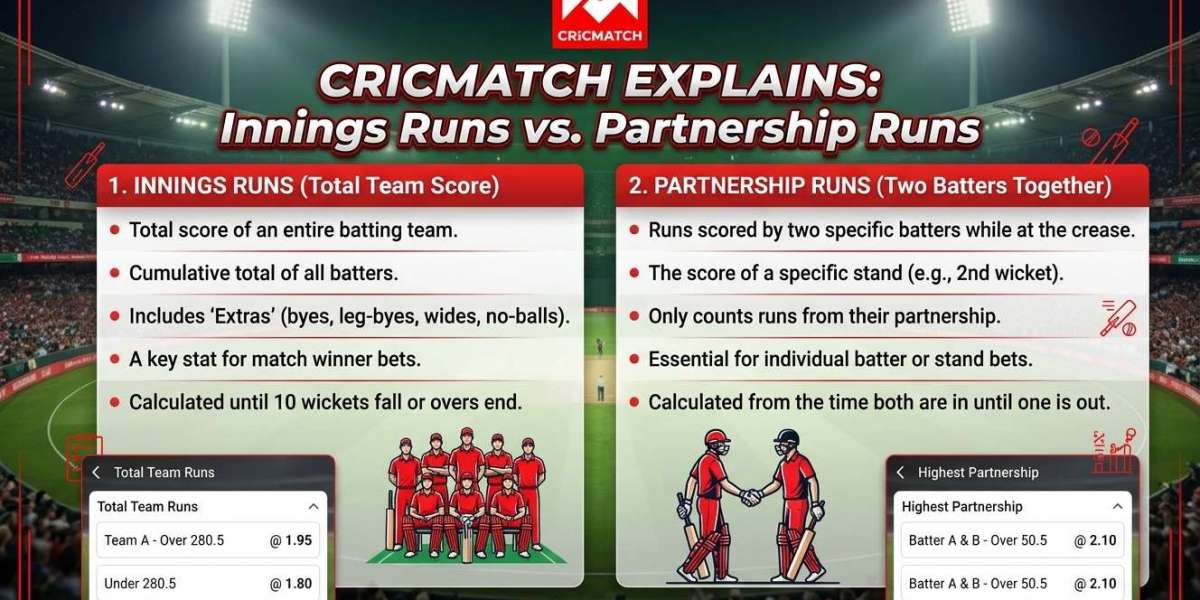

Understanding cricket scorecards becomes easier when you know what each statistic represents. On CricMatch, two figures that readers may come across are innings runs and partnership runs. Although both relate to the total runs scored, they describe different aspects of a team's performance. Innings runs show the overall progress of a team's batting effort, while partnership runs focus on the contribution made by two batters together. Knowing the distinction helps readers interpret match information more accurately.
What Are Innings Runs in Cricket?
Innings runs refer to the total runs accumulated by a team throughout its batting innings. This figure includes contributions from individual batters, extras, and other scoring events recorded during the innings.
For example, if a team scores 175 runs before completing its innings, 175 becomes its total innings score. This number provides an overall picture of the team's batting performance.
Innings runs generally include:
Runs scored through boundaries and running between wickets.
Extras such as wides, no-balls, byes, and leg-byes.
Contributions from every batter who participated in the innings.
This figure is useful when comparing team totals, understanding scoring patterns, and reviewing how an innings developed.
What Are Partnership Runs?
Partnership runs represent the runs added while two batters are together at the crease. Instead of describing the entire team's performance, this statistic focuses on a particular batting pair.
For instance, if two batters add 65 runs before one of them gets dismissed, their partnership contribution is recorded as 65 runs. It helps explain how a pair worked together to build or maintain the team's total.
Partnership figures can reveal:
How effectively two batters rotate the strike.
Whether a pair builds momentum through boundaries.
How partnerships help recover after early wickets.
Which batting combinations contribute significantly to an innings.
These details provide a closer look at the smaller phases that shape an overall team score.
Innings Runs vs Partnership Runs: Key Differences
The main difference is the scope of each statistic. Innings runs cover the complete team total, whereas partnership runs measure the contribution of two batters during their time together.
Consider a team that finishes its innings with 180 runs. Its partnerships might contribute 12, 48, 35, 41, and 44 runs. These individual contributions add up to the team's total.
| Comparison | Innings Runs | Partnership Runs |
|---|---|---|
| Meaning | Total team score | Runs added by two batters |
| Coverage | Entire innings | One batting partnership |
| Main focus | Overall scoring | Batting collaboration |
| Use | Comparing team totals | Understanding partnerships |
| Recorded for | The batting team | Each batting pair |
Both figures are connected, but they answer different questions about the same innings.
How Do Partnership Runs Affect the Final Innings Total?
Partnerships play an important role in determining how an innings progresses. A steady partnership can help a team recover after losing early wickets, while a quick scoring partnership may increase the run rate during the middle or final overs.
However, a large partnership does not automatically mean the entire innings was successful. Other batters may contribute fewer runs, or the team may lose several wickets towards the end.
For example, a partnership worth 80 runs can provide stability, but the final total still depends on the contributions made by the remaining batters and extras.
When reviewing match statistics, consider both figures together rather than treating either one as a complete measure of performance.
Why Should Readers Understand Both Statistics?
Knowing the difference helps readers develop a more balanced understanding of cricket scorecards. Innings runs provide the bigger picture, while partnership runs explain how individual batting combinations contributed to that result.
On the platform, readers exploring match information can use this distinction to understand scoring patterns more clearly. Those interested in broader match situations may also find it useful to learn about chasing a target in T20 cricket, as the required total and batting partnerships often influence how an innings develops.
How to Read These Figures in a Match Scorecard
A scorecard usually presents the team total alongside individual batting performances and partnership details. Start by checking the total runs and wickets, then review the individual contributions.
Next, examine the partnership information to understand which batting pairs added the most runs and when important scoring phases occurred.
If you access match-related information through the Cricmatch app, focus on the figures available in the relevant scorecard rather than assuming every statistical display follows the same layout. Readers should also understand the available information before completing Cricmatch signup or using login to access an account.
Common Misunderstandings About Innings and Partnership Runs
A few common assumptions can lead to confusion:
Partnership runs are not an individual batter's total: They represent the combined runs added by two batters during their partnership.
Innings runs are not limited to boundary runs: They include running between the wickets and applicable extras.
A high partnership does not represent the final score: Other partnerships and scoring contributions also matter.
Every partnership has a separate contribution: The total innings score develops through successive batting partnerships and other scoring events.
Understanding these points makes scorecard interpretation more straightforward. The names cricmatch247 and cricmatch 365 may also appear in related searches.
Conclusion
Innings runs and partnership runs describe two different levels of cricket scoring. The first represents the complete team total, while the second highlights the contribution of a batting pair. Understanding both figures makes it easier to follow scorecards, recognise important partnerships, and interpret how a team's innings develops. Looking at these statistics together provides a clearer and more balanced picture of match performance.