
Enterprise compensation planning has moved far beyond spreadsheets and manual reviews. Today, organizations need structured governance, real-time budget visibility, equity monitoring, and increasingly, intelligent automation.
Two platforms that often come up in enterprise evaluations are HRSoft and Stello AI. While both aim to improve compensation management, they differ in philosophy, automation depth, and financial modeling capabilities.
This comparison breaks down their strengths, differences, and ideal use cases.
1. Platform Philosophy
HRSoft Compensation Management
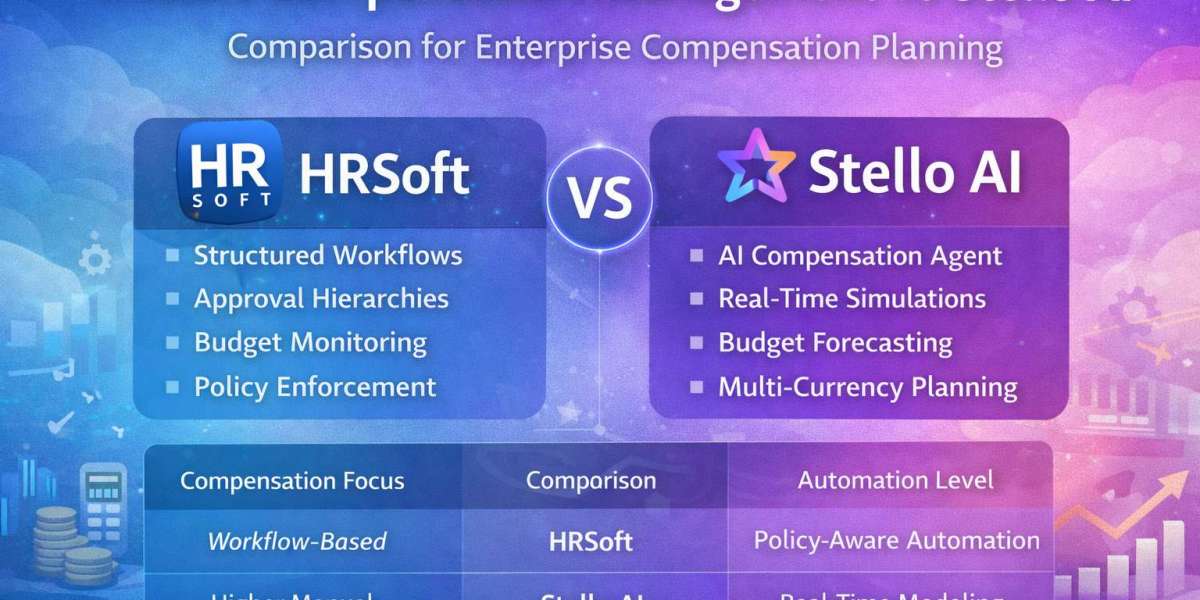
HRSoft focuses on structured compensation cycle governance. Its core objective is to digitize and centralize:
Merit review processes
Bonus allocation workflows
Approval routing
Budget visibility
The platform emphasizes organized workflow management and compensation documentation.
Stello AI
Stello AI positions itself as an AI-powered enterprise compensation management system. Beyond workflow structure, it integrates automation and intelligent decision support directly into the compensation cycle.
Its approach centers on:
AI-assisted merit distribution
Real-time payroll forecasting
Policy-aware enforcement
Scenario simulation before approvals
The philosophical difference is clear:
HRSoft prioritizes workflow structure.
Stello AI layers intelligence and predictive modeling onto that structure.
2. Workflow & Cycle Management
Both platforms support structured compensation cycles.
HRSoft Strengths:
Centralized merit planning
Organized bonus distribution
Defined approval hierarchies
Strong documentation and compliance tracking
HRSoft is particularly effective for organizations replacing spreadsheet-based systems.
Stello AI Strengths:
Structured cycle management
Automated range enforcement
Intelligent budget cap monitoring
Alerts for policy violations
If your primary challenge is process organization, HRSoft may be sufficient. If you need decision optimization within those processes, Stello AI offers deeper functionality.
3. Budget Visibility & Financial Alignment
Compensation directly impacts payroll, often the largest operating expense for enterprises.
HRSoft:
Tracks allocated budgets
Provides visibility into departmental spend
Supports structured financial oversight
Stello AI:
Offers real-time payroll modeling
Enables compensation scenario simulations
Applies automated budget caps
Provides predictive forecasting tools
For finance teams requiring proactive payroll forecasting rather than reactive tracking, Stello AI may provide greater value.
4. AI & Automation Capabilities
This is the most significant differentiator.
HRSoft
Primarily workflow-driven, with strong organizational controls and reporting features.
Stello AI
Built around an AI Compensation Agent that can:
Recommend merit increases based on performance
Detect salary compression
Flag deviations from salary bands
Model financial impact instantly
Enforce compensation policies automatically
Organizations seeking automation beyond documentation will see a meaningful distinction here.
5. Enterprise Scalability
Both platforms are designed for enterprise environments, but complexity requirements differ.
HRSoft
Suitable for enterprises seeking:
Structured governance
Compensation standardization
Controlled merit cycles
Stello AI
Designed for organizations with:
Global workforce distribution
Multi-currency compensation planning
Complex budget structures
High-volume merit decisions
If your organization operates across multiple regions or requires advanced modeling, scalability becomes more critical.
6. Implementation Considerations
When evaluating HRSoft Compensation Management vs Stello AI, consider:
Do you primarily need structured workflows?
Do you require predictive financial modeling?
Is AI-assisted decision-making important?
How complex is your compensation structure?
How closely must HR and finance collaborate?
These questions determine which system aligns with your strategic goals.
7. Workflow Organization vs Decision Intelligence
Compensation software today generally falls into two categories:
Systems that organize compensation workflows
Systems that optimize compensation decisions
HRSoft excels in governance and structure.
Stello AI extends into intelligent optimization and predictive modeling.
As compensation becomes more strategic and financially scrutinized, many enterprises are shifting toward platforms that combine governance with automation.
Final Thoughts
HRSoft Compensation Management and Stello AI both aim to modernize compensation planning.
HRSoft is a strong solution for enterprises seeking structured, centralized workflow governance.
Stello AI may be better suited for organizations looking to integrate AI-driven modeling, automated policy enforcement, and predictive payroll forecasting into their compensation processes.
The right choice depends on your organization’s complexity, financial oversight requirements, and appetite for intelligent automation.
Compensation impacts retention, equity, and profitability. The system you choose should support both operational control and long-term strategic growth.