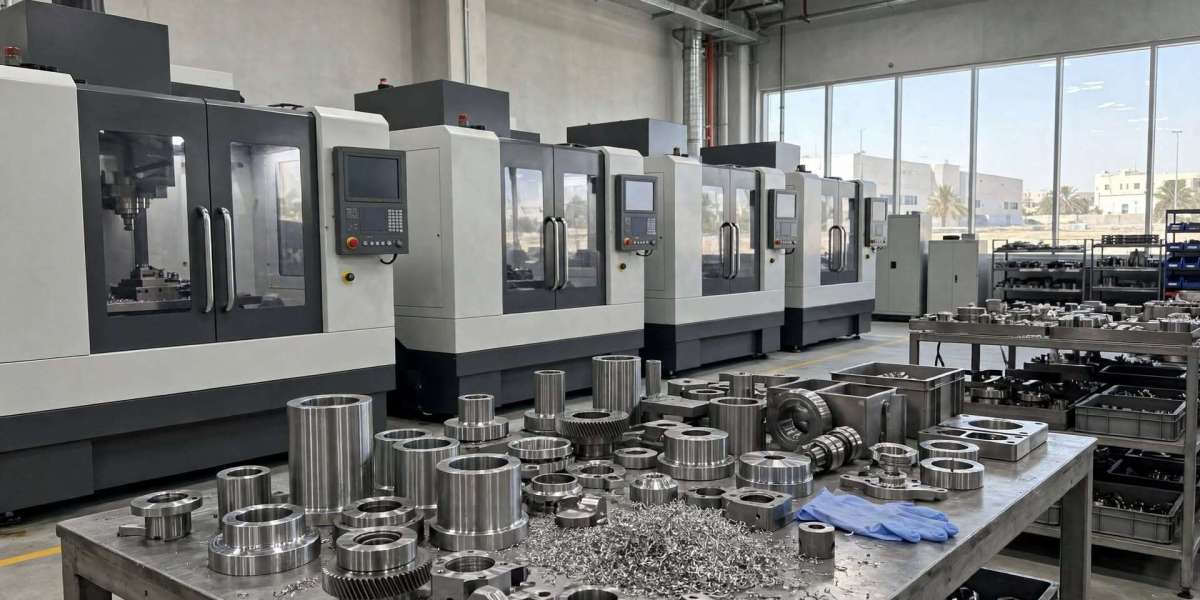

Producing accurate components requires more than selecting suitable raw materials and operating advanced machinery. Every manufacturing stage, from interpreting technical drawings to inspecting finished components, influences the final result. CNC machining services UAE provide manufacturers with a controlled approach to producing custom parts with consistent dimensions, detailed features and dependable quality.
Understanding the Role of CNC Machining in Precision Manufacturing
Computer Numerical Control (CNC) machining is a manufacturing process in which programmed instructions guide machine tools to remove material from a workpiece. Instead of relying entirely on manual operations, the equipment follows digital instructions to create specific shapes, dimensions and surface features.
This process is particularly useful when components require accurate measurements or complicated geometries. Technical drawings and computer-aided manufacturing information help machinists understand the required dimensions before production begins.
Precision manufacturing depends on several connected factors:
Correct interpretation of engineering drawings and measurements.
Appropriate selection of raw materials and cutting tools.
Suitable machining methods for the component's geometry.
Controlled production operations and dimensional inspection.
A small dimensional difference can affect how a component fits with another part. For example, a machined housing may require accurately positioned holes to accommodate connecting components. If those holes are incorrectly positioned, assembly can become difficult.
CNC technology helps reduce such inconsistencies by following programmed toolpaths. Once the machining instructions are prepared correctly, the same program can reproduce the required design across multiple components.
For manufacturers producing specialised equipment, this repeatability supports better control over production quality. It also allows engineers to develop custom components according to specific technical requirements rather than depending entirely on standard catalogue products.
Selecting the Right Machining Process for Component Design
Not every component requires the same machining method. The geometry, material, dimensions and functional requirements determine which process is appropriate.
CNC milling and CNC turning are two important methods used in precision component manufacturing.
CNC Milling for Complex Shapes and Detailed Features
CNC milling uses rotating cutting tools to remove material from a stationary workpiece. The process can produce flat surfaces, slots, pockets, holes and other detailed features.
Three-axis machining is suitable for many conventional components, including plates, brackets and mounting blocks. Five-axis machining provides additional movement, allowing cutting tools to approach a workpiece from different angles.
This is valuable when manufacturing components with complicated surfaces or features located on multiple sides. Reducing the number of setups can also help maintain the relationship between important dimensions.
Examples of milled components include housings, manifolds, valve bodies, flanges and custom fixtures.
CNC Turning for Cylindrical Components
CNC turning works differently because the workpiece rotates while a cutting tool removes material. It is particularly suitable for manufacturing cylindrical components with internal or external diameters.
Common examples include shafts, bushings, sleeves, pins and threaded components.
The choice between milling and turning should be based on the actual design rather than assumptions about which machine is more advanced. A cylindrical shaft generally suits turning, while a component with several flat faces and pockets may require milling.
Some designs combine both processes. Reviewing these requirements before production helps establish an appropriate manufacturing sequence.
Material Selection and Technical Requirements
Material selection directly affects machining performance and the final component's suitability for its intended application. A material should be evaluated according to its mechanical properties, operating environment and manufacturing requirements.
Genesis-MFG's precision machining capabilities cover several material categories, including aluminium, carbon steel, stainless steel, titanium, brass, copper, Inconel and engineering plastics.
Each material has different characteristics.
Aluminium is useful where lower component weight is important. Stainless steel is selected for applications requiring corrosion resistance and durability. Carbon steel and alloy steel provide options for components requiring particular mechanical properties. Engineering plastics such as nylon, PTFE and POM are also suitable for selected applications.
Before production, manufacturers should consider:
Material grade and required mechanical properties.
Component dimensions and design complexity.
Required dimensional tolerances.
Surface finish specifications.
Quantity and expected production requirements.
These details should be communicated through complete engineering drawings. A three-dimensional CAD model can explain the overall geometry, while a two-dimensional drawing can specify important dimensions and tolerances.
Clear documentation reduces misunderstandings between the customer and manufacturing team. It also helps engineers identify potential manufacturing difficulties before machining starts.
Quality Control Throughout the Manufacturing Process
Precision does not depend on machining equipment alone. Inspection and quality management are equally important because finished components must be checked against their specified requirements.
A properly organised manufacturing process begins with reviewing the customer's drawings and material requirements. The machining method is then selected according to the component's design.
During production, important dimensions should be monitored to identify deviations. Final inspection confirms whether the manufactured part meets the agreed specifications.
For example, a machined flange may require accurate dimensions and correctly positioned holes to fit its intended assembly. Checking these features helps identify problems before the component moves to the next manufacturing stage.
Genesis-MFG operates with ISO 9001 and API Spec Q1 certifications, supporting its quality management approach and manufacturing activities.
Working with experienced CNC machining companies in UAE can help customers assess production capabilities, material options and inspection requirements before placing an order.
Manufacturers should also provide complete information when requesting a quotation. Drawings, material specifications, quantities and surface finish requirements give the production team a clearer understanding of the project.
Conclusion
Precision manufacturing requires a coordinated approach to engineering information, machining methods, material selection and inspection. CNC milling and turning provide different capabilities for producing custom components, while appropriate quality controls help maintain dimensional consistency.
Businesses evaluating CNC machining companies in UAE should consider technical capabilities, relevant certifications, material options and inspection procedures rather than focusing only on the machinery available.
Genesis-MFG provides precision machining solutions for custom manufacturing requirements. Reviewing the component drawing with its manufacturing team can be a practical starting point for identifying a suitable production approach.
FAQs
What is CNC machining used for?
CNC machining produces custom components by following programmed instructions to cut and shape raw materials into required dimensions and geometries.
What is the difference between CNC milling and turning?
Milling uses rotating cutting tools to remove material from a workpiece, while turning rotates the workpiece against a cutting tool.
Which materials can be used in precision machining?
Common options include aluminium, carbon steel, stainless steel, titanium, brass, copper and selected engineering plastics.
Why are technical drawings important?
Technical drawings communicate dimensions, tolerances and design requirements, helping machinists produce components according to the intended specifications.
How does inspection support manufacturing quality?
Dimensional inspection checks finished components against their drawings and helps identify deviations before delivery.