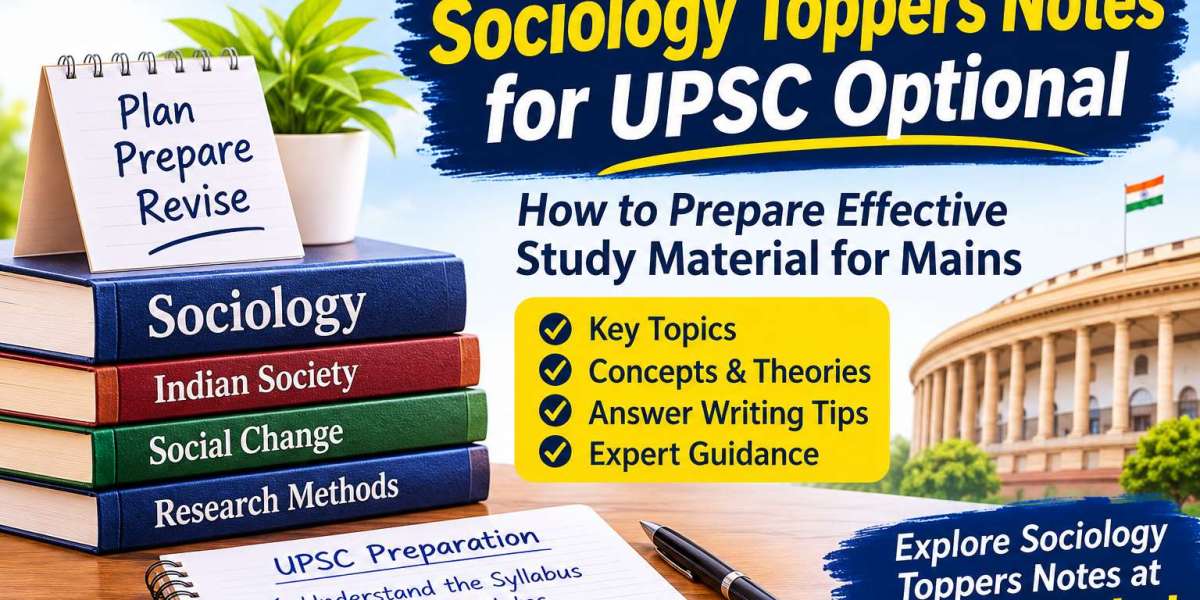

Sociology Optional is a popular choice among UPSC aspirants because it helps candidates understand society, social institutions, human relationships and patterns of social change. However, preparing the subject effectively requires more than reading textbooks. Aspirants need to understand the syllabus, develop clarity about sociological theories and learn how to use these ideas while answering questions.
A focused preparation strategy can help candidates manage both papers without getting lost in excessive study material. Aspirants looking for relevant learning resources can explore IAS Gurukul and its Sociology Optional Toppers’ Notes. These resources can be used alongside standard books, syllabus-based preparation and regular answer-writing practice.
1. Understand What UPSC Expects from Sociology Optional
The first step towards effective preparation is understanding the nature of the questions asked in the examination. Sociology is a subject that tests conceptual understanding, theoretical knowledge and the ability to analyse social issues.
Aspirants should avoid treating it as a subject based only on memorisation. Knowing a definition is useful, but explaining its significance through sociological perspectives and relevant examples makes an answer more meaningful.
The syllabus should remain the centre of preparation. Every book, note or additional resource should contribute to understanding a particular syllabus topic.
2. Build a Strong Foundation in Paper I
Paper I provides the theoretical foundation of Sociology Optional. It introduces the discipline and explains the concepts and perspectives used to study society.
Give attention to these important areas:
Sociological thinkers: Understand their theories, arguments and contributions.
Research methods: Study the nature of sociological research, sampling, observation and other methods.
Social stratification: Understand caste, class, gender and different forms of inequality.
Social institutions: Prepare family, marriage, religion, education and economy.
Social change: Study modernisation, globalisation, development and social transformation.
While preparing each topic, create short notes containing definitions, important concepts, relevant thinkers and examples. This will make revision easier and help you connect different parts of the syllabus.
3. Prepare Thinkers Through Comparison and Application
Sociological thinkers should not be studied as separate names with a list of theories. Their ideas become easier to understand when candidates compare different perspectives and examine their relevance.
For instance, Marx, Weber and Durkheim provide different approaches to understanding society. Their ideas can be used to examine class relations, authority, social solidarity, institutions and social change.
A useful way to prepare each thinker is to organise notes under the following headings:
Major concepts and theoretical arguments.
Important works and contributions.
Perspective on society and social relationships.
Differences from other sociologists.
Contemporary relevance and suitable applications.
This approach helps aspirants use thinkers meaningfully instead of adding names to answers without explaining their relevance.
4. Make Paper II Relevant Through Indian Examples
Paper II requires candidates to apply sociological understanding to Indian society. Topics such as caste, tribe, family, religion, rural communities, urbanisation and social movements should be prepared with relevant examples.
For example, while studying urbanisation, candidates can examine migration, employment patterns, housing challenges and changes in family relationships. While preparing caste, they can study social mobility, political participation, education and changing occupational patterns.
Try to connect each topic with:
Relevant sociological concepts.
Important perspectives and thinkers.
Contemporary examples from Indian society.
Government initiatives and relevant reports where appropriate.
Different dimensions of the issue.
The aim is not to collect as many examples as possible, but to select those that genuinely support an argument.
5. Refer to Toppers’ Notes Without Becoming Dependent on Them
Toppers’ notes are often useful for aspirants who want to organise their revision and understand how a large syllabus can be presented in a concise format.
Candidates can explore the IAS Gurukul Sociology Toppers’ Notes as a supporting resource. They can also refer to the Books and Notes section to explore additional preparation material.
However, ready-made notes should not replace independent study. Aspirants should understand the original concepts, verify their understanding through standard sources and add their own examples and explanations.
A useful practice is to prepare personalised revision sheets after completing each topic. These can include key definitions, thinkers, important arguments, diagrams and previous-year questions.
6. Use Previous-Year Questions to Identify Preparation Gaps
Reading a topic and answering a question on it are two different tasks. Previous-year questions help candidates understand whether they can apply their knowledge to the actual demands of the examination.
After completing each syllabus section, attempt relevant questions. Check whether your answer:
Addresses the central demand of the question.
Uses appropriate sociological terminology.
Includes relevant theories and thinkers.
Provides suitable examples.
Presents a balanced analysis.
Follows a logical structure.
The Sociology Optional Question Papers can be included in this process. Reviewing earlier questions also helps candidates recognise recurring themes and different ways in which topics are examined.
7. Improve Answer Quality with a Consistent Structure
Answer writing should begin early in the preparation process. Candidates do not need to wait until every topic is completed before practising.
A well-organised answer generally contains an introduction, a discussion of the main arguments, relevant examples and a conclusion. The structure should be adapted according to the question.
For analytical questions, include different perspectives rather than presenting only one side. For questions involving thinkers, explain how their theories address the issue. For questions on Indian society, use examples that demonstrate the practical relevance of the discussion.
Candidates should also practise writing within the prescribed time. This helps develop clarity, improve presentation and manage the examination effectively.
8. Make Revision More Effective with Short Notes
Sociology Optional includes many theories, concepts and interconnected topics. Without regular revision, it can become difficult to recall relevant information during answer writing.
Instead of repeatedly reading complete chapters, prepare concise revision material. Keep separate sections for thinkers, definitions, important concepts, Indian examples and frequently practised questions.
A weekly revision routine can include:
Revisiting completed topics.
Reviewing thinkers and their key arguments.
Practising a few previous-year questions.
Updating examples for Paper II.
Writing timed answers.
Identifying topics that require further study.
Regular revision is more useful than trying to cover everything again at the last moment.
9. Explore Learning and Practice Resources at IAS Gurukul
Aspirants who want additional academic guidance can explore the IAS Gurukul UPSC Sociology Courses. Candidates interested in classroom-based preparation can review the Sociology Optional Classroom Course.
For an understanding of the teaching approach, Sociology Demo Lectures are also available. Candidates who want to include structured answer-writing practice in their preparation can explore the Sociology Optional Test Series.
Aspirants can also visit the Pranay Aggarwal profile to learn more about the faculty.
These resources can be considered according to individual preparation needs, study preferences and available time.
10. Common Preparation Mistakes to Avoid
Aspirants should be careful about a few habits that can reduce the effectiveness of their preparation.
Studying without syllabus mapping: Reading extensively without connecting material to the syllabus can waste time.
Memorising without understanding: Theories and definitions should be understood before being used in answers.
Ignoring Paper II examples: Indian society topics need relevant illustrations and contemporary connections.
Delaying answer writing: Regular practice is necessary to learn how to present knowledge within the examination's time limits.
Collecting excessive material: Using too many sources can make revision difficult. It is better to study selected resources thoroughly.
Neglecting revision: Completing a topic once does not ensure that the concepts will remain clear during the examination.
Conclusion
A strong Sociology Optional preparation strategy depends on conceptual clarity, syllabus-based study and regular application of knowledge. Aspirants should give equal importance to theoretical understanding, Indian society, previous-year questions and answer-writing practice.
Toppers’ notes can support revision, while standard books and independent study help build a deeper understanding of the subject. A consistent routine, careful selection of resources and regular evaluation can make preparation more organised.
Candidates can explore the Sociology study material and learning options available at IAS Gurukul to identify resources that complement their individual UPSC preparation strategy.