
Modern software delivery is built around speed. Teams deploy multiple times a day, infrastructure is automated, and microservices communicate across distributed environments. Yet the faster teams release, the higher the risk of shipping a broken build. This is where smoke testing becomes critical. Smoke tests act as the first safety gate in a CI/CD pipeline, ensuring that a build is stable enough to continue through deeper testing stages. Without them, pipelines waste time executing long test suites on builds that are already unusable.
Smoke testing belongs at the very beginning of the automated validation chain because its job is not to prove correctness, but to prove viability. A system does not need to be perfect yet, it only needs to be functional enough to justify further testing investment. When smoke tests fail early, they prevent cascading failures across integration, regression, and staging environments. This dramatically reduces compute cost, debugging effort, and developer frustration.
Why Smoke Testing Must Run Before Integration Tests
Integration tests verify how components interact with each other, but they assume that individual services already work at a basic level. Running integration tests on a broken application is equivalent to diagnosing a car engine before confirming the battery works. Smoke testing validates the minimum working state: the application starts, core endpoints respond, configuration loads correctly, and essential dependencies connect.
Placing smoke tests first ensures the pipeline follows a fail-fast philosophy. If the application cannot boot or a primary API returns an error, the pipeline stops immediately. Instead of waiting twenty minutes for integration tests to fail, developers get feedback within seconds. This shortens debugging loops and keeps the development workflow efficient.
Another benefit is resource prioritization. CI/CD infrastructure is expensive, especially when parallel containers and databases are provisioned for integration testing. By filtering unstable builds early, smoke tests protect infrastructure from unnecessary load.
Example Workflow in Modern CI/CD Systems
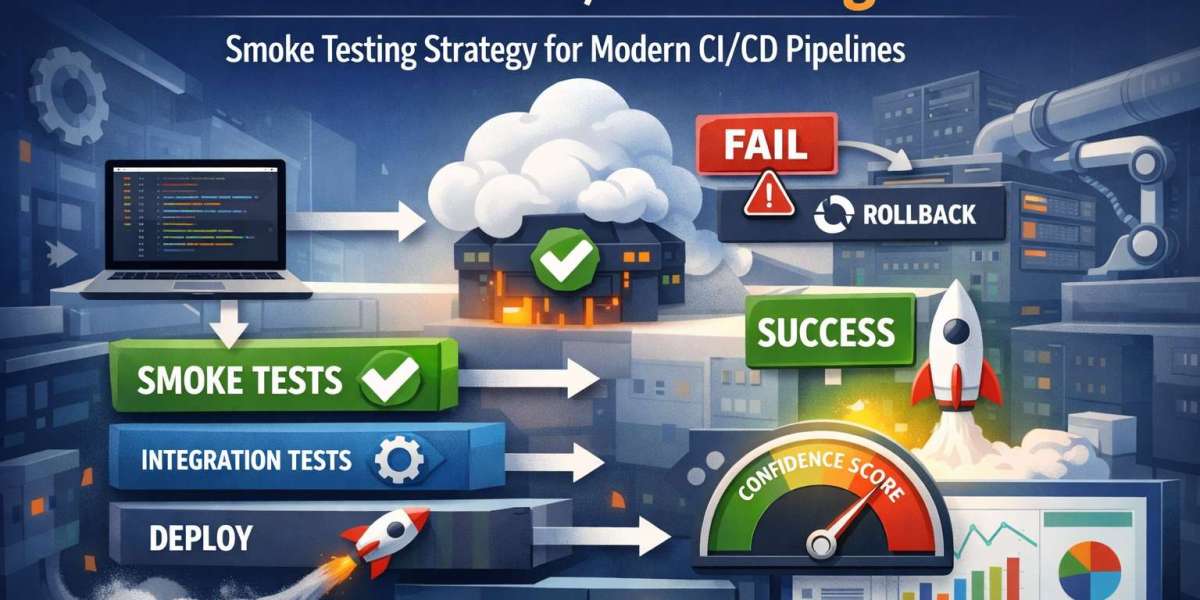
Regardless of the platform used, the workflow logic remains consistent. After code is pushed, the pipeline compiles the application and creates an artifact. Immediately after build creation, the environment spins up in a lightweight container or ephemeral environment. Smoke tests execute against this instance before any heavy test stages begin.
In a typical GitHub Actions workflow, the pipeline checks out the code, installs dependencies, builds the project, launches a service container, and runs a short smoke test script. If the script passes, the pipeline proceeds to integration and regression stages. If it fails, the workflow terminates and reports failure instantly.
In GitLab pipelines, smoke tests usually run inside the build stage before the test stage. This keeps the testing stage reserved for deeper validation. In Jenkins pipelines, smoke testing is commonly placed between the build and test stages, acting as a gate that determines whether downstream stages execute.
The key principle across all systems is identical: smoke tests must guard the expensive stages of the pipeline.
Designing a Fail-Fast Deployment Strategy
Fail-fast is not only about speed but also about clarity. A smoke test suite should contain only the most critical checks that prove the system is alive. These typically include application startup validation, health endpoint verification, authentication flow confirmation, database connectivity, and one or two primary business operations.
The moment any of these checks fails, the pipeline should stop immediately and notify developers. There is no value in collecting additional failures from deeper layers because the root cause already invalidates the build.
Fail-fast pipelines also improve team behavior. Developers begin to rely on immediate feedback rather than waiting for large nightly reports. This encourages smaller commits, faster fixes, and more stable release branches.
Parallel Smoke Tests for Faster Feedback
Smoke tests are small, but they still benefit from parallelization. Instead of executing checks sequentially, modern pipelines distribute them across containers. For example, one container verifies authentication, another checks API endpoints, and a third validates database connectivity.
Parallel execution reduces validation time to the duration of the slowest test rather than the sum of all tests. This keeps smoke testing under one minute, which is important because the value of smoke testing decreases as execution time increases.
Parallel smoke tests also reveal infrastructure problems earlier. If a network configuration or environment variable is incorrect, multiple checks fail simultaneously, making diagnosis straightforward.
Automated Rollback After Smoke Test Failure
Continuous delivery requires confidence that faulty releases will not reach users. When smoke tests run after deployment to staging or production, they become a protection mechanism. If the newly deployed version fails, the system should automatically revert to the previous stable release.
Rollback automation typically works by maintaining a previously verified artifact and redeploying it when smoke tests detect failure. This prevents outages and reduces manual intervention. Teams no longer need emergency hotfixes because the pipeline itself restores stability.
Automated rollback also changes release psychology. Teams become comfortable deploying frequently because failure does not mean downtime. Instead, failure triggers a controlled recovery.
Measuring Release Confidence
To improve a pipeline, teams must measure its reliability. Smoke testing contributes to a release confidence score, a metric that represents how trustworthy a build is. This score can be calculated using factors such as smoke test pass rate, frequency of rollbacks, build stability over time, and mean time to recovery after failure.
High confidence scores indicate that most builds pass smoke testing consistently and rarely require rollback. Low scores signal unstable development practices or insufficient local validation. Over time, teams can correlate confidence scores with production incidents and use them to guide process improvements.
Monitoring these metrics transforms smoke testing from a simple validation step into an engineering quality indicator.
Conclusion
Smoke testing is the smallest test suite in a CI/CD pipeline, yet it delivers the largest impact. By validating basic functionality immediately after build creation, it prevents wasted execution time, reduces infrastructure usage, and accelerates feedback loops. When combined with parallel execution, fail-fast design, automated rollback, and confidence metrics, smoke testing becomes the foundation of reliable continuous delivery.
Modern pipelines succeed not because they run more tests, but because they run the right tests at the right time. Smoke testing ensures every deployment starts with certainty before moving toward completeness.