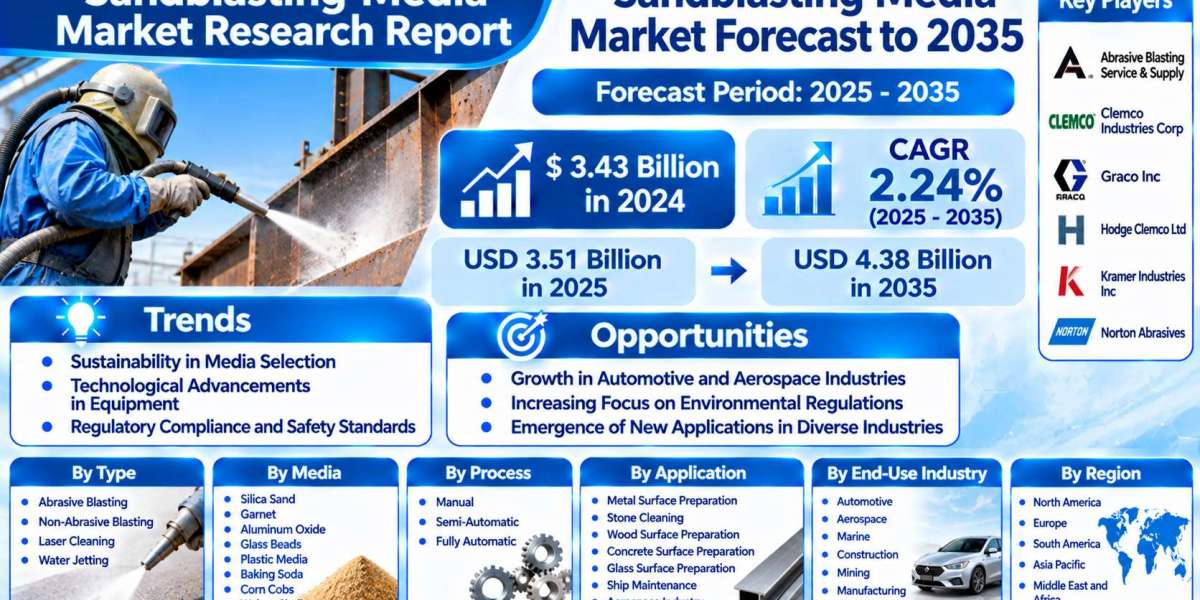

According to Market Research Future® (MRFR), the Sandblasting Media Market is forecast to reach USD 4.38 Billion by 2035, compared with USD 3.51 Billion in 2025, reflecting a CAGR of 2.24% over the 2025–2035 period. The market's 2024 valuation stood at USD 3.43 Billion. Its scope extends across abrasive and non-abrasive blasting, laser cleaning and water jetting, with media options ranging from silica sand and garnet to glass beads, plastic media and organic materials. Demand spans several industries that require surface preparation, cleaning and maintenance.
Market Size and Industry Context
Surface preparation is an important activity across manufacturing, construction and maintenance operations. Sandblasting media supports a variety of surface treatment requirements, including metal preparation and the cleaning or preparation of stone, wood, concrete and glass. The market also includes ship maintenance and aerospace industry applications, highlighting its reach across general industrial operations and more specialized environments.
The market is expected to expand steadily during the forecast period. Its valuation is projected to move from USD 3.51 Billion in 2025 to USD 4.38 Billion in 2035, following a 2.24% CAGR. The 2024 market size of USD 3.43 Billion provides the preceding valuation point. The outlook reflects the continued use of surface treatment processes across multiple end-use industries.
Types of Blasting and Available Media
The market's type classification covers abrasive blasting, non-abrasive blasting, laser cleaning and water jetting. These categories represent the different approaches included in the market's scope. Their relevance varies according to the surface, application and process requirements of the user. This variety gives industrial customers multiple approaches to surface preparation and cleaning.
The media segment includes silica sand, garnet, aluminum oxide, glass beads, plastic media, baking soda, corn cobs and walnut shells. This broad selection reflects the diversity of materials used in blasting operations. Different media options serve different surface treatment needs, and selection is an important consideration for users evaluating the requirements of a particular job.
Sustainability in media selection is one of the key trends shaping the industry. Environmental considerations are becoming more prominent in the assessment of materials and operating practices. The increasing focus on environmental regulations also creates opportunities for market participants to respond to changing expectations. The supplied market scope does not specify individual environmental performance characteristics for each media type, so material choices should be understood within the stated segmentation rather than through assumed product attributes.
Process Automation and Equipment Developments
Sandblasting operations are classified by process into manual, semi-automatic and fully automatic categories. These options reflect different approaches to carrying out surface treatment activities. The appropriate process depends on the operating context and requirements of the application.
Technological advancements in equipment are a notable industry trend. Equipment development is relevant across the different process categories and forms part of the market's wider evolution. As industrial users assess their surface preparation requirements, process selection and equipment considerations remain important components of operational decisions.
Regulatory compliance and safety standards are also central to the sector. Companies and users must consider the requirements applicable to their operations, including the standards associated with equipment and blasting activities. These considerations influence how businesses evaluate processes and equipment alongside media selection.
Application and Industry Demand
The application landscape includes metal surface preparation, stone cleaning, wood surface preparation, concrete surface preparation, glass surface preparation, ship maintenance and the aerospace industry. These uses demonstrate the range of surfaces and operating environments served by the market. Metal surface preparation is relevant to industrial production and maintenance, while stone, wood, concrete and glass applications connect the market to construction and material treatment activities.
Ship maintenance represents another application area, alongside aerospace industry use. These applications contribute to demand from industries where surface preparation and maintenance form part of broader operational activities. The market's end-use segmentation further identifies automotive, aerospace, marine, construction, mining and manufacturing.
The automotive and aerospace industries are specifically highlighted as growth opportunities. Demand from these sectors adds to the market's wider industrial base. Construction, marine, mining and manufacturing also provide varied settings in which surface preparation processes are used. The presence of multiple end-use industries helps distribute demand across different operating environments.
Regional Analysis and Competitive Environment
The market covers North America, Europe, South America, Asia Pacific, and the Middle East and Africa. Each region includes different industrial and commercial conditions that can influence demand for surface preparation products and equipment. The report's regional segmentation provides a global framework for assessing the market, although the supplied information does not identify regional market shares or rank individual regions by size.
The key players include Abrasive Blasting Service & Supply, Clemco Industries Corp, Graco Inc, Hodge Clemco Ltd, Kramer Industries Inc and Norton Abrasives. These companies form part of the competitive landscape serving the market's varied industrial applications.
Competition is influenced by the range of blasting media and processes available, as well as equipment developments and customer requirements. Sustainability considerations and regulatory compliance also form part of the business environment. Companies serving different end-use industries must account for the varied needs associated with surface preparation, cleaning and maintenance.
Opportunities and Forecast Outlook
Three major opportunity areas are identified: growth in automotive and aerospace industries, increasing focus on environmental regulations and the emergence of new applications in diverse industries. Automotive and aerospace demand can support the market's established industrial use, while the development of applications in other sectors may broaden its potential customer base.
Environmental regulations and sustainability in media selection are likely to remain important considerations for manufacturers and users. Technological advancements in equipment may also influence process choices and market offerings. At the same time, regulatory compliance and safety standards remain relevant across the industry's different applications and end-use environments.
The market's forecast trajectory points to measured expansion, with its value expected to rise from USD 3.51 Billion in 2025 to USD 4.38 Billion in 2035. A CAGR of 2.24% over the forecast period reflects the ongoing role of sandblasting media in industrial surface preparation, cleaning and maintenance. Its broad segmentation across media, processes, applications and end-use industries provides a diverse foundation for future market activity.