
Most mobile apps are conceived to drive one of a few outcomes: increase customer interaction, streamline a current internal system, enable a new offering, or generate additional income. Once this concept has taken hold, there is a natural tendency to jump head-first into designing and developing the solution.
If you don't take the time to appreciate the true needs of your product, you're likely to see gaps in functionality, shifting focus, increased spend and re-development down the line.
By discovering your mobile app, you can mitigate some of these risks.
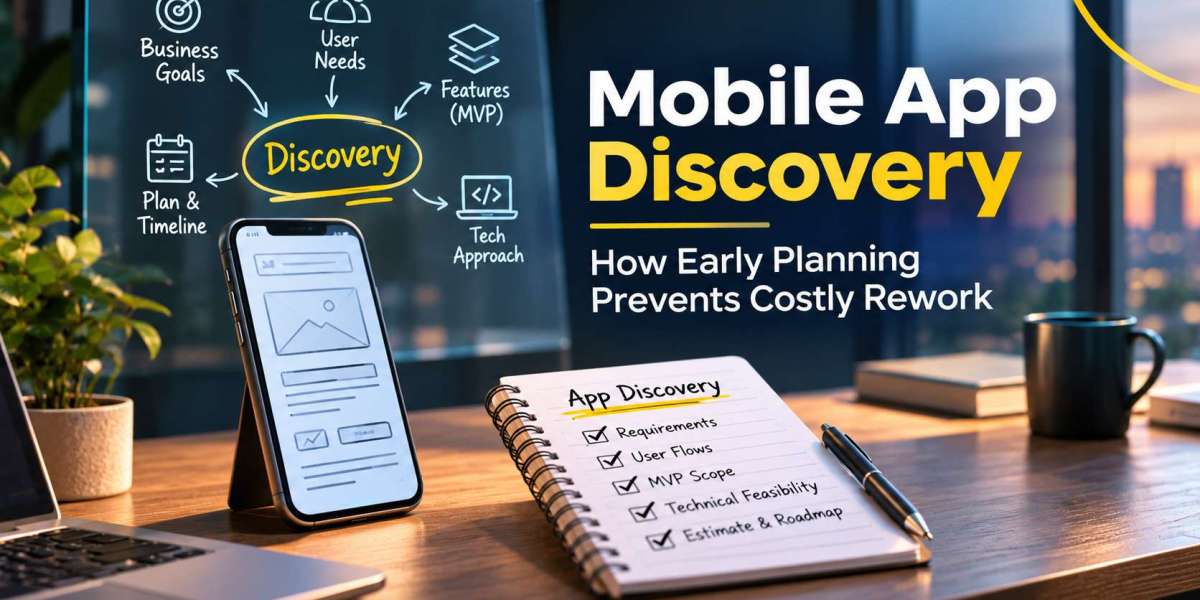
As the name suggests, discovering your mobile app is the act of exploring your product prior to commencing any design and development activity. You will learn more about your customers, determine the requirements for your project, explore suitable technologies and arrive at a development roadmap. As a result, you'll have a greater appreciation of the product you want to build, the reasons for it, and the input required.
Whether you're a start-up or an incumbent, the benefits of discovering your product ahead of time can save substantial sums further along the road.
What Is Mobile App Discovery?
Discovering your product allows you to take the broad concept you've developed and narrow it down to a set of actionable directives. Through a combination of commercial, customer, product, technical and forward-looking considerations, you can begin to shape your product.
Crucially, this should allow you to minimise the unknowns as you progress towards spending large amounts of money on developing your product.
Some of the key areas you will seek to clarify through your discovery process include:
What is the target demographic for your product?
What is the aim of the product?
What functionality will be needed in the initial release?
On which operating systems will you develop?
Are any third-party services required?
What levels of security, responsiveness, capacity, etc. are required?
How much will it cost, and how long will it take to build your product?
Once these factors have been determined, you can move on to the next phase of creating your product.
Why Discover Your Product Before Developing It?
You might assume that forgoing the discovery stage would free up valuable time. In practice, however, this frequently leads to a range of complications as your project progresses.
1. Define the Project's Requirements
A client may state that they wish to create an "app to allow my team to book time". The developers may therefore create a basic calendar-style interface to facilitate this. In reality, the client may also want to accept payments, send automatic reminders to clients, manage cancellations, display team members and create client login details.
If these points are not raised and explored, they could surface much later in the lifecycle of your project.
Through a thorough discovery exercise, you can capture the various scenarios that the product should accommodate, ensuring that the client, designers and developers are aligned.
2. Manage the Project Cost
Any substantial amendment to your product during development will impact the overall spend. Adding a new screen or capability could necessitate corresponding updates to the data model, graphical presentation, connected services, QA regime and more.
By appreciating the requirements of your product, you can flag these considerations in advance and plan accordingly.
For instance, ascertaining that your product requires live location updates at the discovery stage is far less disruptive than attempting to implement them post-development.
3. Determine the Development Lead Time
As noted above, the length of time to complete your product will be influenced by many variables beyond the quantity of screens you require. These can include user management, financial transactions, interaction with third parties, role-based privileges, importing historical data and completing adequate QA.
Through discovery, you can appreciate these considerations and refine your forecast to match the needs of your product.
4. Limit the Scope of Your Initial Product
Clients will invariably have a wide array of ideas for the product they want to develop. However, there may be some that are not critical to fulfilling its primary function.
Identifying these and determining a Minimum Viable Product (MVP) can help ensure that you are not incurring the expense of building unnecessary capabilities.
What Is Involved in a Typical Discovery Process?
Depending on the nature of your product, the scope of the discovery stage may vary considerably. Nevertheless, the following elements will typically be included.
Understanding the Commercial Need for Your Product
The starting point of any discovery will be to establish the motivation for developing your product.
This will involve gaining insight into your prospective customers, the current method of delivering the relevant function, key considerations of your customers, the competitive landscape and the need your product hopes to address.
From this, you can collate:
The key commercial targets and KPIs for the product
An indication of your customers
Key product requirements
Further functional and non-functional requirements
Broad terms of reference for the project
Gaining a Better Understanding of Your Customer
While you may know the general characteristics of your target market, you will also want to understand the actions and considerations that will underpin their use of your product.
For example, if you were developing a food delivery service, you would need to consider how a user would search for and select restaurants, choose dishes, pay for their order and track the delivery, as well as raise any queries.
By documenting and analysing these user journeys, you can start to spot any shortfalls in the product before you begin to design the UI.
Determining the Features of Your MVP
At the end of your discovery, you should be in a position to specify the features that will comprise your MVP. You may categorise these as:
| Priority | Description | Example |
|---|---|---|
| Must-haves | Essential to the first iteration of the product | Customer sign-up |
| Should-haves | Highly desirable, but not strictly necessary | Push messaging |
| Could-haves | Beneficial enhancements to the product | Tailored suggestions |
| Won't-haves (initially) | Lower priority to address in later versions | Reporting tool |
This will give you a baseline of requirements to develop your product from, and allow you to continue to enhance the offering in subsequent releases.
Assessing the Technical Requirements of Your Product
You will need to determine the best means by which to construct and sustain your product.
Your technical team can consider:
Developing native apps for Android and iOS, or using an alternative approach
The structure of the supporting backend and data requirements
Any relevant third-party solutions
Mechanisms for managing user logins
Security and data handling
Deployment, speed and growth of the service
Ongoing evolution and maintenance of the product
Of course, the technology used to power your product should be driven by the product itself, and not dictated by industry trends.
In some cases, further investigation will be required. For example, if your product utilises Facial Recognition Software, you will need to consider additional technical requirements such as capturing and storing images, matching faces to individuals, recording and disclosing user information, and securing the system. Again, it is preferable to uncover these during your discovery stage.
Developing the Product UI
With the principal requirements identified, you can begin to formulate the user experience and interface of your product.
You may produce a suite of screens depicting the likely look and feel of your product, as well as develop an interactive mock-up. Both will enable the client to get a sense of what to expect once your team has commenced production of the UI.
Outputs from a Mobile App Discovery Session
It is important that you leave your discovery stage with sufficient documentation to inform the remainder of the project. While the contents of this will obviously vary, you should ideally have:
| Output | Contents |
|---|---|
| PRD | Summary of the key product requirements, including users and behaviours |
| Customer information | Details of your target markets and associated journeys |
| List of features and MVP definition | As discussed above |
| Screens and wireframes | Representation of the proposed product UI |
| Technical summary | Key decisions around the underlying infrastructure and third-party connections |
| Forecast | Approximate resource and financial implications to deliver the product |
These should be comprehensive but concise, avoiding the pitfalls of producing excessive and under-utilised collateral.
Depending on your use case, you may need to capture further detail. For a health-related product, this could include creating patient profiles, facilitating bookings and viewing health data, and communicating alerts to both patients and clinicians. Alternatively, an e-commerce product would need to consider displaying and sourcing goods, reconciling with the retailer's stock, processing orders, shipping and handling returns.
What Questions Should You Pose to Your Development Team?
Rather than simply outlining the product you hope to create, the discovery process will be most effective if you raise a series of targeted queries. Some examples are given below.
In relation to your company:
What gap in the market do you hope to fill with this product?
By what measures will you know that the product has been a success?
Who are the end users of the product (i.e. consumers, workforce, third parties)?
In relation to the product:
What are the non-negotiable elements of your first release?
What functions will the user be expected to carry out independently?
Is there a comparable product that offers the desired level of functionality?
In relation to the technology:
Does the product need to interface with any legacy IT?
Are any special considerations needed, e.g. continuous data feed, geolocation, accepting payments?
What degree of data confidentiality and integrity is required?
In relation to the project:
What is the budget for the product?
Is there a deadline (internal or external) for the product to go live?
Who will sign off the various inputs throughout the project?
As a final note, if you are operating within the Middle East region, you may benefit from consulting with a mobile app development consultant in Jordan to gain further insight into the above considerations.
Impact of the Discovery Process on Your Product's UX
Many deficiencies in the UX of a product will arise prior to the first iteration of the design being produced. Whether due to insufficient thought on how the customer will navigate the product, absent or incomplete journeys, or other reasons, there is potential for the product to fail to meet the user's requirements.
A key benefit of the discovery process is that it enables the team to identify and remedy any of these issues.
Take, for example, an internet bank. Users will expect to perform a variety of functions, including (but not limited to) viewing their accounts, making a payment, retrieving a transaction history and notifying the bank if their card has been stolen. If the discovery merely considers the home page of the product, these functions may prove challenging for the user to find.
By considering each of the key user journeys, the team can flag where the flow should be simplified, double confirmations implemented or supplementary data displayed.
Ideally, your product will allow the user to intuitively identify and execute their most frequent functions. You can validate this assumption by conducting trials with a limited number of suitable participants against your early designs.
Should I Engage a Third Party to Discover My Product?
If you do not have the appropriate skills and capacity in-house to undertake this task, engaging an external agency can be highly advantageous. However, there are more considerations than simply looking for the most competitive rate or pricing for your product.
When considering a potential vendor, you should look to verify that they will be able to:
Absorb the inputs provided and translate them effectively
Inform you of any relevant implications arising from your product
Highlight any concerns that may arise
Keep you apprised of the project
For example, if you are looking for a Mobile App Development Company in Dubai, you should consider its background and knowledge of the sectors you operate in, familiarity with the nuances of serving local customers, and provision of ongoing support.
Likewise, you may find that your search returns results from Bangalore based Mobile App Development Companies. Here, you will want to weigh up their skill set, methods of working, pricing and track record before reaching a decision. Of course, their proximity is also a factor, but as mentioned, the rigour with which they approach the discovery stage will be equally pertinent.
Ultimately, you should walk away from your discovery meetings feeling well-informed about the work required to deliver your product.
Pitfalls to Watch Out for During Discovery
Despite knowing the merits of taking a considered approach to your product, there are several ways in which the discovery stage can fail to deliver its full benefit:
Populating the discovery stage with an exhaustive list of desired features: While a richer set of capabilities will clearly increase the utility of your product, you should still aim to focus on those most likely to be used.
Conducting the discovery solely with senior members of the organisation: You may miss out on valuable insights regarding the day-to-day activities of your workforce and customers.
Locking into a particular set of technologies: As discussed earlier, you should not prejudge the tools you will use until you have assessed your product.
Receiving an unqualified forecast: It is inevitable that there will be some areas that require further clarification, and you should seek to capture this.
Not considering any existing IT that your product will need to tie into.
Failing to conclude the stage with clear outputs and actions to follow.
Additionally, if any material change occurs to your product, you should revisit the discovery stage to ensure that all relevant factors continue to be addressed.
FAQs
How Long Will the Discovery Process Take?
This will vary depending on the breadth and depth of your product, the diversity of users that you need to consider, the extent of external dependencies and the time that the relevant parties can dedicate to the project. At one extreme, you may only require a brief period to gain a sufficient understanding of your product, whereas at the other, it could take multiple weeks.
What Is the Cost of a Discovery Exercise?
Again, there is no definitive answer. The spend will be a reflection of the effort expended, level of seniority of the contributors, number of sittings and associated activities (e.g. research, prototyping, technical diligence). You should look to receive a granular breakdown of the scope of work prior to receiving any quote.
Do I Really Need to Conduct a Discovery If I'm Only Building an MVP?
Absolutely. As explained, you need to establish the fundamental parameters of your product and determine which are the most salient. Otherwise, you risk depleting your initial pot of funds developing features that are unlikely to resonate with your target market.
Can I Proceed with Developing My Product Without Generating Any Wireframes?
Technically, yes. But there is a heightened likelihood of friction around the key flows and user actions. By presenting the client with a set of draft designs, you allow them to comment on and challenge these prior to the team devoting considerable time to creating the UI.
What Distinguishes Discovery from Developing My Product?
Broadly speaking, the former will involve learning more about the product and its requirements, while the latter will comprise the creation, integration and verification of the solution. In other words, the discovery will determine what and why you need to build, and the development will bring this to life.
Conclusion
The discovery stage can help you address a wide variety of queries relating to your product, before any expenditure is incurred. By aligning the commercial, customer, product and technical teams, you can establish a robust platform to begin the development of your product.
At minimum, you should be able to articulate the challenge that the product aims to overcome, the relevant customer base and the desired output of the first release. Your team can then build the rest from this.