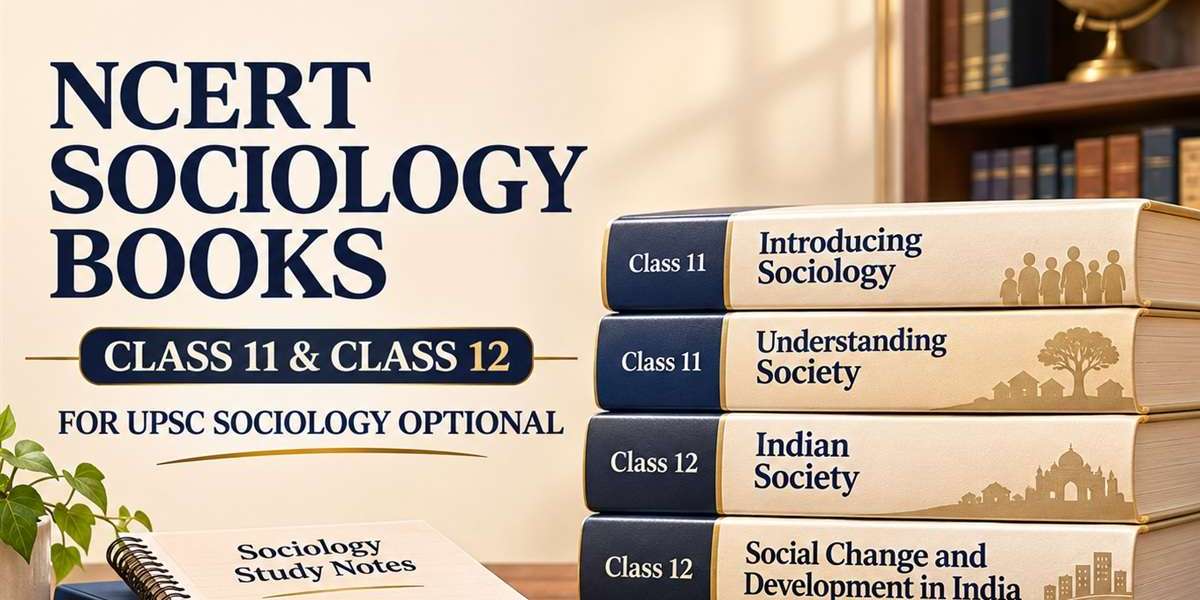

Preparing for UPSC Sociology Optional becomes more effective when aspirants begin with clear and reliable study material. NCERT Books for Sociology provide a useful starting point for understanding society, social institutions, cultural patterns and social change. Instead of immediately moving to advanced reference books, aspirants should first develop a strong understanding of basic sociological ideas.
NCERT textbooks introduce important concepts in simple language and connect them with examples from everyday life. This helps beginners understand how society functions and how different social factors influence individuals and communities. A planned reading approach can make these books valuable throughout Sociology Optional preparation.
Why NCERT Sociology Books Matter for UPSC
Sociology is closely connected with the society we live in. Topics such as family, education, religion, caste, class, gender and social movements can be understood more clearly when aspirants have a sound conceptual foundation.
NCERT books help students become familiar with these areas without making the initial learning process unnecessarily complicated. They also encourage readers to observe social situations and connect theoretical concepts with practical examples.
Aspirants can begin with the relevant Class 11 and Class 12 Sociology textbooks:
Introducing Sociology: Helps develop an understanding of sociology as a discipline and introduces fundamental concepts.
Understanding Society: Explains social relationships, institutions and different aspects of social organisation.
Indian Society: Introduces the structure and diversity of Indian society.
Social Change and Development in India: Covers important developments and transformations in Indian society.
These books should be read with the UPSC Sociology Optional syllabus in mind. The purpose is not simply to complete textbooks but to understand concepts that can later be used in analytical answers.
Connect NCERT Concepts with the UPSC Sociology Syllabus
One effective way to study NCERT books is to identify the syllabus topics connected with each chapter. This prevents unnecessary reading and helps aspirants understand the relevance of what they are studying.
For example, chapters discussing social institutions can support preparation for topics related to family, marriage, kinship and religion. Discussions about inequality and diversity can help students develop an understanding of caste, class and gender.
Similarly, chapters on social change can introduce themes such as urbanisation, industrialisation, globalisation and modernisation. These subjects are important for understanding the changing nature of Indian society.
Aspirants should maintain a simple topic-wise record of important concepts, definitions and examples. This makes revision easier and helps them gradually develop organised notes.
Develop the Habit of Sociological Observation
Sociology is not limited to textbooks. Many concepts become easier to understand when students observe their surroundings.
Consider the changing role of family in urban areas, the influence of education on social mobility, the relationship between technology and social interaction, or the changing participation of women in different sectors. Such observations can help aspirants connect textbook concepts with contemporary society.
However, examples should be used analytically rather than added randomly to answers. Students should explain how an example illustrates a particular concept or sociological argument.
Prepare Short and Useful NCERT Notes
Making notes from every paragraph can consume valuable preparation time. A better approach is to prepare concise notes based on important concepts and syllabus requirements.
A useful set of notes may include:
Important sociological terms and their meanings.
Key arguments and explanations from each chapter.
Examples related to Indian society.
Connections with other syllabus topics.
Questions that may require further reading.
These notes should remain simple enough for quick revision. As preparation advances, aspirants can add relevant perspectives from standard books, thinkers and previous year questions.
Move from Basic Reading to Answer Writing
Understanding a concept is only one part of preparation. Aspirants must also learn to explain it in a structured and analytical manner.
After completing a chapter, try writing a short answer on one related topic. Begin with a clear introduction, explain the central idea, support the discussion with relevant examples and conclude with a balanced observation.
Previous year questions are particularly useful for understanding how UPSC frames questions. Aspirants can explore the Sociology Optional Previous Year Question Papers and identify the concepts that require deeper preparation.
Use Reliable Study Resources for Further Preparation
Once the NCERT foundation is established, students can gradually move towards more detailed Sociology Optional resources. The IAS Gurukul Books and Notes section offers a starting point for exploring relevant study material. Aspirants can also refer to IAS Gurukul Books for UPSC Sociology while organising their preparation.
For additional guidance, students can explore the UPSC Sociology Courses offered by IAS Gurukul. Those who prefer structured classroom learning can learn more about the Sociology Optional Classroom Course.
Guidance from an experienced teacher can help students understand difficult topics, organise their preparation and improve their approach to answer writing. Aspirants can learn more about Pranay Aggarwal and his academic guidance through IAS Gurukul.
Make Revision and Practice Part of Your Routine
Reading NCERT textbooks once is not enough to retain every concept. Aspirants should revisit important chapters and revise their notes at regular intervals.
A practical weekly routine can include reading selected chapters, preparing short notes, revising earlier topics and practising a few questions. This creates a balance between conceptual learning and written practice.
Students who want a structured evaluation process can explore the 70-Day Sociology Optional Test Series, the Sociology Optional Test Series and the 35-Day Sociology Optional Test Series.
The Sociology Toppers Notes can also help aspirants understand how important topics and answers may be organised for examination preparation.
Conclusion
NCERT books can make the beginning of Sociology Optional preparation more organised and meaningful. They introduce fundamental ideas, explain social institutions and provide a foundation for understanding Indian society. Their real value comes from studying them with the syllabus, preparing concise notes, observing social changes and practising answer writing.
Aspirants should treat NCERTs as the starting point of a wider preparation strategy. With regular revision, relevant study material and consistent practice, they can gradually develop the conceptual clarity and analytical approach required for UPSC Sociology Optional.