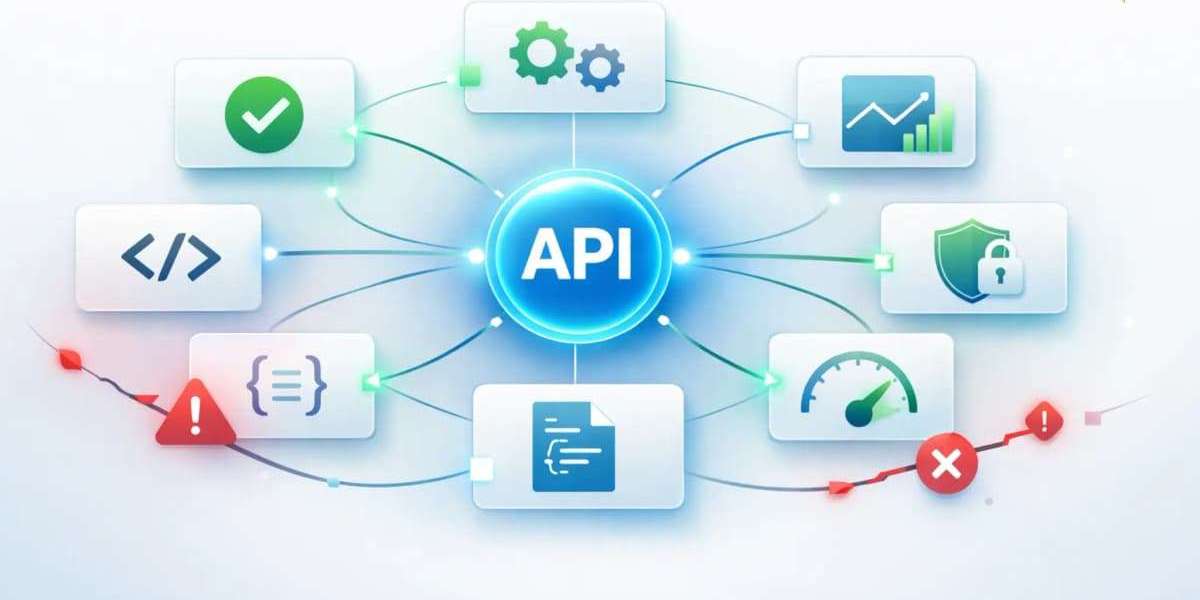

APIs power everything—from mobile apps to SaaS platforms and distributed microservices. As systems grow more complex, ensuring API reliability becomes critical.
Yet many teams still rely on outdated testing approaches—manual scripts, incomplete coverage, and fragile test suites.
In this article, we’ll explore modern API testing strategies that help teams build scalable, reliable systems—and how automation is transforming the way APIs are tested.
Why API Testing Matters More Than Ever
In today’s API-first world, even a small failure in an endpoint can break entire workflows.
API testing ensures:
Correct data exchange between services
Reliable integrations
Faster release cycles
Reduced production bugs
A strong API testing strategy validates responses, status codes, authentication, and error handling, ensuring APIs behave correctly under all conditions (Keploy).
1. Shift-Left Testing Approach
Modern teams don’t wait until QA to test APIs—they test during development.
Benefits:
Faster bug detection
Lower fixing cost
Improved code quality
Implementation:
Write tests alongside API development
Validate endpoints during pull requests
Use mocks for dependencies
2. Adopt Automated API Testing
Manual testing doesn’t scale in modern architectures.
Automation enables:
Running hundreds of test cases simultaneously
Consistent validation across environments
Faster regression testing
Automated API testing ensures systems remain stable even with frequent updates and deployments (GitHub).
3. Use Real API Traffic for Test Generation
One of the most powerful strategies is generating tests from real-world usage instead of assumptions.
Instead of writing test cases manually:
Capture real API requests
Convert them into test cases
Replay them automatically
This approach improves coverage and captures real edge cases.
Tools like API testing strategies leverage traffic-based testing to automatically generate tests, mocks, and validations—reducing manual effort and improving accuracy.
4. Combine Multiple Testing Types
A complete API testing strategy includes:
Functional Testing
Ensures APIs return correct responses for valid inputs
Integration Testing
Validates communication between services
Performance Testing
Checks system behavior under load
Contract Testing
Ensures API compatibility between services
Each type addresses a different failure point, making your system more robust.
5. Prioritize Edge Cases and Negative Testing
Most API failures occur in unexpected scenarios, not happy paths.
Test for:
Invalid inputs
Missing parameters
Unauthorized access
Rate limits
Strong API testing strategies ensure APIs fail gracefully and securely.
6. Integrate Testing into CI/CD Pipelines
Testing should be continuous—not a one-time activity.
Best practices:
Run API tests on every commit
Block deployment on failures
Parallelize test execution
Modern tools allow seamless CI/CD integration, ensuring every build is validated before release (Keploy).
7. Reduce Test Maintenance
Traditional test scripts are hard to maintain:
They break with API changes
Require constant updates
Slow down teams
Modern solutions solve this by:
Auto-generating test cases
Using dynamic data
Updating tests automatically
This reduces maintenance overhead and improves developer productivity.
8. Focus on Real-World Workflows
Testing individual endpoints isn’t enough.
Instead:
Test complete workflows (login → action → response)
Validate data consistency across services
Simulate real user behavior
This ensures your APIs work as part of a system—not just in isolation.
9. Leverage AI in API Testing
AI is transforming API testing by:
Auto-generating test cases
Detecting anomalies
Reducing flaky tests
Modern platforms use AI to improve both coverage and accuracy, making testing faster and smarter.
Final Thoughts
API testing is no longer optional—it’s essential for building reliable, scalable systems.
Key takeaways:
Start testing early (shift-left)
Automate using real traffic
Cover edge cases thoroughly
Integrate into CI/CD
Reduce maintenance with smarter tools
The future of API testing lies in automation, real-world data, and intelligent systems.








