
Introduction: Why GDS Integration Is the Cornerstone of Serious Travel Technology
If the booking engine is the heart of a travel technology platform, the Global Distribution System (GDS) integration is its bloodstream. Without GDS connectivity, a travel platform has no access to the vast global inventory of airline seats and hotel rooms that modern travelers expect to see when they search. With it, a platform instantly has access to millions of flight itineraries across hundreds of airlines, real-time pricing and availability, and the infrastructure to issue tickets, manage reservations, and process changes and cancellations.
For any travel technology platform serving flight bookings, GDS integration is not optional — it is foundational. And yet, GDS integration is also one of the most technically complex and frequently misunderstood aspects of travel technology development. Many businesses discover too late that their development partner's "GDS integration" was far more limited than they realised, covering only basic availability and pricing while lacking the capability to process tickets, manage post-booking changes, or handle refunds.
This guide provides a thorough explanation of what GDS is, how the major systems (Amadeus, Sabre, and Travelport) work, the different integration approaches available, the technical complexity involved, and what to look for in a travel technology partner with genuine GDS expertise.
What Is a Global Distribution System (GDS)?
A Global Distribution System is a centralised reservation network that enables travel agencies and online travel platforms to access travel inventory — primarily flights, hotels, car rentals, and rail — from thousands of suppliers worldwide.
The concept of the GDS dates to the 1960s, when American Airlines developed a computerised reservation system (SABRE) to manage its own seat inventory. The system was later extended to allow travel agencies to access the inventory directly, revolutionising how travel was booked. Over the following decades, similar systems were developed and the industry consolidated into the three dominant GDS providers that exist today: Amadeus, Sabre, and Travelport.
Today, the GDS network connects thousands of airlines, hundreds of thousands of hotels, all major car rental companies, and various other travel suppliers to hundreds of thousands of travel agencies and online booking systems worldwide. The total transaction volume processed through GDS systems annually is enormous — billions of searches and hundreds of millions of bookings.
From the perspective of a travel technology platform, the GDS is the most comprehensive and reliable source of:
- Global flight inventory: virtually every commercial airline seat available for sale globally is bookable through at least one GDS. This includes not just the airline's own flights, but codeshare itineraries and interline connections.
- Real-time pricing: GDS pricing is live — it reflects the airline's actual current inventory and pricing algorithms at the moment of the query.
- Fare rules and restrictions: GDS fare rules specify the conditions under which a ticket is valid — minimum stay requirements, advance purchase requirements, change fees, and refund eligibility. This information is essential for accurately presenting ticket options to travelers.
- Ticketing: The GDS is the mechanism through which electronic tickets (e-tickets) are issued, creating the official record of the traveler's booking in the airline's reservation system.
- Post-booking management: Through the GDS, travel platforms can process seat upgrades, name changes (where permitted by fare rules), itinerary changes, cancellations, and refunds.
The Three Major GDS Systems: Amadeus, Sabre, and Travelport
While there are other reservation systems in use globally, the overwhelming majority of GDS-based travel bookings are processed through three systems. Understanding the differences between them helps you make informed decisions about which to integrate with.
Amadeus
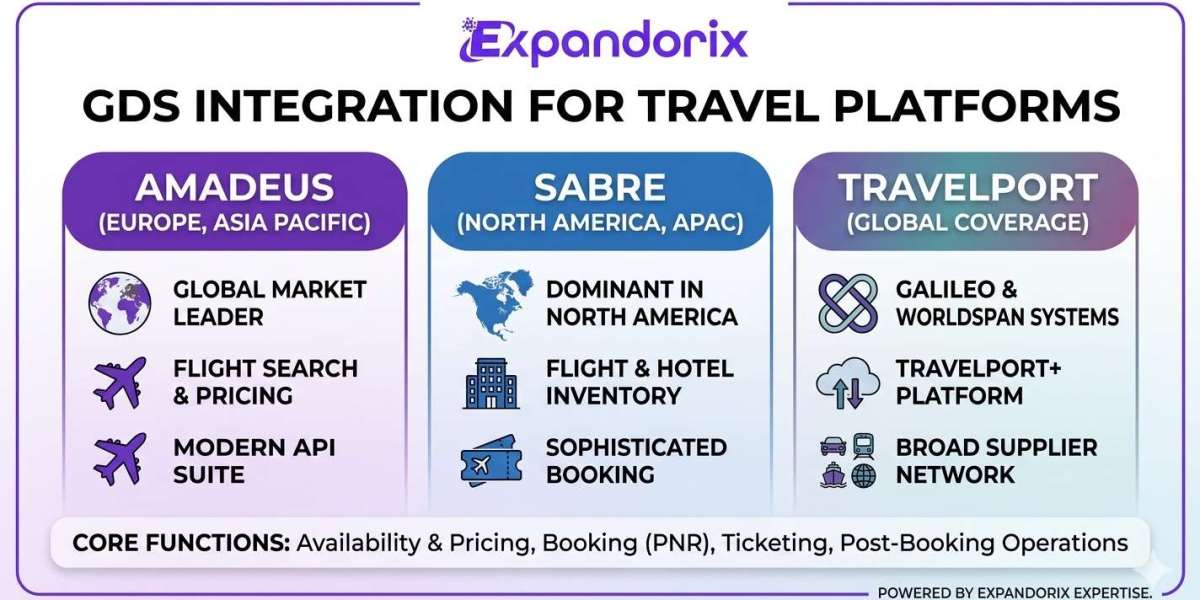
Amadeus is the largest GDS by transaction volume, with dominant market share in Europe, Asia Pacific, Latin America, and the Middle East. Founded in 1987 and headquartered in Madrid, Amadeus powers a significant percentage of global air bookings processed through travel agencies and OTAs.
For travel platforms targeting European markets or travelers from Asia Pacific and Latin America, Amadeus is typically the priority GDS integration. The Amadeus API suite (primarily the Amadeus for Developers REST API platform for modern integrations) is comprehensive, well-documented, and includes capabilities for flight search, pricing, booking, ticketing, and post-booking management.
Sabre
Sabre is the dominant GDS in North America and has a strong presence in Asia Pacific and Latin America. Founded in 1960 as the original computerised reservation system developed by American Airlines, Sabre remains one of the most powerful and widely used GDS platforms globally.
For travel platforms with significant North American user bases or commercial relationships with US-based airlines and suppliers, Sabre integration is essential. The Sabre APIs provide access to flight, hotel, and car rental inventory, as well as sophisticated pricing, booking, and ticketing capabilities.
Travelport
Travelport operates two GDS systems — Galileo and Worldspan — under the Travelport brand. Galileo has strong market presence in Europe, and Worldspan in North America. Travelport has been aggressive in developing modern API capabilities, with its Travelport+ platform offering REST APIs that are easier to integrate than traditional GDS protocols.
For travel platforms requiring broad global coverage, or where specific airline distribution agreements make Travelport the optimal choice, Travelport integration is valuable.
How GDS Integration Actually Works: The Technical Reality
Understanding the technical mechanics of GDS integration is important for making realistic assessments of development complexity and timelines.
Connection and Authentication
Accessing a GDS requires a commercial agreement with the GDS provider. For an established travel agency, this typically comes with a Pseudo City Code (PCC) — a unique identifier assigned to the agency that controls what the agency can access, what fare types are visible, and what ticketing capabilities are available. For newer businesses, access options include working through a GDS aggregator or host agency.
Authentication to GDS APIs uses mechanisms that range from session-based token authentication in legacy SOAP-based systems to OAuth 2.0 in modern REST APIs. The specific authentication mechanism varies by GDS and integration method.
Data Formats and Protocols
This is where GDS integration complexity becomes apparent. Traditional GDS interfaces use SOAP XML protocols with complex, verbose message formats that differ significantly from the clean REST JSON interfaces that modern developers are accustomed to. A flight availability request in a traditional GDS SOAP format can involve hundreds of lines of XML, with complex nesting and numerous required and optional elements.
Modern GDS providers are progressively moving to REST APIs, but legacy SOAP interfaces remain in use for many GDS functions, particularly for ticketing and complex post-booking operations. Successful GDS integration requires developers who are comfortable working with both modern REST APIs and legacy SOAP interfaces.
Core GDS Integration Functions
A complete GDS integration for a flight booking platform covers several distinct functions, each requiring separate implementation:
- Availability and Pricing Search (Low Fare Search): The availability search sends the traveler's search parameters (origin, destination, dates, passenger types) to the GDS and receives back a list of available flight options with pricing. The GDS aggregates options from multiple airlines, constructs optimal itineraries for connecting flights, and returns fares that match the search parameters.
- Fare Rules Retrieval: Each fare offered in search results has associated fare rules that specify its conditions. Retrieving and correctly interpreting fare rules is essential for presenting accurate cancellation and change fee information to travelers — incorrect fare rule display is a common source of customer complaints and disputes.
- Seat Maps: Airlines provide seat maps through the GDS, allowing travelers to view the aircraft configuration and select preferred seats. Seat map integration involves requesting the seat map data, rendering it correctly, and processing seat selection requests.
- Booking (PNR Creation): When a traveler confirms a booking, the integration creates a Passenger Name Record (PNR) in the GDS. The PNR is the master record of the booking, containing passenger details, itinerary, fare, and ticketing status.
- Ticketing: Creating a PNR does not automatically issue a ticket — ticketing is a separate action that converts the booking into an issued e-ticket and creates the official record with the airline. The ticketing process requires specific GDS capabilities and typically requires an IATA-accredited ticketing authority.
- Queue Management: GDS queues are used for managing bookings that require attention — bookings with pending ticketing, schedule changes notified by airlines, or cancellation requests. Queue management is essential for operational efficiency but is often overlooked in basic GDS integrations.
- Post-Booking Operations: After a booking is made and ticketed, various post-booking operations may be required — voluntary changes (rerouting, date changes), involuntary changes (airline-initiated schedule changes), cancellations and refunds, and reissuance for class upgrades. Each of these requires specific GDS API calls and business logic.
The Strategic Choice: Direct GDS Integration vs. Aggregator APIs
Not all travel platforms need to integrate directly with GDS systems. There are several integration approaches, each with different trade-offs.
Direct GDS Integration
Direct integration with a GDS system (Amadeus, Sabre, or Travelport) gives the travel platform the richest functionality, the lowest per-transaction cost at scale, and the most control over the booking experience. The trade-offs are the commercial requirements (GDS agreement, IATA accreditation for ticketing) and the technical complexity of the integration.
For established travel businesses with sufficient booking volume, direct GDS integration is the economically and commercially optimal approach.
GDS Aggregator APIs
GDS aggregators — companies that provide clean, standardised APIs that abstract away the complexity of direct GDS protocols — allow travel platforms to access GDS content without dealing with SOAP XML, complex authentication, or the full range of GDS operations. Examples include Travelfusion, IBS Software's iONE, and various others.
The advantages of aggregator APIs are faster integration, lower initial technical complexity, and reduced need for GDS-specific expertise. The trade-offs are higher per-transaction costs, some limitations on functionality (not all GDS capabilities are exposed through aggregator APIs), and dependence on a third-party intermediary.
For travel startups or businesses in the early stages of building their platform, aggregator APIs can provide a faster path to market while direct GDS integration is developed.
Multi-GDS Integration
Many mature travel platforms integrate with more than one GDS, using each for the markets or airline segments where it is strongest. A platform that integrates Amadeus for European traffic and Sabre for North American traffic, for example, can offer better coverage and pricing than one limited to a single GDS.
Multi-GDS integration significantly increases development complexity but can deliver meaningful commercial advantages for platforms targeting multiple global markets.
GDS Integration Challenges and How to Solve Them
Beyond the technical mechanics, GDS integration involves challenges that are not always apparent upfront.
Response Time Optimisation
GDS availability searches can return large volumes of data — thousands of fare combinations for a given route. Processing and presenting this data within an acceptable response time (under two seconds for a good user experience) requires careful engineering: efficient API calls, intelligent result caching, parallel processing of multiple fare types, and smart client-side rendering of results.
Fare Comparison and Normalization
Different GDS systems represent fares and ancillaries in slightly different ways. A platform integrating with multiple GDS systems must normalise the data into a consistent format so that results from Amadeus and Sabre can be compared and presented consistently.
Error Handling
GDS systems return a variety of error codes and conditions — unavailable itineraries, pricing failures, session timeouts, and others. Robust error handling is essential to prevent these conditions from breaking the booking flow or presenting confusing messages to users.
Cache Management
Pricing data changes rapidly in the airline industry. Caching too aggressively leads to presenting stale prices that result in fare differences at checkout. Not caching at all leads to slow response times and high GDS query costs. Finding the right caching strategy requires careful tuning and continuous monitoring.
Session Management
Traditional GDS SOAP interfaces are session-based — queries must be made within an authenticated session, and sessions expire after a period of inactivity. Managing sessions efficiently (creating, reusing, and terminating them appropriately) is an important performance consideration.
NDC: The Future of Airline Distribution
Any discussion of GDS integration in 2026 must include NDC (New Distribution Capability), the IATA standard that is transforming how airlines distribute their content.
NDC allows airlines to offer richer content — including seat images, fare family comparisons, and ancillary services like upgraded meals and lounge access — directly through a standardised API, bypassing the limitations of traditional GDS distribution.
Airlines including major global carriers have been progressively migrating their content to NDC, and GDS systems themselves are adapting their platforms to support NDC alongside traditional EDIFACT-based distribution.
For travel platforms being built or upgraded in 2026, NDC support is increasingly important — both to access the full range of airline content and ancillary products, and to be positioned for the continuing shift in airline distribution away from legacy GDS toward NDC.
Expandorix: GDS and Travel API Integration Expertise
Expandorix brings proven GDS integration expertise to travel platform development projects. Their team has deep experience with Amadeus, Sabre, and Travelport integrations, covering the full range of integration functions from availability search through ticketing and post-booking management.
Beyond GDS, Expandorix integrates with the full ecosystem of travel APIs that modern platforms require: hotel content and rate APIs (including Hotelbeds), activity and experience APIs, transfer and car rental APIs, travel insurance APIs, and payment gateways optimised for each target market.
Their approach to GDS integration is thorough and production-tested. They account for the full complexity of GDS data — fare rules, seat maps, post-booking operations — not just the basic search and booking functions that less experienced partners might implement.
For travel businesses building platforms where GDS integration is a critical component, Expandorix's integration expertise is a key part of why they are the right development partner.
Frequently Asked Questions
Do I need IATA accreditation to integrate with a GDS?
IATA accreditation is required for direct ticketing authority — the ability to issue and void airline tickets through the GDS in your own name. However, there are alternative arrangements: operating under a host agency's accreditation, using a ticketing authority service, or working through a GDS aggregator that handles ticketing on your behalf. Expandorix can advise on the right approach for your specific situation.
Which GDS should I integrate with first?
For most businesses, the primary GDS choice depends on the target market. Amadeus is dominant in Europe, Asia Pacific, and Latin America. Sabre is dominant in North America. For businesses without a clear geographic focus, Amadeus is often the starting point due to its global market share leadership.
How long does GDS integration take?
A focused Amadeus or Sabre integration covering availability, pricing, booking, and ticketing typically takes 6–10 weeks of dedicated development. Full GDS integration including all post-booking functions, queue management, and multi-GDS connectivity takes longer. Expandorix can provide a precise timeline estimate based on your specific requirements.
What is the difference between NDC and GDS?
GDS (Global Distribution System) is the traditional airline distribution infrastructure built decades ago. NDC (New Distribution Capability) is a modern IATA standard that allows airlines to distribute richer content directly through XML APIs. NDC is not a replacement for GDS but an additional distribution channel being adopted progressively alongside GDS. Modern travel platforms need to support both.
Conclusion: GDS Integration Done Right Is a Competitive Advantage
The depth and quality of your GDS integration determines the quality of flight content you can offer your customers, the smoothness of the booking experience, and your ability to manage bookings efficiently post-sale. Superficial GDS integration — covering only basic search and booking without the full range of operational functions — creates problems that surface only after launch, when they are expensive to fix.
Investing in thorough, production-quality GDS integration from the start, with a development partner who genuinely understands GDS systems, is one of the most important technical decisions a travel platform can make.