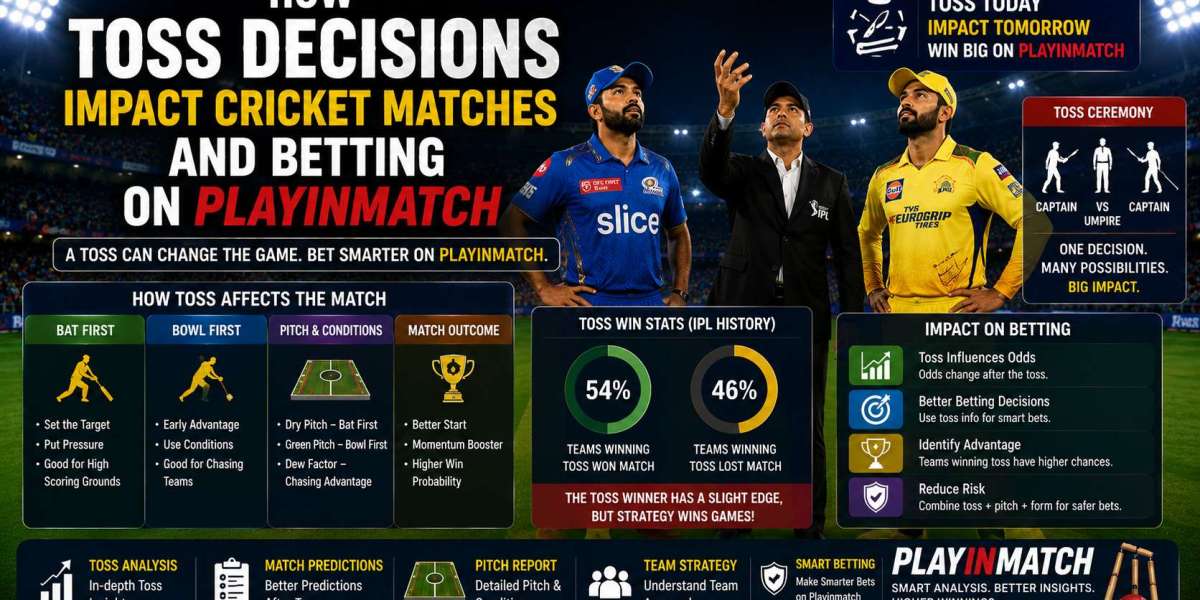

Few moments in cricket carry as much strategic weight as the coin toss. Two captains walk to the center of the ground, one calls heads or tails, and in a matter of seconds a decision is made that can shape the entire trajectory of the match. For the casual viewer, it is a formality. For anyone watching the game closely — or tracking it on a platform like Playinmatch — it is arguably the single most important pre-match event of the evening.
Understanding why the toss matters, how it differs across formats and venues, and what the data actually says about its impact is not just an academic exercise. It is a framework for reading cricket more intelligently.
The Toss in Context: More Than a Coin Flip
The coin flip itself is 50/50. What happens after it is not.
A comprehensive research study analyzing over 44,000 cricket matches found that the winning toss increases a team's probability of winning by approximately 2.8 percent overall. That figure rises to 5.92 percent in day-night One Day Internationals, where dew and changing light conditions create a structural advantage for the team batting second. The team that wins the toss can anticipate those conditions hours before they materialize — and act accordingly.
That 2.8 percent may not sound dramatic in isolation. But across a long tournament, or when two evenly matched teams face each other in conditions where the toss strongly favours one decision, that edge becomes highly meaningful. Do Playinmatch Login Now.
How the Toss Plays Out Differently Across Formats
The impact of the toss is not uniform across cricket formats. Each format has its own logic.
Test cricket is where the toss has historically carried the most weight. Pitches in five-day matches deteriorate progressively over time. Teams that bat first on a fresh surface can accumulate large totals before cracks develop, conditions turn, and spin bowlers begin to extract sharp turn and unpredictable bounce. On the subcontinent, winning the toss and batting first can be the difference between a commanding first innings and batting last on a crumbling pitch against quality spin bowling.
In ODI cricket, the impact of the toss is closely tied to the time of day and the venue. Day matches on good surfaces may not give the toss winner a decisive edge, but day-night ODIs — particularly in the subcontinent — are a different matter. Dew, falling temperatures after sunset, and the difficulty of gripping a wet ball in the second innings create structural conditions that favour chasing teams. Captains are acutely aware of this, and toss decisions in day-night ODIs almost always reflect the prevailing conditions rather than any personal preference.
T20 cricket presents the most nuanced picture. In domestic T20 leagues like the IPL, the toss has become an increasingly decisive factor, particularly at venues prone to evening dew. In the early stages of IPL 2026, the first seven consecutive matches all saw the toss winner elect to field first — a sequence that illustrated just how strongly captains view chasing as the preferred strategy in evening conditions at modern batting-friendly venues.
The Dew Factor: Cricket's Hidden Match-Shaper
Dew is the single most discussed variable after the toss in T20 cricket played under lights on the Indian subcontinent. It forms when the evening temperature drops and humidity rises after sunset, settling moisture on the outfield, pitch, and ball. The result is a wet, slippery ball that becomes difficult for bowlers to control.
For spinners, dew is particularly damaging. It removes the ability to generate turn and sharp fizz through the air. Leg-spinners who rely on wrist position and a precise grip find their effectiveness reduced significantly once moisture accumulates on the ball. Even for seamers, hitting yorker lengths and controlling swing becomes harder as the ball loses its dry surface.
For batters in the second innings, the same dew that undermines bowlers accelerates the outfield. The ball races to the boundary on a surface it might have stopped on two hours earlier. Chase targets that look competitive at the innings break can suddenly feel very manageable.
At IPL 2026 venues including Mumbai, Bengaluru, and Dharamsala, evening dew has been particularly impactful this season. IPL 2026 has already witnessed 14 successful chases of 200-plus totals — shattering the previous tournament record of nine — and dew has been a consistent contributing factor at many of those venues.
Venue Sensitivity: Not Every Ground Behaves the Same Way
One of the most important pieces of context when interpreting a toss is understanding how the specific venue historically responds to the batting-first or bowling-first decision.
Some grounds are strongly biased toward chasing. Eden Gardens in Kolkata — where chasing teams have won 57 out of 100 IPL matches played there — is one example. Dew, quick outfields, and high-scoring conditions all point toward the team batting second holding an advantage. Captains winning the toss at Eden Gardens almost always elect to field first.
Other venues behave very differently. Ekana Stadium in Lucknow is considered one of the more balanced surfaces in IPL cricket, with a slower pitch that can assist spin bowling even in the second innings. At Chepauk in Chennai, the surface turns from very early, and batting first on a fresh pitch before the cracks deepen is often the preferred approach.
Understanding venue-specific toss data is therefore a critical part of reading any match preview intelligently. At Playinmatch, match analysis and venue history data provide the context needed to interpret toss decisions in real time.
Team Strategy and Captain Tendencies
Toss decisions are also shaped by the composition of the batting and bowling lineup. A team with a strong top order built for chasing — one with aggressive openers who thrive when a target is in front of them — will almost always prefer to bowl first on a neutral surface. A team whose bowling attack is better suited to taking early wickets on a fresh surface may bat first to keep that option open.
Captain tendencies add another dimension. Certain captains are well documented in their toss preferences. Chennai Super Kings, historically one of the most strategically disciplined teams in the IPL, have been cited as the franchise with the highest conversion rate when winning the toss — winning approximately 64 percent of their matches in those situations. Their approach reflects a consistent philosophy: read the pitch carefully, defer to conditions, and back the batting lineup to chase whatever is required.
Reading Toss Information on Playinmatch
For anyone following cricket on Playinmatch, the toss result is one of the first and most important updates available before a match begins. Knowing which team has won the toss, what decision they have made, and how that decision fits within the historical trends for that venue gives an immediate framework for understanding how the game might unfold.
Combined with the pitch report, weather conditions, and team composition data available on Playinmatch, the toss outcome transforms from a two-second formality into a sincerely informative data point. A team that wins the toss and fields first on a dew-affected evening venue with two aggressive openers in form has stacked multiple advantages before the first delivery is bowled.
The following live toss updates and match analysis at playinmatch.net.in ensures you are never watching cricket without the context that makes it meaningful.
Final Thoughts
The toss in cricket is not decisive on its own. Teams still have to bat, bowl, field, and execute under pressure. But it is a consistent, measurable, and statistically significant advantage - one that shapes team selection decisions, influences captain strategy throughout the match, and provides an early signal of how the game is likely to unfold.
In the data-rich environment of modern T20 cricket, ignoring the toss means ignoring one of the most reliable pre-match indicators available. On Playinmatch App , that information is always front and center — because following cricket well means understanding not just what happens on the field, but why it is happening.