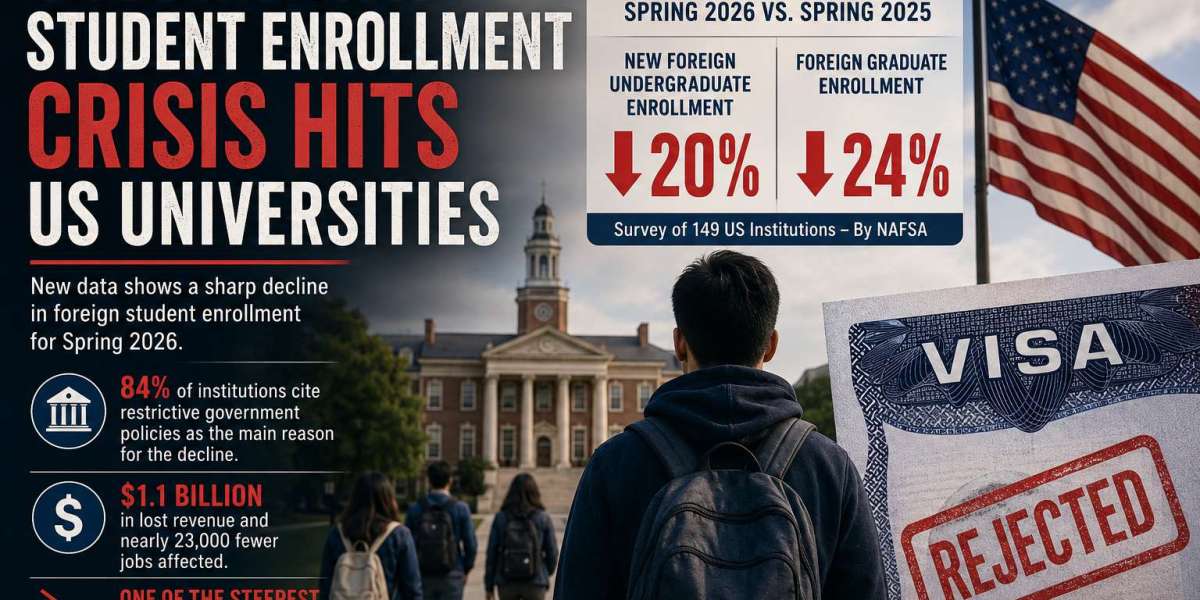

The international student enrollment crisis is no longer a future concern for American universities. It is happening now, and the effects are spreading far beyond admissions offices. Across the United States, colleges that once depended on steady global enrollment are cutting budgets, freezing hiring, and rethinking degree programs as fewer international students arrive on campus.
A recent analysis published on Medium explains how universities built entire financial models around international tuition revenue. When enrollment drops, the pressure hits quickly. Smaller regional colleges feel it first, but even major research institutions are starting to feel the strain.
At the center of the issue sits a mix of policy uncertainty, visa delays, rising costs, and changing student preferences. Countries like Canada, the UK, and Australia now compete more aggressively for global students. The US still attracts talent, but the process feels harder and less predictable than it did a decade ago.
Why Universities Relied So Heavily on International Students
Many universities quietly used international enrollment to offset declining domestic admissions. International students often pay full tuition, which helped schools balance budgets without raising costs for local students too aggressively.
That strategy worked for years. Then the cracks appeared.
Pandemic disruptions changed mobility patterns, but the bigger issue came afterward. Families began questioning whether studying in the US still offered enough return on investment. Tuition climbed. Housing costs exploded. Visa processing slowed. Students who once dreamed about studying in Boston or California started considering universities closer to home.
The effect resembles a business that depends too much on one client. Everything looks stable until the revenue stream weakens. Then the entire structure starts wobbling.
Several universities now face difficult decisions. Some are reducing niche programs with lower enrollment. Others are cutting research budgets or delaying infrastructure projects. Campus communities also lose something less measurable: cultural diversity and global perspective.
The Human Side Behind Enrollment Declines
Statistics only tell part of the story. The emotional toll on students rarely appears in enrollment reports.
A discussion shared on Reddit highlights how many international students feel trapped between rising expectations and shrinking support systems. Students describe isolation, financial stress, and uncertainty about future employment opportunities after graduation.
For many families, sending a child abroad requires enormous sacrifice. Parents take loans, sell property, or drain savings accounts hoping education will create long-term stability. When visa rules shift or employment prospects weaken, the pressure becomes personal very quickly.
That tension now shapes student decision-making worldwide. Universities are not simply competing on academic rankings anymore. They are competing on safety, affordability, career outcomes, and immigration confidence.
Academic Pressure Is Growing Alongside Financial Stress
The enrollment crisis also exposes another issue universities often overlook: student burnout.
International students already face language barriers, unfamiliar academic systems, and intense performance expectations. Add financial pressure, and academic stress rises sharply. Many students juggle part-time jobs while trying to maintain high grades in demanding subjects like engineering, healthcare, and data science.
That explains why support services outside the classroom are expanding rapidly. Educational platforms, tutoring networks, and assignment guidance services now fill gaps universities struggle to manage internally. Articles discussing services like Physiology Assignment Help for Stress-Free Academic Success show how students increasingly look for academic support systems that reduce pressure without sacrificing learning quality.
The same trend appears in technical disciplines. Subjects like optimization, logistics, and quantitative analysis overwhelm many students balancing work and study. Resources such as Operation Research Assignment Help reflect how specialized academic assistance has become part of the modern student ecosystem.
This shift matters because universities can no longer assume students will handle everything independently. Academic support has become a competitive advantage. Platforms like Expertsmind.com, which connect students with verified subject experts and tutoring support, have grown partly because students want faster, more flexible academic guidance than many institutions currently provide.
What Happens Next for US Higher Education
The next five years could permanently reshape university recruitment strategies.
Some colleges will likely reduce dependence on international tuition altogether. Others may expand partnerships with overseas institutions or create hybrid learning models that let students study partly online before relocating.
STEM programs will remain attractive, but universities may need to rethink how they support international students after admission. Career placement services, mental health support, and immigration advising now influence enrollment decisions almost as much as academic reputation.
The universities that adapt fastest will probably focus less on marketing slogans and more on practical outcomes. Students want clear career pathways. They want transparent costs. They want confidence that their investment will still matter after graduation.
That reality changes the tone of global education recruitment. Glossy brochures are no longer enough.
A Crisis That Could Force Smarter Education Models
The international student enrollment decline exposes weaknesses universities ignored during years of growth. Many institutions assumed global demand would continue indefinitely. Now they face a harder truth: students behave like informed consumers.
They compare countries. They compare visa policies. They compare job outcomes. And increasingly, they compare support systems.
American universities still hold enormous academic influence. Their research power, innovation culture, and global recognition remain strong. But reputation alone cannot solve affordability concerns or immigration anxiety.
The schools that recover best from this crisis will likely be the ones that treat international students as long-term members of the academic community rather than financial lifelines. That difference may determine which institutions thrive in the next decade and which continue struggling to rebuild trust.