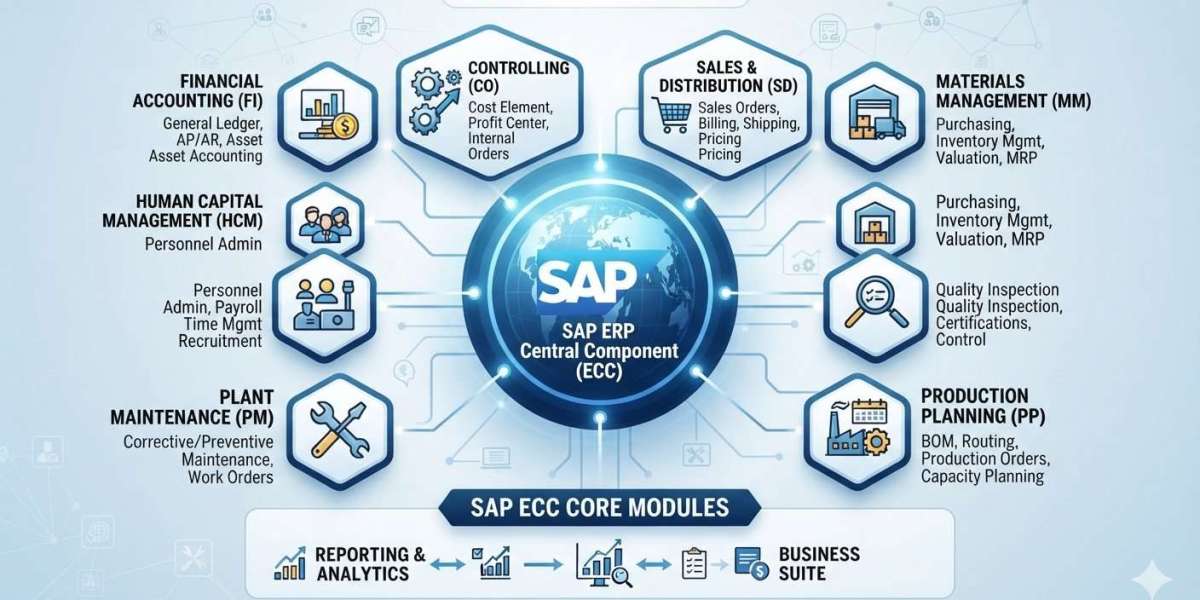

SAP module training teaches you to configure and use specific parts of SAP, such as FICO, MM, SD, or HCM. Most learners choose one module, study its core processes, practice in a sandbox system, and then take an SAP associate-level certification exam. SAP FICO, MM, and SD are among the most demanding SAP modules in enterprise projects.
What Are the Most Demanding SAP Modules? Demanding has two meanings here: modules companies hire for often, and modules that are hard to learn. Both matter when you pick a career path.
Finance, procurement, sales, and production sit at the heart of almost every large business, so the modules covering them are widely implemented. Rather than quoting unverified numbers, I suggest checking job boards in your own country. Search each module name and see which ones list the most openings and the best pay.
| Module | What it covers | Best for |
|---|---|---|
| FICO (Finance and Controlling) | Accounting, reporting, cost management | Accountants, finance analysts |
| MM (Materials Management) | Procurement, inventory, vendor invoices | Supply chain, purchasing staff |
| SD (Sales and Distribution) | Orders, pricing, delivery, billing | Sales operations, logistics |
| PP (Production Planning) | Manufacturing and scheduling | Production, plant professionals |
| HCM / SuccessFactors | Payroll, talent, HR processes | HR professionals |
| ABAP | Custom programming and reports | Developers |
Finance and supply chain modules tend to be the most approachable for people with business backgrounds. Technical areas like ABAP and integration are harder if you have no coding experience.
What Is SAP FICO Master?
If you're asking What is SAP FICO Master?, you're most likely looking at a training program or learning track that takes you from the basics of SAP FICO to confident, project-ready skills. Master is a label used by training providers, not an official SAP credential. Always check what a course actually includes before you pay.
SAP FICO combines two components:
- FI (Financial Accounting): General ledger, accounts payable, accounts receivable, asset accounting, and bank accounting. It produces the external financial statements.
- CO (Controlling): Cost centers, profit centers, internal orders, product costing, and profitability analysis. It supports internal management decisions.
A solid FICO program should cover both, plus how they connect to MM and SD.
A practical example
Imagine a company buys raw materials. The goods receipt in MM automatically posts to inventory and a goods-received/invoice-received clearing account in FI. When the vendor invoice arrives, the system updates accounts payable. If the cost belongs to a department, CO assigns it to a cost center.
A FICO consultant understands this chain and can configure it correctly. That integration knowledge separates job-ready candidates from people who only memorized menu paths.
Core Skills You Need for SAP Module Training
Technical knowledge is only part of the job. Most SAP roles combine these skills:
- Business process understanding: Procure-to-pay, order-to-cash, record-to-report
- Configuration knowledge: Using the SAP Implementation Guide (IMG) to set up the system
- Master data management: Vendors, customers, materials, and chart of accounts
- Analytical thinking: Tracing errors across modules
- Documentation: Writing functional specifications and test scripts
- Communication: Translating business needs for technical teams
For FICO specifically, a grounding in accounting principles helps far more than any software knowledge. Debits, credits, month-end close, and reconciliation concepts come up constantly.
SAP Training Course Options
You have several paths, each with trade-offs.
| Option | Strengths | Limitations |
|---|---|---|
| Official SAP Learning (SAP Learning Hub / learning journeys) | Accurate, aligned to certification exams | Self-paced; little hands-on guidance |
| Instructor-led online courses | Structure, live questions, mentor feedback | Quality varies widely by provider |
| University or academic programs | Often include system access through SAP's university alliance | Limited to enrolled students |
| Self-study with a practice system | Flexible and low cost | Needs discipline; hard to get realistic data |
| Corporate or on-the-job training | Real project exposure | Only available if you already work in an SAP environment |
How to evaluate a course
Before enrolling, ask:
- Does it include hands-on access to a real SAP system?
- Is the content based on S/4HANA, the current SAP platform, rather than only legacy ECC?
- Is the instructor an active or former consultant with project experience?
- Does the syllabus cover end-to-end processes, not isolated screens?
- Are claims about job placement or salary backed by evidence?
Be cautious about any provider that guarantees a job. No training can honestly promise that.
SAP Certification: What to Know
SAP certification validates your knowledge at a point in time. SAP offers certifications at associate and professional levels, organized by solution area and release version. Exam codes and versions change as SAP updates its products, so confirm the current details on the official SAP Training and Certification Shop before you register.
General points worth knowing:
- Associate-level exams suit beginners with some training and project exposure.
- Exams are typically multiple-choice and cover configuration, processes, and concepts.
- SAP periodically retires older versions and adds new ones, so a certification tied to an older release loses relevance.
- A certificate helps you get interviews, but project experience carries more weight with employers.
Steps to get certified
- Choose your module and confirm the current exam on SAP's official site.
- Download the exam topic areas and their weightings.
- Complete the matching learning journey or course.
- Practice in a sandbox system on every major topic.
- Take practice questions to find weak spots.
- Book and sit the exam.
A Realistic 90-Day Learning Plan (FICO Example)
- Days 1–30: Learn SAP navigation, the organizational structure (company code, controlling area), and general ledger basics.
- Days 31–60: Study accounts payable, accounts receivable, asset accounting, and cost center accounting.
- Days 61–90: Practice integration scenarios with MM and SD, month-end closing, and reporting. Begin exam preparation.
Adjust this to your background. An accountant may move faster through finance topics, while someone from IT may need extra time on accounting concepts.
How to Choose the Right Module
Match the module to your existing strengths:
- Accounting or finance background: FICO
- Procurement or warehouse experience: MM or EWM
- Sales or customer service background: SD
- HR experience: HCM or SuccessFactors
- Coding comfort: ABAP or integration roles
Switching later is common, and many consultants add a second module after gaining experience.
FAQ's
1. Which SAP module is most in demand?
It depends on your region and industry. FICO, MM, and SD are widely implemented, so check local job listings to see current demand.
2. What is SAP FICO Master?
It usually refers to a training program covering both Financial Accounting and Controlling in depth. It isn't an official SAP certification.
3. Is SAP FICO hard to learn?
It's manageable if you understand accounting basics. Without them, expect a steeper learning curve.
4. Do I need a finance degree for SAP FICO?
No, but you need working knowledge of accounting principles. Many people learn these alongside SAP.
5. How long does SAP module training take?
Typically a few months of consistent study for one module, depending on your background and the course format.
6. Is SAP certification worth it?
It can strengthen your resume and prove foundational knowledge. Employers still value hands-on project experience more.
7. Can I learn SAP without a practice system?
Theory is possible, but real skill comes from hands-on practice. Look for courses that include system access.
8. What's the difference between SAP ECC and S/4HANA training?
S/4HANA is SAP's current platform, with a simplified data model and a new user interface (Fiori). New learners should prioritize S/4HANA.
9. Can beginners with no IT background learn SAP?
Yes, especially functional modules like FICO, MM, and SD. They rely on business knowledge more than programming.
10. Should I learn one module or several?
Start with one and go deep. Add related modules once you understand how they integrate.
Conclusion
Choosing among the most demanding SAP modules comes down to your background, your goals, and the job market you're targeting. For finance professionals, SAP FICO is a natural starting point. Look for a program that offers hands-on practice, covers S/4HANA, and teaches real business processes rather than isolated screens.








