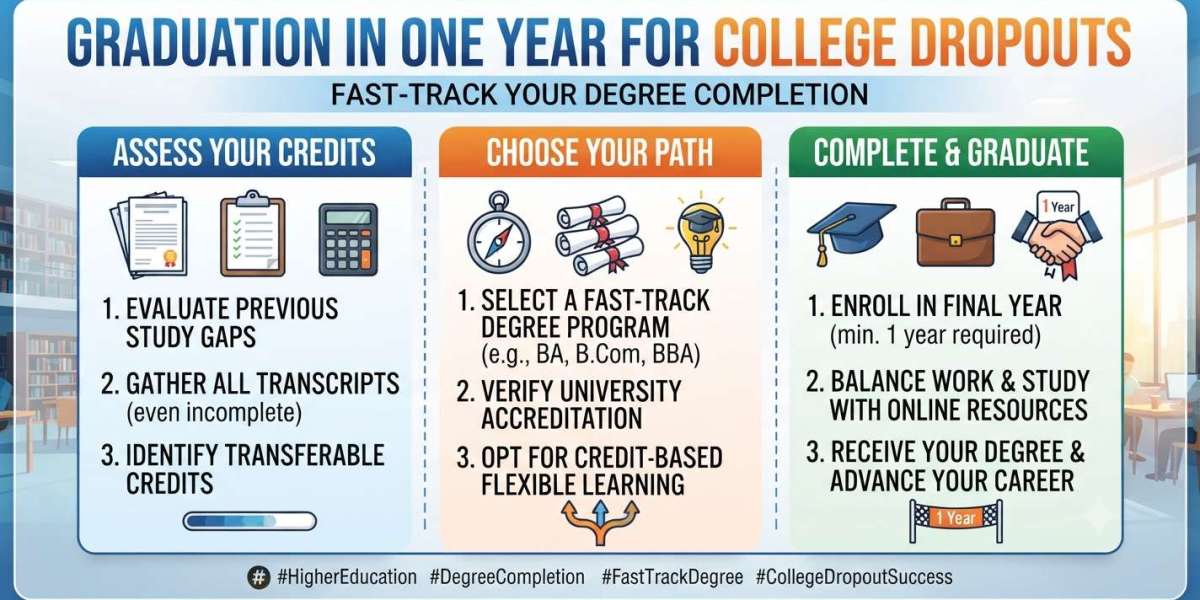

Leaving college before completing graduation can create difficulties when applying for better employment opportunities or planning higher education. Many students discontinue their studies because of financial problems, family responsibilities, relocation, personal circumstances, or the need to start working. After several years, they may decide to return to education and complete their unfinished degree.
For such learners, searching for Graduation in One Year or Degree in One Year options is common. However, the right approach depends on previous academic performance, completed semesters, and university regulations. Re-admission and credit transfer are two important pathways that college dropouts can explore when planning to complete their graduation.
Why Do College Students Discontinue Their Graduation?
Not every student gets the opportunity to complete college within the expected academic period. Different circumstances can interrupt an educational journey.
Some common reasons include:
Financial difficulties that make higher education expensive.
Family responsibilities requiring immediate attention.
Employment opportunities that affect regular college attendance.
Relocation to another city or state.
Academic backlogs or examination failures.
Personal reasons that lead to a temporary or permanent study break.
A discontinued degree does not necessarily mean that students must abandon their educational goals. Depending on their academic records and applicable university rules, they may be able to continue their studies through an eligible admission pathway.
What Is Re-Admission for College Dropouts?
Re-admission is a process through which eligible students seek permission to resume an academic programme after discontinuing their studies.
For example, a student who enrolled in a Bachelor of Commerce (BCom) programme but left after completing the first year may contact the university to understand the possibility of continuing the course.
The university may review previous examination results, enrolment status, programme duration, academic regulations, and applicable time limits before approving the request.
Students should contact their previous institution first because it may have specific policies regarding discontinued admissions and continuation of incomplete programmes.
Understanding Credit Transfer for Degree Completion
Credit transfer is an academic facility that allows eligible students to use previously earned academic credits towards another approved programme, subject to the receiving institution's rules.
This can be useful for learners who have completed some semesters but could not finish their graduation.
For instance, a student who previously studied BA or BCom may explore whether completed subjects and academic credits can be considered by another eligible university.
Credit transfer generally involves:
Reviewing the student's previous academic records.
Checking the subjects and credits already completed.
Evaluating course equivalence and academic requirements.
Confirming whether the receiving university accepts the credits.
Completing the remaining prescribed academic requirements.
Credit transfer is not automatic. The university determines the acceptance of credits, applicable conditions, and remaining programme requirements.
Can College Dropouts Complete Graduation in One Year?
Many students look for Graduation in One Year because they want to save time and return to their professional or personal goals quickly.
However, completing an entire undergraduate degree in one year is not automatically permitted simply because someone has discontinued college.
The possibility of completing the remaining requirements depends on several factors:
Number of semesters previously completed.
Validity and recognition of earlier academic credits.
Minimum programme duration.
University credit-transfer policies.
Applicable UGC regulations.
Remaining examinations and academic requirements.
Students who have completed substantial coursework may have different options from those who discontinued their studies after the first semester.
Therefore, candidates should obtain an official academic evaluation before applying for any Degree in One Year programme.
Suitable Degree Courses for Returning Students
College dropouts can explore different undergraduate programmes depending on their previous qualifications and interests.
Bachelor of Arts (BA): Suitable for students interested in humanities, literature, social sciences, and related subjects.
Bachelor of Commerce (BCom): An option for learners interested in accounting, finance, business, and commerce.
Bachelor of Business Administration (BBA): Focuses on management, marketing, entrepreneurship, and business operations.
Bachelor of Computer Applications (BCA): Suitable for individuals interested in computer applications, programming, and IT-related subjects.
Bachelor of Science (BSc): Provides opportunities to study different science disciplines according to eligibility and university offerings.
Students should verify the programme's admission requirements, duration, and availability before selecting a course.
Online and Distance Education for College Dropouts
Returning to a regular college may not be practical for every student. Individuals who are employed or have family responsibilities can explore recognised online and Open and Distance Learning programmes.
These learning modes provide alternatives to traditional classroom-based education.
Distance Education: Students receive academic materials and follow the university's examination schedule. It can be suitable for learners who prefer independent study.
Online Education: Students access digital lectures, online learning resources, assignments, and academic support through university platforms.
Both options require students to fulfil the prescribed course duration, examinations, and other academic requirements.
Before admission, candidates should verify the university and programme recognition for the relevant academic session through the UGC Distance Education Bureau.
Documents Required for Re-Admission and Credit Transfer
Students should organise their previous academic documents before approaching a university.
Commonly required documents include:
Class 10 mark sheet and certificate.
Class 12 mark sheet and certificate.
Previous college semester mark sheets.
University enrolment or registration details.
Academic transcript or credit records.
Migration certificate, if applicable.
Transfer certificate, where required.
Government-approved identity proof.
Recent passport-size photographs.
Additional documents may be requested depending on the university's admission policy.
How to Select the Right University?
Choosing an institution requires careful research, particularly when students are returning after a long study gap.
Consider these important points:
University Recognition: Check whether the institution is legally recognised and authorised to award the degree.
Programme Approval: Verify online or distance programme recognition for the relevant admission session.
Credit Transfer Policy: Ask whether previously completed academic credits can be accepted.
Course Duration: Understand the minimum duration and remaining academic requirements.
Fee Structure: Review tuition fees, examination charges, and other expenses.
Official Admission Process: Apply through the university's authorised admission channel and obtain official confirmation.
Avoid institutions that promise guaranteed graduation certificates without proper academic requirements.
Conclusion
Returning to college after discontinuing graduation is an important step towards achieving long-term educational and career goals. College dropouts can investigate re-admission, credit transfer, distance learning, and online education according to their academic background and eligibility.
Although searches for Graduation in One Year and Degree in One Year are increasing, students should not assume that every accelerated programme is recognised or permitted. The right approach is to review previous academic credits, understand university regulations, and select an authorised programme.
With proper planning and verified admission information, students can restart their education and work towards completing their graduation successfully.
https://justpaste.it/distance-bca-course
https://janjaonline.mn.co/posts/ma-distance-education-admission-specializations-and-career-scope
https://penposh.com/blogs/28870/MCom-Distance-Education-Course-Benefits-Eligibility-Career-Scope
https://chodilinh.com/threads/msc-distance-education-admission-2027-eligibility-fees-process.692839/
https://www.mcmacademy.in/blog/doctorate-in-organizational-leadership/